6 min read Last Updated : Dec 22 2020 | 11:01 PM IST
Calendar year 2020 will end in a week and will remain etched in collective memory due to the devastation caused by the Covid-19 pandemic. As of mid-December 2020, there were about 1.7 million deaths globally because of this virus and it could even take a decade for economies around the world to get back to trend growth. The year also saw communist China make its deep-rooted hostility towards India abundantly clear. It was not politic but the then prime minister Atal Bihari Vajpayee was prescient in alluding to the Chinese threat when justifying the nuclear tests of May 1998.
Turning first to the hobbling of the Indian economy, corporate defaults on large long-term loans and the resulting non-performing assets (NPAs) of public sector banks were highlighted six years ago. Since then, the Insolvency and Bankruptcy Code (IBC) has been dealt repeated blows through the machinations of motivated owners of failed enterprises. The Insolvency and Bankruptcy Board of India has tried to resolve cases involving defaults but if the Reserve Bank of India, government and courts are not sufficiently single-minded, it all comes to naught through motivated delays. Unfortunately, some resolution professionals are in league with defaulting corporations.
If the central government is sincere about reviving long-term bank lending, it needs to identify heads of regulatory institutions with character and the required expertise. The government should not recruit mostly from among malleable officers often with discreet links to major corporate houses. Improvements in the legal framework are relatively simple to devise. It is implementation that has repeatedly come up short against the deep-rooted collective self-interest of the politically heavyweight regardless of party affiliation.
Changing gears, the on-going farmer agitation against the three laws recently approved by parliament is an illustrative example of how meaningful reform can be misunderstood by some and self-servingly opposed by entrenched interests. The less said the better about the knee-jerk opposition of the Congress party and the cynical behaviour of Delhi’s Chief Minister Arvind Kejriwal in publicly tearing up the Acts. Indefinitely subsidising electricity and fertilisers resulting in excess production of rice, wheat and sugarcane in regions which could grow cash crops is a sure way of perpetuating the relative poverty of food grain farmers. The National Democratic Alliance government should have used every available forum prior to passing the three laws to explain the basic facts in all Indian languages and why these laws are beneficial for farmers. For instance, 41 per cent of farming households own small land holdings of less than one acre (Swaminathan report 2006) and that India is overproducing water-guzzling crops such as rice and sugarcane.
As for foreign policy, every country wishes to eat its cake and have it too. For India, the US and the Western democracies are on one side and China-Russia on the other. China’s armed intrusion in Ladakh and Russia’s substantial dependence on exports of fossil fuels to China have constricted India’s choices. Russia’s $1.2 trillion GDP is too centred on commodities and 60 per cent of its exports are oil and gas. Oil prices have plunged since March 2020 compounding Russia’s economic woes. It follows that India needs to seek a greater meeting of minds with Western democracies. There will be bickering about intellectual property rights, freer movement of Indian professionals, global warming and so on but those can be worked around.
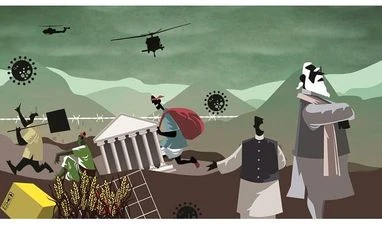
Illustration: Binay Sinha
Specifically, on December 9, Russian foreign minister Sergey Lavrov implied that the concept of the Indo-Pacific is a way for the US, Japan and Australia to engage India “in anti-China games by promoting Indo-Pacific strategies”. Lavrov should have been more sensitive about Indian concerns particularly after what has happened in Ladakh. No doubt Russia has been a reliable supplier to India of sophisticated defence equipment and classified technology in sensitive fields. Russia has provided equipment and technology which was either not available from G7 countries or exorbitantly priced. India has recently contracted to purchase the S-400 missile defence system from Russia even though the US has made threatening noises.
Although every effort needs to be made to get things back to some semblance of normalcy with China, India has no option but to promote its defensive capabilities for a two-front war. Consequently, India’s defence budget should be raised by at least 2 per cent of GDP from the levels of 1.5-2 per cent of GDP over the last six years. India should indicate its willingness for closer interaction with the North Atlantic Treaty Organisation by forging a formal “dialogue” relationship with that body. To ameliorate Russian concerns, India could emphasise that Russia deserves to be pre-eminent in Central Asia and this may be made obvious within the Shanghai Cooperation Organization (SCO). India could also offer to provide farming manpower in the Russian Far East as Russia is concerned about its growing dependence on Chinese labour in that region.
To put matters in perspective, Central Asian countries look to the lumbering Indian elephant to soften the embrace of the clawed Russian bear and dilute the economic inroads made by the fire-breathing Chinese dragon. The relatively low and declining population of Russia makes that country less threatening than China. If China settles a few of its workers in Central Asian republics that would change local demographics and make these regimes lean towards China. Kyrgyzstan and Kazakhstan have populations of 6.4 million and 18.6 million and their borders with China are 1,063 and 1,783 kilometres long, respectively.
Summing up, India’s domestic absurdities often take attention away from making even half-way sensible economic and foreign policies. For example, Uttar Pradesh (UP), India’s largest state, had an annual state domestic product per capita in 2018-19 of Rs 66,152, one rank higher than the lowest ranking state Bihar. The same numbers for Tamil Nadu and West Bengal were Rs 193,964 and Rs 101,138, respectively. Yet even in this pandemic year, UP’s government finds time to pass a “love-jihad” Ordinance and harass inter-religious couples.
j.bhagwati@gmail.com
The writer is a former Indian Ambassador, Ministry of Finance official and World Bank Treasury professional
Disclaimer: These are personal views of the writer. They do not necessarily reflect the opinion of www.business-standard.com or the Business Standard newspaper