Strategic depth of borrowing capacity

What is the institutional infrastructure through which the Union and state governments can expand borrowing in a special situation?
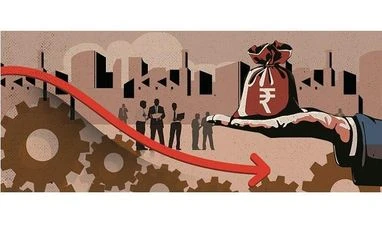
indian economy, gdp, growth, investment
Illustration: Ajay Mohanty
Ajay Shah
5 min read Last Updated : Oct 18 2020 | 11:57 PM IST
The decline in gross domestic product (GDP) induced by Covid-19 has resulted in lower tax collections. Both the Union and the states are in need of greater debt. Enlarged deficits would assist the economy. Stop-gap solutions, like taxing petroleum products, have their own problems. This requires a greater institutionalised capacity for borrowing by the Union and the states. It calls for the Public Debt Management Agency (PDMA), bond market reforms, phasing out financial repression, and stubbornly achieving small primary surpluses.

Tax collections obviously depend on GDP. The income tax charged to corporations is particularly important in Indian public finance, but it depends on profitable corporations, and in 2020-21 many corporations are likely to have weak earnings. Job losses of salaried workers will affect the steady flow of income tax associated with these workers. For these reasons, tax collections are likely to be poor in 2020-21. The early evidence shows that Union government tax receipts were down 32.65 per cent, on a year-on-year basis, for April-May-June 2020.

There is a disagreement between the Union government and the state governments about the promise of goods and services tax (GST) compensation, which was to grow at 14 per cent nominal. This is an important question in inter-governmental fiscal relations. For the present moment, we will focus on macroeconomics and the problem that both the Union government and the state governments need to borrow more. How can this be achieved?

Over the last two years, the price of Brent crude oil halved, from $86 a barrel in October 2018 to $42 today. It would have been a great assistance to the economy if the domestic prices of petroleum products had halved over the recent two years. In the Indian middle class, expenditures on petroleum products are a surprisingly large part of the household consumption basket, and reduced prices of petroleum products would have directly reached a class of households which also have a high propensity to consume. In an ideal world, it would have been better to pass on lower crude oil prices to consumers and commensurately increase government borrowing.

At a time like this, enhanced borrowing is required to keep up government expenditures on core public goods, and possibly to give some subsidies as well. To the extent that the deficit is enlarged in a time like this, this would assist short-term business cycle conditions. In other countries, we have seen massive expansions of the deficit in response to Covid-19, but this has not been done in India. It is important to understand the institutional difficulties which have bounded the envelope of possible economic policy choices, and to alleviate these constraints.

What constitutes a sound institutional arrangement for borrowing by the Union and state governments? Three elements are required. The first piece is a professional arms-length institution, which has been termed the “Public Debt Management Agency” in India. The PDMA would be a professional who serves finance ministries (Union and states). It would advise ministries on what is feasible and how best it can be done, it would engage with bond investors and bring their concerns into the budget process, and finally it would take instructions from ministries and issue bonds as their agent. In doing this, it would have in its possession integrated databases about all the borrowing and contingent liabilities of the Indian state and the skill to find optimal methods for borrowing.

Illustration: Ajay Mohanty
Such an organisation does not exist in India today. Borrowing is currently done through weak institutional structures. As an example, there is no unified database about the borrowing and contingent liabilities of the Indian state. For an analogy, this is like an investment banker who works for a corporation, solving the borrowing requirements of the corporation, without knowing the full picture of its outstanding debt. The PDMA reform was begun in the 2015 Budget speech, but it was rolled back.

The second element required is a broad pool of voluntary lenders to the government. When government bonds are auctioned, thousands of bidders should participate in these auctions. Thousands of financial firms should be active in the bond-currency-derivatives nexus, which should be an active and liquid market. At present, bonds are forcibly pushed down into about 100 entities. While this system of “financial repression” appears expedient in the short run, it fails to set the stage for large expansions of borrowing in a moment of need. When thousands of financial firms are voluntarily participating in auctions and are active in the secondary market, larger quantities of borrowing can be obtained with a small increase in interest rates. This ability to surge borrowing will give strategic depth to the Indian state to cope with economic or national security crises. As an example, Britain borrowed 50 to 100 per cent of GDP in order to fight the Napoleonic wars, the First World War, and the Second World War. Voluntary lenders to the government were the economic foundation of their ability to wage war. Such arguments were often considered speculative or even alarmist in the glorious years of 1991-2011, but they now appear prescient.

The third element required is a stubborn attitude of paying down debt in normal times. For an analogy, in the household balance sheet, prudence demands that the ratio of debt to annual income can increase only once a decade. In all other years, repayment should take place and the ratio of debt to annual income should decline. Similar reasoning applies at the level of the country. In nine out of 10 years, under normal circumstances, the debt/GDP ratio should go down. This requires a small primary surplus in nine out of 10 years. For fiscal analysis, it is particularly convenient that this rule (“run a small primary surplus in most years”) does not require observation of GDP. Such prudence, applied consistently over long periods of time, would reassure voluntary lenders, who would then demand lower interest rates when lending to the government.

The writer is an independent scholar

One subscription. Two world-class reads.

Already subscribed? Log in

Subscribe to read the full story →
*Subscribe to Business Standard digital and get complimentary access to The New York Times

Smart Quarterly

₹900

3 Months

₹300/Month

SAVE 25%

Smart Essential

₹2,700

1 Year

₹225/Month

SAVE 46%
*Complimentary New York Times access for the 2nd year will be given after 12 months

Super Saver

₹3,900

2 Years

₹162/Month

Subscribe

Renews automatically, cancel anytime

Here’s what’s included in our digital subscription plans

Exclusive premium stories online

  • Over 30 premium stories daily, handpicked by our editors

Complimentary Access to The New York Times

  • News, Games, Cooking, Audio, Wirecutter & The Athletic

Business Standard Epaper

  • Digital replica of our daily newspaper — with options to read, save, and share

Curated Newsletters

  • Insights on markets, finance, politics, tech, and more delivered to your inbox

Market Analysis & Investment Insights

  • In-depth market analysis & insights with access to The Smart Investor

Archives

  • Repository of articles and publications dating back to 1997

Ad-free Reading

  • Uninterrupted reading experience with no advertisements

Seamless Access Across All Devices

  • Access Business Standard across devices — mobile, tablet, or PC, via web or app

More From This Section

Disclaimer: These are personal views of the writer. They do not necessarily reflect the opinion of www.business-standard.com or the Business Standard newspaper

Topics :CoronavirusIndian EconomyGDPpublic debt management agency

Next Story



