A lower cost of solar power means cheaper electricity in the long run as it replaces more costly generation. That is the next step the government is working on
3 min read Last Updated : Jul 07 2020 | 10:59 PM IST
India concluded another solar auction last week, as the pandemic raged on, and managed to set a fresh national record for the cheapest solar power.
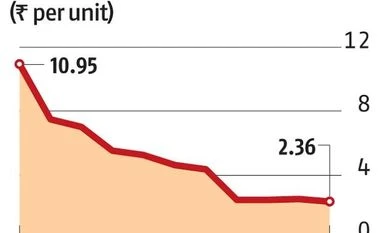
New record: The auction for 2,000 megawatts by Solar Energy Corporation of India or SECI yielded a tariff of Rs 2.36 per unit of solar power, beating the previous low of Rs 2.44 that held for two years (see chart: Lowest annual tarrif at auctions). Despite the uncertainty and risks emerging from the pandemic, and the likely imposition of customs duty on the import of PV panels, a new record emerged.
“Covid-19 fails to halt the aggressive RE (renewable energy) growth story...,” Raj Kumar Singh, Minister of State (IC) for Power and New and Renewable Energy, tweeted after the completion of the auction.
Overseas firms lead: Many of the auction winners were overseas companies, indicating confidence in India as an investment destination, and in its policies.
The lowest bid was by a Spanish company Solarpack for building 300 megawatts, followed by Italy’s Enel, the United States-based Amp Energy and Eden Renewables from France. They bagged over half of the capacity auctioned, with the rest going to Ayana Renewables, Renew Power, Tata Power and O2 Renewables.
According to BNEF analysts, these companies are likely betting on a “temporary window of nil import taxes on solar equipment” as well as access to cheap capital, among other things.
Cheaper power for all: A lower cost of solar power means cheaper (and cleaner) electricity for all in the long run as it replaces more costly generation. That is the next step the government is working on in a wider reform package.
The proposed changes aim to unshackle the distribution sector to give choice to consumers, besides ensuring more competitively priced power for all segments.
To encourage local manufacturing, the cost of industrial power, in particular, has to be lower. In an interview with BNEF, minister Singh said that he aims to bring industrial power down 36 per cent to 7 US cents (Rs 5.3) per unit, against an average of 11 cents (Rs 8.3) currently.
Renewables boom: Singh also spoke about a plan to substantially increase the penalties on distribution companies and large power users for not complying with renewable purchase obligations. This would lead to surging demand for renewables, while the proposed customs duty would provide protection to solar equipment manufacturers. It is not clear if these changes will indeed be implemented, since there is opposition from some of the states to the changes proposed.
Rs 1 trillion+: The long-standing systemic issues in the power sector, meanwhile, threw up another headline: overall dues of the ‘discoms’ to generators jumped to almost Rs 1,14,000 crore ($15 billion-plus) in May. The government has announced a liquidity package for discoms, but a more fundamental reset is required to ensure that the power system remains financially robust. The low tariffs quoted for auctions conducted by federal-level bodies like SECI also reflect the lower risk of payment delays or defaults in agreements signed with such entities.
Vandana Gombar is the Editor – Global Policy for BloombergNEF. She can be reached at vgombar@bloomberg.net
Disclaimer: These are personal views of the writer. They do not necessarily reflect the opinion of www.business-standard.com or the Business Standard newspaper




