From Narasimha Rao to L K Advani: The faces of the Babri era

While Rao will be remembered for his inaction, Advani faces additional charges of criminal conspiracy
Babri
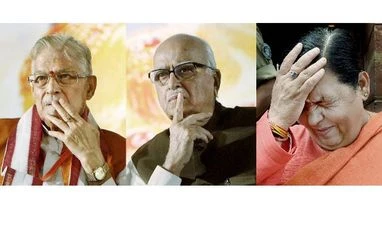
File photo of BJP leaders L K Advani, Murli Manohar Joshi and Uma Bharti
Nibir Deka New Delhi
7 min read Last Updated : Aug 06 2019 | 5:13 PM IST
On December 6, 1992, a large crowd of Hindu 'Kar Sevaks' demolished the 16th-century Babri Mosque in Ayodhya, which is considered to be the birthplace of Lord Rama. The demolition occurred after a political rally at the site led by the VHP and the BJP involving 150,000 'kar sevaks' turned violent.

Two FIRs were filed in the aftermath of the demolition. FIR no. 197 deals with actual “demolition of the mosque by kar sevaks” and FIR no. 198 named BJP leaders L K Advani and Murli Manohar Joshi, former UP chief minister and current governor of Rajasthan Kalyan Singh, founding president of VHP and former MP Vinay Katiyar, current cabinet minister Uma Bharati, VHP leader  Sadhvi Ritambhara and others for ‘communal’ speeches before the demolition. 

FIR no. 198 alleges offences under Section 153-A of the Indian Penal Code (promoting enmity between different groups on grounds of religion, language, etc), Section 153-B (assertions prejudicial to national integration) and Section 505 (statements amounting to public mischief). Another 46 FIRs pertaining to cognizable offences and one pertaining to non-cognisable offences were also lodged. Further, section 120-B (criminal conspiracy) was added.

On October 5, 1993, the CBI filed a consolidated charge sheet against 48 persons in all, including the names of Balasaheb Thackeray, Kalyan Singh, BJP leader Ram Bilas Vadanti, former VHP General Secretary Ashok Singhal, BJP MP Brij Bhushan Saran Singh, and others.

A subsequent inquiry into the incident by the Liberhan Commission led by Justice M S Liberhan submitted its findings to the government after an inquiry of nearly 17 years. It found 68 people responsible for the demolition. Justice M S Liberhan termed Atal Bihari Vajpayee, Advani, Joshi as pseudo-moderates, pretending to keep a distance from the Ram Janmabhoomi campaign when they were actually aware of the whole conspiracy. A report in The Hindu, quoted Justice Liberhan as saying, “It cannot be assumed even for a moment that L K Advani, A B Vajpayee or M M Joshi did not know the designs of the Sangh Parivar. Even though these leaders were deemed and used by the Parivar to reassure the cautious masses, they were [in fact] party to the decisions which had been taken.”

The Supreme Court on April 19, 2017 revived conspiracy charges against Advani, Joshi and 13 others in the 25-year-old Babri Masjid demolition cases.

Throughout the timeline of the proceedings, several charges and allegations have been levied against the names involved in an incident that shook the secular fabric of the Constitution.

L K Advani: According to the Indian Express, the CBI chargesheet alleges that Advani asserted that the kar seva to be held at Ayodha “would not mean only bhajan and kirtan, but would also involve construction of the Shri Ram temple.” It adds that the final decision to demolish the disputed structure was taken on December 5, 1992, at “a secret meeting” which was “held at the residence of Vinay Katiyar and was attended by Advani."

While the demolition was in progress, the chargesheet says Advani instructed the public to block the national highway so that forces do not reach Ayodha. He also told Kalyan Singh, not to tender his resignation to the governor of UP till the disputed structure was completely demolished.

Uma Bharti: The CBI chargesheet says that she had shouted at Ayodhya, “Ek dhakka aur do, Babri Masjid tod do (Bring down Babri Masjid with a solitary blow)”. It adds she had told kar sevaks that the Supreme Court had not told them to demolish but only to not do construction work and hence they are removing the black spot from the nation’s forehead.

Following the Supreme Court prosecution in April 2017, Uma Bharti refuted claims about her speech and told TV channels, "I did not give any speech on December 6, 1992. When we reached the site, the demolition had already begun. There was no opportunity to give any speech".

Kalyan Singh: Though he wasn't present at the time of occurrence, the former UP chief minister was still found prima facie guilty u/s 120-B of IPC. Kalyan Singh had given assurance to the National Integration Council that the disputed structure wouldn't be razed and the Supreme Court had permitted only symbolic ‘kar seva’ to be performed at the site. 

At his swearing-in as chief minister, Singh and Joshi visited Ayodhya along with members of his cabinet and party legislators, where they allegedly took a vow to construct the temple, the chargesheet claims.

A conspiracy was hatched with the people being trained by the Bajrang Dal of Gujarat. In pursuance of this, Kalyan Singh acquired 2.77 acres of land in October 1991 "under the pretext of developing the land for tourism purposes.”

Kalyan Singh made statements and gave public speeches indicative of his involvement in the matter.

Murli Manohar Joshi: According to the CBI investigation, Murli Manohar Joshi had said at Mathura that no force can stop the construction of Ram temple. He was accused of encouraging the kar sevaks from the manch to carry out the demolition and for shouting provocative slogans.

Brij Bhushan Singh: On December 6, 1992, Brij Bhushan Singh, who is serving as MP from Gowda was allegedly in Ayodhya and provoked the kar sevaks. He has also been accused of sheltering some kar sevaks and facilitating their journey to Ayodhya. As cited in the Times of India, in December 2012, the special CBI court in Lucknow hearing the demolition case issued a non-bailable warrant against him, for his continuous absence from the court during the trial.

P V Narasimha Rao: The Prime Minister's tenure is well known for his inaction during the demolition. NDTV has reported recent revelations by Congress leader Mani Shankar Aiyyar, in which he said that Rao possessed a “pro-hindu mindset” and was convinced that by talking to the sadhus and saints, he could solve the problem. The Congress leader maintained that Rao could have dismissed the Kalyan Singh government and imposed President's Rule in Uttar Pradesh. Excerpts from the memoirs of former Union Minister Arjun Singh, published posthumously, reveal the PM's inaction over the issue.

Administration: Accused public servants R N Srivastava, (then District Magistrate of Faziabad) and Sri D B Rai (then SSP of Faizabad who later became Member of Lok Sabha from BJP) and Kalyan Singh were well aware that the central para-military forces were duly equipped with riot gear and plastic and rubber bullets to avoid casualties. 

Majority of the UP officers indicted by the Liberhan Commission for their role in the Babri Masjid demolition have since retired. 

Other leaders: The special CBI judge S K Yadav also asked Vinay Katiyar, VHP’s Vishnu Hari Dalmia and Hindutva preacher Sadhvi Ritambhara to remain present before the court in person. 

The Liberhan Commission held Sadhvi Ritambhara culpable of leading the country "to the brink of communal discord" for her role in the demolition of the Masjid. She was one of the three key women leaders of the movement, the other two being Uma Bharati and Vijayaraje Scindia; their leadership was largely responsible for the involvement of women in the movement and the form it took. Her speech “Haan Hum HINDU Hain (Yes, we are Hindus)” preceding the aftermath of the demolition is still available on social media portals.

One of the prime accused, Vinay Katiyar reiterates that there was no conspiracy. “Whatever happened that day took place in front of lakhs of people. Nothing took place in a closed room,” he told Times Now TV channel following the Supreme Court hearing on April.

Another accused, BJP leader Ram Vilas Vedanti, told TV reporters, “I told the court in clear terms that the structure was built over Ramlalla. And I am responsible for breaking the structure. If I am found guilty, I am ready to go to jail or be hanged.”

One subscription. Two world-class reads.

Already subscribed? Log in

Subscribe to read the full story →
*Subscribe to Business Standard digital and get complimentary access to The New York Times

Smart Quarterly

₹900

3 Months

₹300/Month

SAVE 25%

Smart Essential

₹2,700

1 Year

₹225/Month

SAVE 46%
*Complimentary New York Times access for the 2nd year will be given after 12 months

Super Saver

₹3,900

2 Years

₹162/Month

Subscribe

Renews automatically, cancel anytime

Here’s what’s included in our digital subscription plans

Exclusive premium stories online

  • Over 30 premium stories daily, handpicked by our editors

Complimentary Access to The New York Times

  • News, Games, Cooking, Audio, Wirecutter & The Athletic

Business Standard Epaper

  • Digital replica of our daily newspaper — with options to read, save, and share

Curated Newsletters

  • Insights on markets, finance, politics, tech, and more delivered to your inbox

Market Analysis & Investment Insights

  • In-depth market analysis & insights with access to The Smart Investor

Archives

  • Repository of articles and publications dating back to 1997

Ad-free Reading

  • Uninterrupted reading experience with no advertisements

Seamless Access Across All Devices

  • Access Business Standard across devices — mobile, tablet, or PC, via web or app

Topics :Babri Masjid

Next Story


