TDP pulling out of Modi govt harks back to permafrost problem of coalitions

The core of coalitions, the single largest party, requires the shield that the smaller partners provide
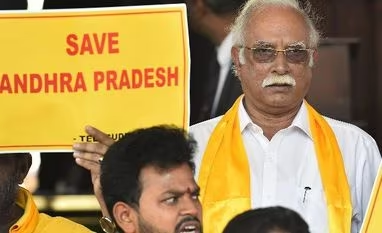
Gajapathi Raju
TDP MP & Former Union Civil Aviation Minister Ashok Gajapathi Raju with Party MP's protest at Parliament House demanding special status for Andhra Pradesh during the second phase of the budget session in New Delhi (Photo: PTI)
T C A Srinivasa Raghavan
Last Updated : Mar 09 2018 | 6:34 PM IST
The decision by N Chandrababu Naidu, leader of the Telugu Desam party which has been an ally of the BJP and an important member of the NDA for the last five years, to more-or-less get out of the coalition is not surprising. 

Several explanations have been put forth. All have to do with money.

Mr Naidu has said that financial promises made to his fledgling state of Andhra Pradesh have not been kept. He wants ‘special status’ which would guarantee him more money.

Another explanation, uttered sotto voce, is that he needs money for the 2019 election. A helping hand from the BJP which enables him to keep some of the promises he has made would come in handy.

A third explanation, again a whispered but far-fetched one, is that the alliance was between the two Naidus – Venkiah and Chandrababu. With the former being made vice president, the key cement has dissolved.

A fourth explanation has to do with the Polavaram project that is being run by the Centre but over which Mr Naidu wants an open ended, without financial limits, control without administrative oversight by the Centre. The key lies in the freedom to award contracts.

And a fifth explanation is that Mr Naidu is keeping his options open for a post-2019 election situation in which the BJP is reduced substantially in strength in the Lok Sabha.

These add up to a lot of reasons and each is probably a little bit true. Together they add up to a strong reason to separate, not the last of which is the fact that the BJP doesn’t really care any longer. 

What it loses if the TDP goes out, it has gained from Nitish Kumar joining the NDA. Bihar has 40 Lok Sabha seats while Andhra has 25. And let’s not forget that Nitish Kumar too wants special status for Bihar which he has not got. 

The permafrost problem 

These are the proximate reasons. Underlying all this is the permanent problem of coalitions, what I call the permafrost problem. 

Permafrost is the layer of soil or rock which remains frozen for more than two consecutive years. If there is ice above it, it stays as it is; if not, it freezes and thaws annually. 

The BJP in the NDA is the bit that doesn’t thaw or freeze; it remains frozen and is extremely hard to break. On the other hand, the other members of the NDA are like the top soil or snow. They thaw and freeze depending on the political temperature. 

As long as they are there, they provide strong protection to the permafrost. But once they start to drift off it becomes vulnerable because the effects cannot be predicted.

This is exactly true of coalition politics also. The core of coalitions, the single largest party, requires the shield that the smaller partners provide. 

Take those away and because of the knock-on effect, you don’t know what will happen in the election. The loss of a partner means the loss of goodwill also, as the BJP discovered in Bihar in 2016.

One subscription. Two world-class reads.

Already subscribed? Log in

Subscribe to read the full story →
*Subscribe to Business Standard digital and get complimentary access to The New York Times

Smart Quarterly

₹900

3 Months

₹300/Month

SAVE 25%

Smart Essential

₹2,700

1 Year

₹225/Month

SAVE 46%
*Complimentary New York Times access for the 2nd year will be given after 12 months

Super Saver

₹3,900

2 Years

₹162/Month

Subscribe

Renews automatically, cancel anytime

Here’s what’s included in our digital subscription plans

Exclusive premium stories online

  • Over 30 premium stories daily, handpicked by our editors

Complimentary Access to The New York Times

  • News, Games, Cooking, Audio, Wirecutter & The Athletic

Business Standard Epaper

  • Digital replica of our daily newspaper — with options to read, save, and share

Curated Newsletters

  • Insights on markets, finance, politics, tech, and more delivered to your inbox

Market Analysis & Investment Insights

  • In-depth market analysis & insights with access to The Smart Investor

Archives

  • Repository of articles and publications dating back to 1997

Ad-free Reading

  • Uninterrupted reading experience with no advertisements

Seamless Access Across All Devices

  • Access Business Standard across devices — mobile, tablet, or PC, via web or app

Next Story



