In the spring of 1851, during the gold rush, a California state militia called the Mariposa Battalion was combing the Sierra Nevada mountain range, searching for Native American warriors who were fighting the colonisers from the east. On March 27, they came upon a valley along which flowed the Merced River.
Lafayette Bunnell, an officer with the battalion, stood there transfixed at the array of magnificent, vertical rock faces, carved by glaciers 20,000 years ago, and vertical waterfalls a thousand feet high. Bunnell was instrumental in naming the valley Yosemite, after the local tribe that his battalion would soon drive out of the area.
Proceeding south, the troopers came upon what was later named the Mariposa Grove, enormous sequoia trees that were the largest and oldest living things on the planet.
Both the valley and the trees today form part of Yosemite National Park, over 3,000 square kilometres of protected area that attracts almost four million visitors every year. Amongst them this year was the Shukla family, when my wife, Sonia, and I, along with our 28-year-old son, Aaryaman, and 8-year-old daughter, Meera, embarked on a driving-cum-camping trip to the great American national parks.
Over 25 days and 10,000 kilometres we would learn that one gets a sense of the vastness, magnificence and friendliness of that country and its people while covering it step by step.
The concept of national parks is a uniquely American idea. It was based on the egalitarian principle that, unlike in 19th century Europe, where the grandest and most magnificent sceneries, monuments and palaces were reserved for those who could afford them, America’s grandest and most spectacular places should be reserved for the common people.
In 1864, with America’s attention rivetted on the Civil War, John Conness, senator from California, introduced a Bill in the Senate that involved the “grant of a certain premises in Sierra Nevada… a matter involving no financial appropriation from the government, only the setting aside of a large tract of natural scenery for the future enjoyment of everyone.”
The Senate passed Conness’ Bill. On June 30, 1864, President Abraham Lincoln signed the Yosemite Grant, effectively giving birth to the national park idea.
Yosemite was not the first national park — the honour would go to Yellowstone.
* * * *
Our first job was to kit up for the camping trip — expensive but cheaper than staying in hotels and eating in restaurants. We quickly learnt that America is a camper’s paradise, with stores like REI and Eastern Mountain Stores that are single-stop supermarkets for expeditions like ours. There are also cheaper outlets, like the Army & Navy Stores, which provide bargains on all-weather clothing, hiking boots and camp gear.
With Aaryaman and Meera insisting upon their own tent, we decided to buy a couple of three-person tents — the two-person variety is too cramped for extended camping trips. Cooking is done on propane stoves, with uniform propane cylinders available all across America. We also picked up air mattresses and pillows, a barbecue grill, camp lighting, utensils, an icebox for perishables; and we were set. And, yes, bear spray.
It would take three days of dawn-to-dusk driving to get from Philadelphia, from where we were starting, to Yellowstone. Driving back to the east coast, from where we were catching our flight back to Delhi, would take another three days, eating into our camping time. Eventually, we decided to drive only one way, and fly back from Denver, Colorado to Philly. Hiring a car in Philly and dropping it off at Denver would cost us more, but would save three days of driving.
A quick look at the mountain of equipment and it was clear that nothing less than a van would do.
* * * *
Our first major destination was Yellowstone. By the 1860s, reports were coming in from Wyoming about a place where the ground was boiling, and where local Shoshone Indians would catch a fish in one creek and cook it immediately in a natural geyser nearby. There were also rumours of a massive waterfall and canyon and a geyser that spouted every hour.
With the construction of the Northern Pacific Railroad in full swing in Montana, an expedition was mounted to verify these reports that might bring in hordes of visitors. It quickly became clear that this geyser wonderland, teeming with wolves, bears and bison, would be a great attraction.
In January 1872, President Ulysses Grant signed the Yellowstone Bill, designating it as a “national park”, the world’s first. Other national parks quickly followed. In 1890, Yosemite too became a national park.
There was still no authority to oversee the national parks. In 1886, after Washington failed to appropriate money to pay for running Yellowstone, the US cavalry stepped in to protect it from poachers, loggers and vandals. Only in 1916 was the US National Park Service constituted: it protects and administers all US national parks as well as other monuments.
* * * *
US campsites are geared for functionality, not style. There are numbered spots for pitching tents, and clear instructions about what cooking fires are allowed. There is a community toilet, but only a few permit showering. Only the larger parks have paid community showers.
In parks with wild bears, each campsite has a heavy, metallic box for placing foodstuff; put it in your tent or your car and it could be ripped apart by a bear.
There are separate campsites for the motorcycle community, which seems straight out of the 1960s: large men still sporting drooping handlebar moustaches, leather jackets, bandanas and shades. Surprisingly, they are the friendliest of all.
* * * *
Driving west from Billings, Montana, people and cars are largely replaced by an eerie emptiness. This leads on to the famous Bear Tooth Highway to Yellowstone, one of the most picturesque roads in America, and into the magnificent Yellowstone National Park.
Yellowstone has multiple dimensions. The picturesque Lamar Valley consists of rolling meadowlands populated by bison and wolves. The blue of the river merges with the green of the meadows and the darker shade of the Lodgepole Pines that make up 80 per cent of Yellowstone.
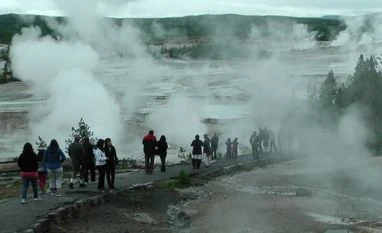
The Norris geyser basin is a scene straight from some smoking hell: steam rising from fumaroles and thermophiles, including a geyser called Congress! Signs everywhere warn against leaving the path, and the danger of being swallowed up by a geyser.
The wind blows off people’s hats, but those cannot be retrieved for fear of getting scalded. A large, florid humourist tells a group of earnest Taiwanese listeners that a bunch of four hats lying on the geyser was all that is left of people who tried to walk across the surface.
Yellowstone was, for centuries, a trading post, where Native Americans came in the summer to escape the heat in the surrounding plains of Idaho, Wyoming, Montana and Arizona. They would rest, fish, hunt, dry their meat for winter, and trade Obsidian: the hard, volcanic rock that was the most prized material for arrow heads. This was also a place where the US cavalry would come and keep an eye on what was going on in the tribes.
After three days in Yellowstone, we drive south to the Grand Teton National Park, a magnificent range of snow-capped mountains that adjoins Yellowstone to the south. This was carved out by glaciers aeons ago, during the ice age.
From the Tetons we embark on the 800-mile, 15-hour drive to Yosemite, in California. We drive through the vast emptiness of Nevada, a landscape so bleak and barren it could be from another planet. The black ribbon of the road extends ahead as far as the eye can see through enormous, flat valleys, one after the other, interspersed with jagged ridgelines devoid of vegetation.
The landscape is redolent of the days of the Pony Express in the 1860s and 1870s, when stage coaches would carry passengers and mail from one staging station to the other, where a night’s lodging and fresh horses would be waiting. During the journey, the stagecoach would have a solitary armed guard to protect it from bandits, outlaws and Native Americas who were being driven from their territory.
Yosemite comes as a disappointment after Yellowstone. The latter’s endless spaces easily absorbs the vast numbers of visitors it receives, but Yosemite seems overrun by tourists who are everywhere, clogging the traffic and pouring out of every restaurant and display. The park is too close to to the populous metros of California, from where thousands of visitors travel conveniently on short trips to the world’s most famous national park. Even so, the major attractions of Yosemite --- the rock faces of El Kapitan and the Half Dome --- do not disappoint. Sadly, the famous Mariposa Grove of giant sequoias was closed for restoration work.
From Yosemite we have another long drive to the Grand Canyon, passing through Death Valley --- the lowest point in America with the highest temperatures. To vociferous protests from Sonia, Aaryaman and Meera, I insist on having the air-conditioning off and the windows open. At 50 degrees Centigrade, it was just like being in Delhi in May!
The Grand Canyon is one of the few natural wonders of the world that actually leaves one speechless. Even Meera, who few things can keep quiet, actually stood still for several moments and absorbed the multi-hued chasm that the Colorado River had taken millions of years to gouge out of the surrounding plateau. The geological history of millions of years was there on display, in layer upon layer of rock that made up the canyon.
After days of camping, we decided to treat ourselves to a lodge --- the famous Grand Canyon Lodge on the North Rim of the abyss. It was quite astonishing to be able to take a shower whenever we liked and the food at the lodge was outstanding. Meera, who by now was an accomplished walker, took a sixteen kilometre hike with us to a viewpoint. During the course of our visit, she accumulated five junior ranges badges, for which each national park requires the youngster to make a specified number of treks, attend ranger talks and take a quiz.
After the Grand Canyon, we made our way to the nearby Bryce and Zion National Parks --- both carved out of the Arizona plateau by the elements over millennia. Even though we were inured by now to spectacular natural beauty, Zion’s massive rock faces still made for astonishing viewing. A highlight of the Zion visit was our trek to Angel’s Landing --- a harrowing climb over a narrow ledge, 1,400 feet above the canyon floor, grasping for dear life onto a chain fixed along the route. Our confidence was not enhanced by a warning sign, which informed trekkers that, over the preceding dozen years, six climbers had fallen to their deaths on this route.
From Zion, we drove to Denver to begin our journey back to India. Describing our camping vacation to a friend in Philadelphia, we were rewarded by her observation that 95 per cent of Americans have not made such a journey, nor seen so much of America. To our friends in India we have only this to say: on your next visit to the US, bypass the big cities. Go to the national parks and see the real America.

 "The real America: A drive through the US National Parks")


 Connect with us on WhatsApp