Associate Sponsors

Co-sponsor

A Flag to Live and Die For: Navtej Sarna's rich study of freedom, identity

Navtej Sarna's book is utterly fascinating for the insights it provides into the politics of the freedom movement, personal freedom and the flag
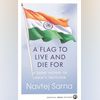
A Flag to Live and Die For: A Short History of India's Tricolour
A Flag to Live and Die For: A Short History of India’s Tricolour
Aditi Phadnis
4 min read Last Updated : Feb 24 2026 | 10:09 PM IST
A Flag to Live and Die For: A Short History of India’s Tricolour
by Navtej Sarna
Published by 
Aleph Book Company
499  pages ₹146
  A national flag represents the beating heart of a nation. It is a testament to unity but must also acknowledge diversity. In many ways, it represents a national philosophy, mythology and aspiration (just as an aside, Sri Lanka’s national flag has a stylised golden lion holding a sword. No lion has been spotted on the island for 40,000 years). This slim volume captures the debate over India’s freedom and its aftermath, telling the story through the discussion surrounding the national flag.
 
In the first phase of the freedom struggle, many flags were designed: The first by Srish Chandra Bose in Lahore; then, in 1906, at Parsi Bagan Square in Calcutta, a flag called the Vande Mataram flag was flown. Sister Nivedita designed another one. And of course, the most rebellious act of the time was the unfurling of a flag on foreign soil by Bhikaji Cama, when she raised it at the Seventh Congress of the Second International Socialist Conference in Stuttgart.  The design of all the flags was different. But it was the action that mattered, not the elements of the flag.
 
Initially, Mahatma Gandhi didn’t think having a flag would make much material difference to India’s struggle for freedom. However, he changed his view because of the indefatigable Pingali Venkayya’s efforts to design the perfect flag for swaraj. Venkayya, who had met Gandhi in South Africa, was a devoted follower and had tried many times to persuade Gandhi that an appropriate flag was imperative for the freedom movement and the Congress. Shrewd strategist that he was, Gandhi asked Venkayya to design a Swaraj flag with a spinning wheel at the centre of three strips: Red (for Hindus) white (for all other religions) and green (for Muslims). The flag was flown at the Ahmedabad session of the Congress against a background of the rise of the Khilafat movement and the launch of the non-cooperation movement in 1920.
 
Neither Venkayya nor Gandhi thought the flag would become a point of contention. Inevitably, it did, and it was part of the ferment caused in the freedom movement after Chauri Chaura that led to Gandhi’s call for suspension of the civil disobedience movement.  Navtej Sarna explains how: The Swarajists or the pro-changers wanted to take part in legislative councils and change the system from within. The no-changers wanted to boycott the councils and continue with Gandhi’s constructive work. Both groups claimed the flag but differed in their approach. The British, meanwhile, saw the flag as a threat to their sovereignty represented by the Union Jack. Gandhi saw in this an opportunity to unite not just the two threads of thinking inside the Congress but also the fraying relations between Hindus and Muslims.
 
The Swaraj flag however, could not subsume the demands made of an imagined India: The Sikhs wanted their claims legitimised by some representation on the flag. The Muslim League rejected it altogether. The RSS’s prime allegiance was to the bhagva jhanda (saffron pennant) of Shivaji and Maratha rulers. The princely states had their own flags and resented the “imposition” of a national flag. By 1931, the issue was important enough to merit a seven-member Flag Committee authorised by the Congress Working Committee at the Karachi session. Mr Sarna says  Badruddin Tyabji is “credited” with the redesign of the final flag, with the Ashoka Chakra in the middle. He does not appear convinced of the veracity of the claim. The Indian tricolour was adopted following a resolution moved by Jawaharlal Nehru on July 22,1947.
 
The story doesn’t end there. Mr Sarna says that on June 24, 1947, Lord Mountbatten presented a flag to Nehru as an alternative design — with a small Union Jack inserted on it. The same design was offered to Pakistan. Unsurprisingly, both countries rejected it.
 
Once India became free, the flag had to be shown requisite decorum and respect, Mr Sarna says. The Flag Code emerged in 1950. This was challenged by Naveen Jindal, who later became a political figure, and in 2002 Indians got a new flag code that stated that the right to fly the national flag with respect and dignity is a fundamental right of a citizen. This code has been liberalised further.
 
This book is utterly fascinating for the insights it provides into the politics of the freedom movement, personal freedom and the flag. It is refreshing because it is factual rather than fashionably hysterical about a national symbol.
 

One subscription. Two world-class reads.

Already subscribed? Log in

Subscribe to read the full story →
*Subscribe to Business Standard digital and get complimentary access to The New York Times

Smart Quarterly

₹900

3 Months

₹300/Month

SAVE 25%

Smart Essential

₹2,700

1 Year

₹225/Month

SAVE 46%
*Complimentary New York Times access for the 2nd year will be given after 12 months

Super Saver

₹3,900

2 Years

₹162/Month

Subscribe

Renews automatically, cancel anytime

Here’s what’s included in our digital subscription plans

Exclusive premium stories online

  • Over 30 premium stories daily, handpicked by our editors

Complimentary Access to The New York Times

  • News, Games, Cooking, Audio, Wirecutter & The Athletic

Business Standard Epaper

  • Digital replica of our daily newspaper — with options to read, save, and share

Curated Newsletters

  • Insights on markets, finance, politics, tech, and more delivered to your inbox

Market Analysis & Investment Insights

  • In-depth market analysis & insights with access to The Smart Investor

Archives

  • Repository of articles and publications dating back to 1997

Ad-free Reading

  • Uninterrupted reading experience with no advertisements

Seamless Access Across All Devices

  • Access Business Standard across devices — mobile, tablet, or PC, via web or app

Topics :BOOK REVIEWBS OpinionNational FlagPolitics

Next Story


