India in Flux offers up new ways to think about complex challenges ahead

Few could have played the role Shankar Acharya did-navigating political, fiscal, and global pressures with clarity and conviction
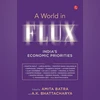
A World in Flux: India's Economic Priorities. Essays in Honour of Shankar Acharya
A World in Flux: India’s Economic Priorities. Essays in Honour of Shankar Acharya
Laveesh Bhandari
5 min read Last Updated : Aug 05 2025 | 10:24 PM IST
A World in Flux: India’s Economic Priorities. Essays in Honour of Shankar Acharya
Edited by Amita Batra & A K Bhattacharya
Published by 
Rupa
448 pages   ₹795
 

Also Read

Shankar Acharya is undoubtedly a unique personality. Disarmingly affable yet ruthlessly incisive, both as a policy economist and as a thought leader, he has made significant contributions to India’s growth. Over a period of eight years, as the chief economic advisor, he played a pivotal role in helping shape economic policies that have propelled India from being a laggard economy to the forefront of economic growth globally. This success, no doubt, cannot be ascribed to any one person but a whole group of policymakers. The era was interesting; bureaucrats and politicians had to take decisions that were risky both politically and administratively. Economists, many of whom are contributors to this volume, had to navigate multiple pressures, balancing the immediate with the long term.  And in all of this, Dr Acharya was playing a role few could have played, balancing multi-fold pressures and, more importantly, actively contributing to the most important period in modern Indian economic history.
 
He has always advocated policies towards economic liberalisation, where both trade and finance are not limited by protectionism and unnecessary regulation.  Yet he is also a conservative, tending to favour fiscal tightness rather than government profligacy. His monetary policy instincts are no different, as also acknowledged by one of the contributors.  Those days now seem distant, but not too far back, integration into the global economy was yielding great benefits in terms of economic growth. Many know this, but it needs to be said again and again: This combination of liberal economics and fiscal conservatism helped generate the surpluses that could then be used to ramp up welfare and public infrastructure creation beyond the 2000s. 
 
But Dr Acharya has not stopped there. Through his columns and his books (Essays on Macroeconomic Policy and Growth in India and India’s Economy: Performance and Challenges), he continues to inspire rational and balanced economic decision-making.   I have been fortunate to have heard his views every Monday at the Business Standard edit meetings.  For me, that was a time when I was quite disillusioned with the prevalent economic thoughts of the day, and on the verge of giving it all up.  But in those meetings, I found a different world existed that I had not known of, where a richly layered thought process would attempt to decipher the problem at hand in an amazingly humble manner.
 
So I am so glad that the editors Amita Batra and A K Bhattacharya have been able to get among the most deep economic thought-leaders in India to contribute to this volume.  The contributors are a Who’s Who of India’s economic thinkers and practitioners and then some more.  Uday Kotak has penned a warm foreword. Chapter contributors include Montek Singh Ahluwalia, Rakesh Mohan, Shyam Saran, Sudipto Mundle, Mahendra Dev, Ajay Chhibber, Michael Patra, Sajjid Z Chinoy, Deepak Misra, Radhika Kapoor and more.
 
Thankfully, the volume is not about the past, but the future — how should India work with a very different geo-economic scenario where geopolitics seems to be overwhelming economics?  It is also not inward-looking but highly outward-oriented, drawing from insights from Asia and Latin America, specifically and the world in general.  And yes, there is a separate contribution on China as well.  The topics cover not just macroeconomics, but also urban development, employment, small and medium enterprises, climate change, finance, growing digitalisation, agriculture, human capital, trade and even political economy.
 
Would I read this volume again?  The answer is an unqualified yes.  First, to know Dr Acharya's life and contributions better. Second, to better understand how global thought leaders are thinking through some of the most difficult and complex sets of challenges humanity is facing.  And third, a deeper insight into the challenges that are emerging for India and the world and the potential path forward.
 
That gets me to what I missed — the introspection.  Today, neat models of economic interactions reflect only the past, and tactical and geopolitical issues have become far more important for decision-makers than they were in the past. Technology change has become so rapid and concentrated that it is unlikely to give the necessary space for trickle-down to work.  In such a situation, what do the objectives of equity, growth and efficiency mean?  Moreover, as government intervention in the economy is becoming more and more acceptable, it would be nice to also think about where the boundaries may be.
 
The reviewer heads CSEP Research Foundation.
 
Amita Batra is a Business Standard columnist, and A K Bhattacharya is editorial director at Business Standard

One subscription. Two world-class reads.

Already subscribed? Log in

Subscribe to read the full story →
*Subscribe to Business Standard digital and get complimentary access to The New York Times

Smart Quarterly

₹900

3 Months

₹300/Month

SAVE 25%

Smart Essential

₹2,700

1 Year

₹225/Month

SAVE 46%
*Complimentary New York Times access for the 2nd year will be given after 12 months

Super Saver

₹3,900

2 Years

₹162/Month

Subscribe

Renews automatically, cancel anytime

Here’s what’s included in our digital subscription plans

Exclusive premium stories online

  • Over 30 premium stories daily, handpicked by our editors

Complimentary Access to The New York Times

  • News, Games, Cooking, Audio, Wirecutter & The Athletic

Business Standard Epaper

  • Digital replica of our daily newspaper — with options to read, save, and share

Curated Newsletters

  • Insights on markets, finance, politics, tech, and more delivered to your inbox

Market Analysis & Investment Insights

  • In-depth market analysis & insights with access to The Smart Investor

Archives

  • Repository of articles and publications dating back to 1997

Ad-free Reading

  • Uninterrupted reading experience with no advertisements

Seamless Access Across All Devices

  • Access Business Standard across devices — mobile, tablet, or PC, via web or app

Topics :Fiscal DeficitBOOK REVIEWIndian Economybooks

Next Story



