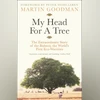
My Head For A Tree: The Extraordinary Story of the Bishnoi, the World’s First Eco-Warriors
Author: Martin Goodman
Publisher: Profile Books /Hachette
Pages: 272
Price: Rs 699
Would you give your own life to protect a tree or save an animal from being killed? This question might sound absurd if you believe that human life — and more specifically your own — is inherently more precious than all other forms of life. However, the Bishnoi community in Rajasthan looks at things a bit differently. Their beliefs, based on rules laid down by their guru Jambhoji (1451-1536), require them to be kind to all living beings. This goes beyond watering plants, feeding birds and taking care of animals. They are ready to put their own lives at stake.
Martin Goodman’s book My Head For A Tree: The Extraordinary Story of the Bishnoi, the World’s First Eco-Warriors is essential reading for anyone who wants to learn about the Bishnoi worldview and way of life. An Emeritus Professor of Creative Writing at the University of Hull in the United Kingdom, the author has approached the subject with curiosity, rigour and emotional depth. The book does not merely inform or educate; it compels us to reflect on what it means to be human, how we interact with other species, and what shifts we need to make.
“Saving chinkaras is my religion,” says Mukesh, a young man from the community, while talking to Dr Goodman about a kind of gazelle found in India, Iran, Pakistan and Afghanistan. When he was 17 years old, back in May 2020, schools were shut because of the Covid-19 pandemic. Poaching was on the rise during the lockdown, so a 15-member group including Mukesh stayed up all night, every night for a community vigil. On his way to the patrol area, Mukesh heard a gunshot and saw four men —two with guns, and two others with the body of a dead chinkara. Mukesh chased the poacher on foot and grabbed hold of his gun. Luckily, the bullets had been discharged. Mukesh and his friend informed other Bishnoi villagers and forestry department officials. The murder weapon was found after pursuing a blood trail but the poachers had fled the scene.
For Mukesh, and many other Bishnois, looking after animals and trees is a religious duty. The book has many such anecdotes, which help us appreciate their indigenous environmentalism rooted in social conditioning, oral traditions of storytelling, and an inner conviction. One of the foundational stories that Bishnoi children hear as they grow up is about Amrita Devi and the 363 “martyrs” from Khejarli village who stepped forward to hug and save their beloved khejri trees from being hacked down by Maharaja Abhay Singh’s men from Jodhpur. The year was 1730. Dr Goodman writes, “Shocked by the news, the Maharajah…issued an edict: It was now forbidden to chop down a living tree, and to hunt or poach any animal, throughout Bishnoi land.”
The rules established by Jambhoji require Bishnois to refrain from cutting down or trimming any trees “with the sap still in them”. They are also asked to abstain from eating meat and eggs. Castration of bulls is forbidden because of the pain it causes them. Old animals belonging to the community are to be housed, looked after and fed till their moment of death, and not sent to the slaughter house. Bishnois are also required to take care of all abandoned and injured animals.
While most of his informants from the community are men, Dr Goodman does include women’s voices. Pooja, for instance, runs an animal shelter alongside training to be a schoolteacher. Apart from chinkaras, she takes care of rabbits, vultures, peacocks, eagles, crows, parrots, pigeons, desert cats, bee-eaters, and even dogs, though dogs kill and eat chinkaras. Dr Goodman quotes journalist Gangadharan Menon, who clarifies that, for Bishnois, “killing a monitor lizard is as hideous a crime as killing a tiger”. Bishnoi women also breastfeed baby chinkaras and baby monkeys who have lost their mothers. Young Bishnois are also training to be lawyers so that they can use the law to carry out their mission of protecting animals and trees. This book would be an eye-opener especially for those who believe that Jainism and Buddhism are the only two religions that preach nonviolence.
This book also connects the dots between the Khejarli Massacre and the Chipko movement. The author recalls that, India’s former Environment Minister Jairam Ramesh had said, in April 2011, that “Amrita Devi inspired Gaura Devi to lead a band of intrepid women to protect their trees in Reni village in Chamoli district of Uttarakhand in 1974.”
Dr Goodman’s respect for the Bishnois, and his gratitude for their hospitality, come through in the book but he also makes room for critical observations. He notes that, while Jambhoji prohibited the use of opium, tobacco, cannabis and alcohol, the rule forbidding their consumption is often flouted and some Bishnoi villages are involved in trading opium. He also emphasises that the Lawrence Bishnoi gang’s attempt to murder actor Salman Khan, given the latter’s alleged involvement in a blackbuck hunting case, goes against Jambhoji’s insistence on nonviolence.
Dr Goodman never downplays his gaze as an outsider in this milieu. The flight of Great Indian Bustards in the Thar Desert reminds him of boats sailing through East Yorkshire. He also mentions that the people who hosted him for meals were alerted to his gluten-free diet. Apart from the serious and light-hearted moments, this book is a visual treat thanks to Franck Vogel’s excellent black-and-white photographs of the Bishnois and the landscape in which they live.
The reviewer is a journalist, educator and literary critic. @chintanwriting on Instagram