Associate Sponsors

Co-sponsor

Rebellion in Verse: Devotion as a social disruptor in Tamil Bhakti movement

Raghavan Srinivasan reclaims the Tamil Bhakti saints as radical poets who challenged caste, ritual authority and hierarchy through powerful Tamil verse
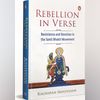
Rebellion in Verse: Resistance and Devotion in the Tamil Bhakti Movement
Sudha G Tilak
5 min read Last Updated : Feb 13 2026 | 11:10 PM IST
Rebellion in Verse: Resistance and Devotion in the Tamil Bhakti Movement
by Raghavan Srinivasan
Published by Penguin
300 pages, ₹799
 
Each year, during Panguni Uthiram in the Tamil months of March and April, the streets around Kapaleeswarar Temple in Mylapore come alive for the Arubathu Moovar festival in Chennai. Sixty-three bronze idols representing the Saiva Nayanmars

Also Read

are taken out in procession, gleaming with silk, flowers and jewels. As a child perched on my father’s shoulders, I remember less the meaning of the festival and more the heat, the noise, the press of bodies, and the towering wooden chariot carrying a resplendent Siva. The saints were distant, magnificent figures, part of a grand religious spectacle. 
Raghavan Srinivasan’s Rebellion in Verse: Resistance and Devotion in the Tamil Bhakti Movement offers something very different from that sensory overload. It is a quiet, thoughtful companion that brings the Nayanmars and their Vaishnava counterparts, the Alwars closer, not as statues or processional icons but as living poets who reshaped faith, language and society through their songs. 
The book’s central argument is clear and compelling: The Tamil Bhakti movement was not just about personal devotion. It was also an act of resistance. Through poetry and music, Bhakti saints challenged rigid caste hierarchies, questioned religious authority, and made devotion available to everyone, regardless of birth or status. Srinivasan shows us that these poets were not passive mystics but active social voices, using verse as a way to speak back to power. 
The Nayanmars — 60 men and three women — and the Alwars — 11 men and one woman — lived between the 6th and 12th centuries CE. The Saiva saints sang of Siva and local deities like Murugan, while the Alwars devoted themselves to Vishnu, often called Tirumāl. What united them was their choice of Tamil over Sanskrit. This was a bold and political decision. 
Sanskrit was the language of ritual elites, while Tamil was the language of the people. By composing hymns in Tamil, the Bhakti poets ensured that devotion could be felt, sung and understood by ordinary men and women. 
Srinivasan traces how these hymns grew out of older traditions. The poets borrowed the lyrical beauty of Sangam poetry, absorbed Buddhist and Jain ideas, and reshaped them through intense personal emotion and love for a chosen god. Bhakti, as the book explains, was deeply intimate and a direct relationship between devotee and deity, yet it was also public and collective, sung aloud in streets, temples and town squares. 
One of the book’s strengths lies in its portraits of the saints themselves. These were people from all walks of life: Kings who gave up their thrones, Brahmins, traders, hunters, forest dwellers, and Dalits. Nandanar, born into a marginalised leather-working community, longed to worship at Chidambaram and was ultimately accepted into the temple. Tiruppaan Alwar, considered “low caste,” was carried on a priest’s shoulders into the Srirangam temple. Tirumangai Alwar was once a military commander and bandit before becoming a Vaishnava saint. Sambandhar, the child prodigy, is said to have been fed divine wisdom by Siva himself and began composing hymns at the age of three, attaining liberation by 16. Appar, once a Jain monk, turned fiercely against Saiva and used his verses to challenge Jain authority, even converting kings. 
Women saints receive careful attention, too. Andal, who refused earthly marriage in favour of Vishnu, and Karaikal Ammaiyar, who chose an extreme ascetic life, are presented not as exceptions but as proof that Bhakti opened spiritual space for female voices. 
The book also explores sacred geography. The Alwars sang of 108 Divya Desams or blessed Vishnu temples, while the Nayanmars praised 275 Padal Petra Sthalams, or Siva temples sanctified through song. These hymns turned the Tamil
landscape itself into sacred space, mapping devotion onto everyday geography. 
Srinivasan pays close attention to how these verses were preserved. Under Chola king Rajaraja I, the Saiva hymns were recovered from crumbling palm-leaf manuscripts in the Chidambaram temple vaults and compiled by Nambiyandar Nambi, even restoring their original musical forms. Vaishnava hymns were similarly collected by Nathamuni in the 9th century. What began as wandering songs eventually became temple liturgy — rebellion absorbed into ritual. 
At times, the book’s richness can feel dense, with the many strands of history, philosophy, iconography, gender and social commentary woven together. But its aim is generous: To move Bhakti beyond devotional nostalgia and show its radical energy. Srinivasan also traces how this Tamil movement travelled north, influencing Basavanna in Karnataka, the abhang poets of Maharashtra, and later figures like Kabir, Mirabai, Tulsidas, Guru Nanak, Chaitanya Mahaprabhu, and Sankardev in Assam, all of whom used local languages to speak of devotion and equality. 
Rebellion in Verse ultimately asks us to listen again — to hear Bhakti not as background music to ritual, but as songs that once disrupted social order. In doing so, it restores risk, urgency and a voice to saints too often frozen in bronze. For readers willing to move past spectacle into reflection, this book makes the Tamil Bhakti movement feel alive, questioning and deeply human.
 
The reviewer is the author of Temple Tales and translator of Hungry Humans 
 

One subscription. Two world-class reads.

Already subscribed? Log in

Subscribe to read the full story →
*Subscribe to Business Standard digital and get complimentary access to The New York Times

Smart Quarterly

₹900

3 Months

₹300/Month

SAVE 25%

Smart Essential

₹2,700

1 Year

₹225/Month

SAVE 46%
*Complimentary New York Times access for the 2nd year will be given after 12 months

Super Saver

₹3,900

2 Years

₹162/Month

Subscribe

Renews automatically, cancel anytime

Here’s what’s included in our digital subscription plans

Exclusive premium stories online

  • Over 30 premium stories daily, handpicked by our editors

Complimentary Access to The New York Times

  • News, Games, Cooking, Audio, Wirecutter & The Athletic

Business Standard Epaper

  • Digital replica of our daily newspaper — with options to read, save, and share

Curated Newsletters

  • Insights on markets, finance, politics, tech, and more delivered to your inbox

Market Analysis & Investment Insights

  • In-depth market analysis & insights with access to The Smart Investor

Archives

  • Repository of articles and publications dating back to 1997

Ad-free Reading

  • Uninterrupted reading experience with no advertisements

Seamless Access Across All Devices

  • Access Business Standard across devices — mobile, tablet, or PC, via web or app

Topics :BOOK REVIEWBook readingBS Reads

Next Story



