Associate Sponsors

Co-sponsor

Tatyasaheb: Reading Bombay's past through the life of an entrepreneur

A biography of a Mumbai businessman written by his great-granddaughter is more than an anecdote-rich story of entrepreneurship
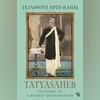
Tatyasaheb: The Story of a Bombay Entrepreneur
Sneha Pathak
5 min read Last Updated : Feb 11 2026 | 10:27 PM IST
Tatyasaheb: The Story of a Bombay Entrepreneur
By Tejaswini Apte-Rahm  
Published by Westland Business 
273 pages  ₹699
 
Tatyasaheb: The Story of a Bombay Entrepreneur is the biography of Vaman Shridhar Apte, also known as Vaman Seth or Tatyasaheb, written by his great-granddaughter Tejaswini Apte-Rahm. Ms Apte-Rahm looks at the legacy built by Tatya and gives her readers a story of his rise and growth in the business world. At the same time, she also paints a picture of the period in which he lived and worked, thus making it an account not just of the single life, but of an entire bygone era.
 
Ms Apte-Rahm begins the narrative with Tatya’s family background and also sets the scene of what Mumbai — then Bombay — was like in 1869 when Tatya’s father arrived there with his family. After a few years of initially moving away from the city, Tatya returned to Mumbai in 1892, a period of boom in the textiles business. Ms Apte-Rahm devotes two chapters to his return and subsequent rise to prominence in the textile industry despite starting with little capital and suffering initial losses. 
The next two chapters detail Tatya’s other business ventures: Production of silent films under the banner of (mainly) Hindustan Film Company and later, in his 50s, his foray into the sugar industry. She also dedicates one chapter to the less successful ventures such as in the oil and paper industry. 
Tatya comes across as a man with an even temper who was not averse to taking risks and was a good judge of character. He also had a knack for managing people and situations. This is reflected in his successful dealings with people from various walks of life, from Marwari and Gujarati businessmen to the Englishmen with whom he did business. His frayed but working relationship, and the ultimate break with Dadasaheb Phalke, the father of Indian cinema who was a genius with a mercurial temperament, also makes for an interesting reading experience in the chapter on silent films. 
 
Ms Apte-Rahm broadens the scope of the biography by situating Tatya in a world that was moving and changing alongside him. For instance, in the first chapter we get a sense of Mumbai as it was when Tatya’s father brought his family there — a bustling city with a population of close to 8,00,000, which could boast of railways and wide roads, but whose poor lived in congested and unsanitary conditions. The working of cotton mills and the textile business as well as a substantially detailed history of silent films and how they were produced, especially by Hindustan Film Company in keeping with the limitations and restrictions of the time provide an immersive experience.
 
Because the primary focus of the biography is on Tatya as an entrepreneur, chapters on his personal life titled “The Family” and “Tatya and Kaku” (Tatya’s wife) — are placed towards the end of the book. In the vein of the previous chapters, these sections provide readers not just a portrait of his family members and family-life but also situate them within the wider socio-cultural contexts and practices, such as coveting a male child, the rigid ideas of food and eating in an orthodox Brahmin household and so on. Choosing an entrepreneurial lens also means that the political currents of the time, including the Independence movement, stay in the background, converging only when they directly impact or shape Tatya’s work. This is reflected in Tatya’s decision to invest in Phalke’s films only because of a letter of recommendation by Lokmanya Tilak, or in the impact of independence and the subsequent merger of princely states with India on Phaltan Sugar Works.
 
The author has made use of many formal and informal sources of information about the subject of her biography. As she writes in “A Note on this Biography”, her father translated many documents from Marathi to English and accompanied her to multiple locations where Tatya had either lived or had business dealings. She also used old photographs, and researched at the National Film Archive in Pune and various libraries. She has provided a substantial number of photographs and also included two appendices at the end of the book. The first Appendix provides information related to Tatya’s textile business for a period of close to 20 years, while the second appendix provides a filmography of the Hindustan Film Company. This detailed research reflects in Tatyasaheb, elevating it from the status of the anecdotal life-story of a glorious relative.
 
In 2022, Ms Apte-Rahm published a novel, The Secret of More, which was inspired by Tatya’s life. While The Secret of More is as much a portrait of the businessman as of the man and the people in his life, Tatyasaheb views Tatya’s life from the lens of his entrepreneurship, with everything else providing a rich and layered background. 
 
The reviewer is an independent writer and translator

One subscription. Two world-class reads.

Already subscribed? Log in

Subscribe to read the full story →
*Subscribe to Business Standard digital and get complimentary access to The New York Times

Smart Quarterly

₹900

3 Months

₹300/Month

SAVE 25%

Smart Essential

₹2,700

1 Year

₹225/Month

SAVE 46%
*Complimentary New York Times access for the 2nd year will be given after 12 months

Super Saver

₹3,900

2 Years

₹162/Month

Subscribe

Renews automatically, cancel anytime

Here’s what’s included in our digital subscription plans

Exclusive premium stories online

  • Over 30 premium stories daily, handpicked by our editors

Complimentary Access to The New York Times

  • News, Games, Cooking, Audio, Wirecutter & The Athletic

Business Standard Epaper

  • Digital replica of our daily newspaper — with options to read, save, and share

Curated Newsletters

  • Insights on markets, finance, politics, tech, and more delivered to your inbox

Market Analysis & Investment Insights

  • In-depth market analysis & insights with access to The Smart Investor

Archives

  • Repository of articles and publications dating back to 1997

Ad-free Reading

  • Uninterrupted reading experience with no advertisements

Seamless Access Across All Devices

  • Access Business Standard across devices — mobile, tablet, or PC, via web or app

Topics :biographyentrepreneursBOOK REVIEWBook readingBS Reads

Next Story



