Superbloom: How Technologies of Connection Tear Us Apart
By Nicholas Carr
Published by WW Norton
272 pages ₹2,240
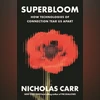
The subtitle of Nicholas Carr’s Superbloom: How Technologies of Connection Tear Us Apart is a pithy expression of the book’s central tenet. Mr Carr borrows the metaphor of superbloom from the phenomenon of excessive blooming of poppies in the Temescal Mountains, California in 2019. This phenomenon went on to become an internet sensation through #superbloom, and Mr Carr uses it as a metaphor for the era of excessive information, connectivity and communication in which we live. Then, with the help of history, he sets out to prove that beliefs like more communication is good communication don’t always hold true.
Superbloom has three parts. In the first, Mr Carr provides a detailed history of the development of mass communication services from a mostly American perspective, offering his readers a sweeping view of how the laws also changed and evolved in keeping with the rapidly evolving means of communication — at least in the beginning. He begins with the era of radio, moves on to the age of digital computers, followed by personal computers and the internet. This last era, he tells readers, presented a challenge before the lawmakers who were unable to fathom its power and the changes it will bring about in a very short span of time.
The second part begins with the ubiquity of email as it gradually comes to replace the traditional mail and discusses how instant messaging changed not only the language of communication but also what communication looked like for an entire generation. Mr Carr moves on to social media and argues against its “democratisation fallacy,” the belief that in giving everybody a voice and doing away with the difference between those who created and those who consumed information, internet and social media acted as great levellers and created spaces where everyone had equal power. In the third part, Mr Carr discusses artificial intelligence (AI) and large language models (LLMs) among other things, along with their probable impact as they become smarter.
Underlying all three parts of the book is the idea that not all communication is good communication. By referring to the works of various thinkers, researchers, and philosophers such as Charles Horton Cooley, Jean Baudrillard, Margaret Mead and others, Mr Carr goes on to show how excessive communication can have the opposite effect of what its supporters claim. He cites various researches and studies that prove how it’s easy for misinformation to spread faster than truth, how knowing too much about someone tends to foster animosity more than friendship, and how being always on display and peeping into lives of others through social media increases envy and reduces our capability to feel empathy as well as our self-awareness. Describing social media as a “neurosis machine” and comparing it to a bad parent or a cruel lover, Mr Carr points out that social media not only creates angst, but it also makes angst “cool”.
When it comes to AI, Mr Carr’s approach feels balanced and at a distance from the fear-mongering that pervades contemporary popular culture. For Mr Carr, the threat of AI and LLMs lies not in the fact that they might take away a lot of jobs or in an AI uprising, but in how big corporations will use them to generate an unlimited loop of content tailor-made to everyone’s smallest requirements, thus chaining people to their devices more than ever. A future world might very well become a “bot besotted world” where all actions and all assistance will be delegated to bots made to suit all our needs based on the data that we might have already provided to these big companies.
Mr Carr is very clear about identifying the blame for our predicament. While he blames the companies for exploiting the psychological chinks in the human makeup for their own benefits, he doesn’t let users go scot-free either. He refutes the idea of users being mere victims and suggests that our manipulation is “secondary to and dependent upon the pleasure” that we derive from social media. Mr Carr is unable to give readers a concrete solution, though; perhaps in a rapidly evolving world, it would be too much to demand of him. He concludes his book with simple, perhaps even simplistic, advice but it makes sense. Only “wilful acts of excommunication,” he says, can help us if we don’t want to live by someone else’s code.
Superbloom makes use of many theories and researches to drive home its point. This gives it gravitas and makes it more than just a long opinion piece. Though by no means a breezy read, the tone and writing style make Superbloom readable and engaging by providing readers a glimpse of what the future might look like, and urging due caution.
The reviewer is an independent writer and translator