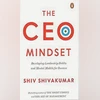
THE CEO MINDSET
By Shiv Shivakumar
Published by Penguin
240 pages ₹599
This is not the first book on leadership. The bookshops are overflowing with umpteen leadership books. Readers are intrigued about which ones to read, and later, to contemplate whether they learnt anything useful. Leadership books pose a dilemma as much as leadership itself does! This comment should not be interpreted as meaning that such books are of no value. It merely implies that there are multiple leadership lessons that are possible for successful leaders to share. There are books that teach you lessons from sports, from mythology, from political leaders, and from business leaders. Many books extol the virtues of the author or the protagonist.
My personal experience has been that lessons about “great men” can inspire people, but lessons from personal acquaintances instruct people! I learnt and practised great lessons from my father and physics teacher but was surely inspired by lessons from Mahatma Gandhi and Abraham Lincoln. My perception is worth mentioning as I write about this distinctive book by S Shivakumar. It is also fair to mention that Shiv has been a long-time colleague at Unilever, a good friend, and an active professional colleague. Having made the statutory disclosures, what is the book about?
It is an unusual repository of leadership behaviour and mindset. Which is more important: Behaviour and mindset on the one hand or actions and practices on the other? Many leadership books focus on action and practices. Shiv’s book focuses on the former, almost exclusively. Look at the chapter titles: CEO Mindset, Engagement to Build Trust, Teamwork, and so on. Why are mindset and behaviour so important? Because actions and practices emanate from them.
If a person is deeply convinced that he or she is elite (great schools and pedigree) or is a constant pusher (get it done regardless) or is an eloquent demagogue (can speak on anything mesmerisingly), those mindsets will influence his or her leadership behaviour. Have you not encountered MAFA leaders, who Mistake Articulation For Action? Have you not seen ZING leaders who make a supreme virtue of presence and personality?
Subordinates judge you all the time. Make no mistake, the higher the monkey climbs, the more of his backside is seen by those below. Shiv’s book addresses mindset and behaviour as a priority. The book does not refer constantly to great and famous leaders, nor what smart things he himself did. The examples are about situation references and to common bosses whom he has encountered.
One chapter is about the emerging mantra of corporate governance. Due to developments in laws and practices, every retiring bureaucrat and business leader thinks he or she should secure a director’s role. Shiv has sane advice for them. Yes, as a director, one can contribute to the CEO’s thinking even if one is from a different domain, but one must never try to do the job of the CEO. A director should be a great listener rather than a great talker. The director should bring in an outside-in point of view rather than second guess the insiders.
Shiv makes out a case for CEOs to receive coaching by making an explicit statement that “CEOs underestimate the power of coaching.” He explains how CEOs can be good coaches to their subordinates as much as receiving good coaching advice from the CEO’s own coach. He points out correctly that “coaching others is about asking questions so that the person unearths the answers for himself or herself. This requires time, effort, emotional honesty and commitment.” When I interviewed top CEOs such as A M Naik, Deepak Parekh, Uday Kotak and so on for my book series on how institutions can be built, I asked how much of their time as CEO is spent on people matters, the stunning, but consistent reply was in the range of 25-35 per cent!
An interesting chapter is titled “Dealing with an insecure CEO.” How do you recognise an insecure CEO? Shiv advises to watch their behaviour, watch their words. How do you spot an insecure CEO? Shiv suggests looking out for: (i) laying the blame on someone else; (ii) rarely taking feedback; (iii) having all the answers; (iv) failing to delegate; (v) not celebrating others’ successes. The list is long, so buy the book! He also suggests that you cannot prevent a CEO from feeling insecure but offers a few handy tips for readers.
Shiv also has some novel expansions of the acronym CEO — chief ecosystem officer, or chief engagement officer, or chief emotions officer, or chief education officer. Each such expansion is accompanied by explanations and examples. The chapter seems to eulogise the CEO as a sort of demigod, but believe me, it is practical and mind stimulating.
The genre of leadership books in enterprise and management should have many more authors. I think of the cemetery as the world’s richest place because a lifetime of professional experiences is interred every day without any record of the lessons that the interred person has learnt during the career. What a pity!
Shiv’s book is a welcome addition to the literature on leadership in the Indian context. I say this because each vignette adds to the palette, and there are eager students to appreciate every palette.
The reviewer is author and corporate commentator