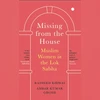
Missing from the House: Tracing the political legacy of Muslim women MPs

Despite exclusion and patriarchy, 18 Muslim women have entered the Lok Sabha to date - but their absence from public discourse is stark. This book recalls their political legacy

Missing from the House: Muslim Women in the Lok Sabha
Neha Bhatt
5 min read Last Updated : Sep 24 2025 | 12:40 AM IST
Missing from the House: Muslim Women in the Lok Sabha
by Rasheed Kidwai and Ambar Kumar Ghosh
Published by 
Juggernaut
270 pages  ₹599
 

Also Read

In 1957, state legislator Maimoona Sultan from Bhopal made history by becoming one of the first two Muslim women elected to the Lok Sabha. The other was Mofida Ahmed from Assam. This was groundbreaking at a time when women had a minor representation in Indian politics, much less Muslim women. Sultan served two consecutive terms, and her ability to connect with voters across religious and social lines and her eloquence and progressive approach made her stand out in the crowd.
 
To date, there have been just 18 Muslim women elected to the Lok Sabha since 1952. And yet the stories of those who made it to that list despite systemic exclusion, patriarchy and religious orthodoxy remain little known.
 
Missing From the House is a book that aims to remedy their omission from public discourse and call attention to their political legacy. It also highlights that, among 70 million Muslim women in India, the fact that too few have been elected to power is closely tied to their low participation in the workforce. Authors Rasheed Kidwai and Ambar Kumar Ghosh work with the limited material available in the public domain to draw a handy portrait of these pioneering women and how they shaped India’s politics in their own way. What follows is an analytical account of their political journeys, while assessing their performance as parliamentarians. The authors also place them within India’s democratic framework, to examine and how it may have empowered them to step into politics.
 
This lends itself to a number of fascinating stories and insights. A sizeable number of them, note the authors, come from dynastic families and regions such as Bengal, Assam and Uttar Pradesh, and were propelled into power with the support of family members. Some of them entered politics only after the unexpected deaths of their husbands, such as Abida Ahmed, the wife of India’s fifth President, Fakhruddin Ali Ahmed, who was persuaded by Indira Gandhi to join active politics after she lost him. Even before she entered politics, Ahmed was the first visible and socially active First Lady in the then 24-year history of the republic, the authors write.
 
Other Muslim women leaders are remembered for playing a role in historic events. For instance, Congress leader and former minister Mohsina Kidwai from an aristocratic Uttar Pradesh family, now 93, found herself caught in the middle of a hijack of a Lucknow-Delhi-Kolkata plane in 1978. The hijackers said they would release the plane only if she asked them to. Despite the advice given to her at the time to apply for anticipatory bail, she handled the horrific situation tactfully. Disaster was averted. Several such compelling anecdotes from her political life, including important moments with Indira Gandhi, made it to her memoir, My Life in Indian Politics (also written by Rashid Kidwai).
 
There are other stories of personal tragedies followed by acts of political courage and success. One of them is of Sajda Ahmed, who was fielded by Mamata Banerjee from Uluberia in West Bengal in 2018 after her husband, popular TMC leader Sultan Ahmed, who was Ms Banerjee’s close confidant, died suddenly. She won by a record margin, increasing the vote share by 13 per cent from the last Lok Sabha elections.
 
Yet other essays tell us about the complexities a modern Muslim woman leader faces. After 31-year-old Iqra Hasan, the London-educated Samajwadi Party MP won from Kairana in 2024 and became a social media sensation, she is often asked why she wears a hijab (she told the media it was a “secular” act rooted in social and cultural traditions of her region). For Nusrat Jahan, the first Muslim superstar in Bengali cinema and MP, online trolling, intense speculation on her personal life and corruption scandals overshadowed her political work.
 
In the epilogue, the book notes that some women politicians, such as Subhashini Ali and Afrin Ali, were left out of the list due to their self-confessed lack of “Muslimness”, so over several pages in this section, the authors highlight the importance of their work.
 
What’s missing from the book are first-hand interviews, which would have made it more engaging. The reliance on secondary sources occasionally results in a somewhat flat, uneven retelling, capturing the broad strokes but lacking vivid, personal details to make their stories whole. The book works better as a sum of its parts, with some essays more detailed and nuanced, while others more cursory.
 
All the same, the book spotlights an important subject and hints at buried stories, with each account a world unto itself. Perhaps it is best read, as the authors themselves suggest, as a foundational effort to document the political legacies of these personalities, meant to inspire deeper, more expansive explorations.
 
The reviewer is an author and journalist based in Delhi who reports on public health, policy, gender, and culture

One subscription. Two world-class reads.

Already subscribed? Log in

Subscribe to read the full story →
*Subscribe to Business Standard digital and get complimentary access to The New York Times

Smart Quarterly

₹900

3 Months

₹300/Month

SAVE 25%

Smart Essential

₹2,700

1 Year

₹225/Month

SAVE 46%
*Complimentary New York Times access for the 2nd year will be given after 12 months

Super Saver

₹3,900

2 Years

₹162/Month

Subscribe

Renews automatically, cancel anytime

Here’s what’s included in our digital subscription plans

Exclusive premium stories online

  • Over 30 premium stories daily, handpicked by our editors

Complimentary Access to The New York Times

  • News, Games, Cooking, Audio, Wirecutter & The Athletic

Business Standard Epaper

  • Digital replica of our daily newspaper — with options to read, save, and share

Curated Newsletters

  • Insights on markets, finance, politics, tech, and more delivered to your inbox

Market Analysis & Investment Insights

  • In-depth market analysis & insights with access to The Smart Investor

Archives

  • Repository of articles and publications dating back to 1997

Ad-free Reading

  • Uninterrupted reading experience with no advertisements

Seamless Access Across All Devices

  • Access Business Standard across devices — mobile, tablet, or PC, via web or app

Topics :BOOK REVIEWbooksMuslim womenParliamentBook readingBS Reads

Next Story