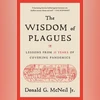
The Wisdom of Plagues: Lessons From 25 Years of Covering Pandemics
by Donald G. McNeil Jr.
Published by Simon & Schuster India
382 pages ₹699
The collective wisdom of past plagues reveals much about the state of the world: Its fault lines, its interconnectedness, its vulnerabilities. But as veteran journalist and former New York Times science and health reporter Donald G McNeil Jr observes in The Wisdom of Plagues, while societies today are well-armed to remain on guard against military threats, aided by elaborate detection mechanisms, our disease-alert systems remain far less sophisticated with “inherent flaws”. “In practice, the WHO’s systems have not worked very well. I can’t think of a single serious outbreak I learned of first from them,” he writes.
When Mr McNeil first saw a notice on a disease-alert service on December 31, 2019, about unexplained pneumonia cases linked to a seafood market in Wuhan, he thought it sounded suspiciously like the way SARS began. At first distracted by other deadlines, McNeil writes he quickly sensed a public health crisis looming well before political leaders believed it, and recounts his furious email exchanges with colleagues and editors to warn them of what may lie ahead. Yet through his career, covering public health, epidemics and infectious disease across 60 countries, he has often wrestled with the question of whether he was too alarmist, or not alarmist enough.
Now that we have something of a healthy distance from the Covid-19 pandemic, examinations of our response to it are finally taking different forms. As a prominent media voice during the Covid-19 pandemic, Mr McNeil offers a reporter’s perspective that’s both intriguing and expansive. He draws readers into the newsroom and in the field, and behind the scenes of the stories he wrote covering pandemics for over 25 years — including those that made the front page, those buried in the inside pages, and those dropped. At its heart, the book asks: What saves the most lives? It delivers a series of hard answers that can sometimes feel uncomfortable. He doesn’t try to walk the politically correct line or pander to ideals.
By placing Covid-19 within the larger history of other plagues such as AIDS, Ebola, SARS, and MERS, McNeil explores how each outbreak foreshadowed the next in terms of patterns, responses and impacts. In one of the early chapters, he compares the American response to AIDS to Cuba’s. “In the 1980s, as the United States protected civil liberties at all costs, health officials confidently predicted a vaccine and a cure within three years. Cuba, by contrast, chose the iron fist…..Forty years later, there is still no vaccine and no cure….During those forty years, more than 700,000 Americans died of AIDS. Fewer than 5,000 Cubans did.”
In his view, “the Western focus on personal liberty” and poor leadership cost the United States hundreds of thousands of more lives, whereas countries like Germany and Canada fared far better because their political leaders took the threats seriously from day one. The author acknowledges that his perspective on dealing with such outbreaks, including one of his articles that called for a “medieval” approach to fight Covid-19 makes him unpopular in some circles. It was “the saddest epidemics I’ve ever covered,” because his country not only ignored ways to control the virus proven by other countries but also rejected the vaccines in millions, he writes.
The book avoids medical and academic jargon, opting for a more conversational, at times exasperated tone as he recalls the stories behind the headlines. Through the many layers of news gathering and joining the dots, the author explores the social, psychological, and cultural forces, along with the political and medical structures, that dictate how pandemics move through populations. While Part One is a more informal reflection on pandemics, Part Two looks at the tangled roots of such diseases, and how they change society. Part Three goes deeper into the ways they spread globally, including in India, and the role of understanding crowd psychology in controlling them. McNeil also turns his attention inward, with an insider account of “Media’s Forced Errors”, and the sometimes insidious synergy between media outlets, politicians and health agencies and the issue of “sources deceiving reporters”, such as when he believes a group of scientists misled him early in the Covid-19 pandemic.
The last part of the book is largely prescriptive, with suggestions on ways to head off future pandemics: Including reforms like reducing global poverty, building a pentagon for disease, better surveillance, cheaper medicines, stricter mandates and a ban on religious exemptions.
The book doesn’t offer new data or research, but what it does successfully is offer journalistic context and a sharp perspective on a valuable subject, written with a fair dose of candour, without “trying to please anyone”.
The reviewer is a Delhi-based freelance journalist who writes on policy, development, public health, gender and culture