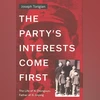
The Party’s Interests Come First: The Life of Xi Zhongxun, Father of Xi Jinping
by Joseph Torigian Published by
Stanford University Press
696 pages ₹4,581
American academic Joseph Torigian has attempted to write a biography of Xi Zhongxun, a senior member of the Chinese Communist Party (CCP) and the father of Xi Jinping. This effort is commendable given the CCP’s opaque nature. Writing a free and open biography is tougher because, as the author explains, the “weaponisation of Xi Zhongxun’s life by both his son’s detractors and his son’s boosters, as well as by the inherently political nature of party history … raises serious challenges for any potential biographers.”
The title of the book is rooted in a well-worn anecdote. “During the revolution, Mao often gave short, pithy formulations to characterise his favourite cadres. For Xi, Mao wrote the words, ‘The party’s interests come first’ on a white cloth and gave it to him as a gift. It became one of Xi’s most treasured possessions.” It also became the driving force for his political and personal life.
Meticulously written and displaying thorough archival work, the book is full of anecdotes. It is possible to argue that the senior Xi’s life overlaps with the life of the CCP. In fact, this book could be regarded as an alternative party history, one that is more humane, believable and less sanitised. Xi Zhongxun’s struggles and relationships with the party and leaders, especially Mao Zedong and Deng Xiaoping, underscore the difficulty of understanding the functioning of the CCP. Given the huge timeline it covers, the book reveals the existential challenges the CCP has also faced. Tracing key national, international and even personal developments and incidents, the book shows why stability and peace became the party’s driving narrative. The author shows the interconnectedness between the party and Xi Zhongxun when he writes that, “Xi’s behaviour during land reform and especially his self-criticisms are enormously revealing both in terms of what they tell us about him as an individual and also about the Communist Party as a system”.
In his long political life, Xi Zhongxun was critical in determining the CCP’s policies towards the minorities, religious groups, media, culture and the United Front. He was one of the first to formulate policies towards the minority regions and how they should be accommodated within the People’s Republic of China. He is known for his close relationship with the Tibetan population. “Of all Xi’s friendships with the Muslim and Tibetan figures that began at this time, by far the most significant was his relationship with the tenth Panchem Lama. During the following several decades, this relationship would prove fateful not only for the two men themselves but also for the entire trajectory of Tibetan history,” Dr Torigian says.
The Cultural Revolution had a major impact not only on the party but Chinese history and society as well. After it officially ended, there were multiple efforts to make sure it was never repeated. But the CCP has had a history of purges and persecution before and after the Cultural Revolution. Every leader and party member was stuck in a cycle of trust and mistrust, being labelled a rightist or a leftist all rooted in the insecurity of the central leadership. “The enduring nature of the system proved more powerful than the lessons it taught,” Dr Torigian writes.
This is also rooted in the desire to hold on to power. The author points out, “It shows that power is tricky, slippery, and contingent even for an organisational weapon like the party.... Xi himself whispered privately that power corrupted.” When it comes to sharing power the party has drawn a thin line between criticism and challenge. Even today, the party grapples with the notion of “… how to empower potential allies and include them in governance without giving up control.”
Xi Zhongxun and his family suffered persecution during the Cultural Revolution. Still, “the party’s interests come first”. What drove such loyalty? It is possible, as the author suggests, that Xi Jinping could not betray the party for which his father had sacrificed so much. Xi Zhongxun also exemplifies the kind of person the party has created. “During his career, Xi Zhongxun had his setbacks, but he did succeed in one regard: He established a reputation as the very best kind of individual that the party could produce,” Dr Torigian writes.
Dr Torigian has provided a detailed and nuanced portrait of Xi Zhongxun’s life, but he offers the caveat: “… despite the findings provided in this book, many aspects of Xi’s life remain a mystery”. So much would have been discussed and argued within closed doors which the world will never know. The book is best read as a text that provides a peek into the opaque world of the CCP and could possibly help one understand Xi Jinping’s thought processes.
The reviewer is associate professor, OP Jindal Global University