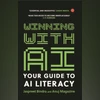
Winning with AI: Your Guide to AI Literacy
by Jaspreet Bindra and Anuj Magazine
If all the hype about artificial intelligence (AI) is giving you sleepless nights because you feel clueless and unprepared, pick up a copy of Jaspreet Bindra and Anuj Magazine’s book Winning with AI: Your Guide to AI Literacy. Written for beginners, it covers the basics so quickly and effortlessly that you might wonder why it took you so long to get started. It also helps readers wrap their head around jargon such as machine learning, natural language processing, large language models, computer vision, tokens, sessions, prompts, and agents, among other terms.
Jaspreet Bindra is the co-founder and chief executive officer of AI&Beyond, a company that employs human beings as well as AI agents to build “AI literacy” in organisations. Anuj Magazine is the co-founder and chief technology officer of the same company. They write from a wealth of experience in the corporate sector. The former has worked at Microsoft, the Mahindra Group and Tata Administrative Services. The latter has worked at Walmart, Citrix, McAfee and Quark.
What does “AI literacy” mean? Defining it seems to be an important task because words such as “emotional literacy”, “financial literacy”, “digital literacy” and “media literacy” have been in circulation for a while, and one no longer associates literacy only with the ability to read and write. According to this book, literacy involves learning the “patterns, structures and grammar” of a language so that one can build on these to “read a story, write a poem or make sense of your bills”. Similarly, the authors argue that familiarising themselves with the fundamentals of AI as a language in its own right will equip individuals to be ready for “higher-order functioning”.
As experts in providing advisory and consulting services to organisations on their AI road maps, and facilitating workshops and bootcamps, the authors are brilliant at demystifying their subject, which is scary for many who lap up the panic and paranoia on social media without actually trying out AI. The authors’ calm and confident approach makes AI seem less monstrous than it is made out to be. They talk about AI neither as a godsend nor as a necessary evil. Instead, they treat it as a reality that is present, needs to be acknowledged, and can be used to one’s advantage. This is a mature way to deal with changes in one’s environment rather than living in denial.
Drawing from the Microsoft LinkedIn Work Index Report (2023), the book classifies AI users into four categories — sceptics, novices, explorers, and power users — based on their proficiency, adoption and comfort levels with respect to AI. It adds a fifth category: Advanced AI users. The road map that one can follow to move from being a sceptic to an advanced user is broken down into five simple steps: Reads, writes, adds, thinks and does. One begins with using AI “to better learn and absorb content”, progresses to creating videos and presentations with the help of AI, then moves on to data-driven decision-making, ventures into product development and innovation, and eventually uses AI to expedite work by delegating it to AI agents.
These wide-ranging possibilities of AI would be an eye-opener for those who have been turning to ChatGPT and Gemini mainly as substitutes to Google Search and Wikipedia. The book shows how to employ AI as a brainstorming partner, an assistant, and even a secretary. It introduces readers to AI tools such as Perplexity, Claude, Microsoft Pilot, Grok, and more, along with their applications. It shares best practices on framing prompts to get relevant and high-quality outputs. At the same time, the authors caution against placing unshakeable faith in the wonders of AI. They talk about “critically evaluating AI-generated outputs” for accuracy and reliability. In response to concerns about privacy, they also offer guidance on how to keep one’s data safe.
The book is targeted at business leaders, educators, marketers, lawyers and students to help them “integrate AI into their workflows, enhancing their efficiency, creativity and decision-making capabilities”. Thankfully, the authors do not get too carried with their technological optimism. They are aware that AI “will render some jobs obsolete”. Instead of painting a dreadfully gloomy scenario, they encourage readers to empower themselves. They note, “It is not AI that will take your job, but someone using AI who will. So, it is incumbent on you to learn how to work with AI and remain relevant for this new era — to become the replacer rather than the replacee!”
The authors point out, for instance, that employees will have to reorient themselves to be part of teams comprising humans as well as AI agents. One wonders what this not-so-distant future will mean for office friendships, workplace romances, and informal mentor-mentee relationships. This book is more about getting work done, so it does not reflect deeply on human bonds but that is a glaring absence since workplaces often fulfil social, intellectual as well as emotional needs.
The reviewer is a journalist, educator and literary critic.
Instagram/X: @chintanwriting

 "Winning with AI: It's not AI, but users of AI, who'll take your job")











