5 min read Last Updated : Mar 25 2025 | 7:06 AM IST
By Mihir S Sharma
India’s policymakers should be drawing up strategies to deal with the new age of trade barriers. Instead, they seem to be looking forward to it with a certain confidence, even optimism. There is none of the concern or outrage visible in other countries that US President Donald Trump has targeted.
Indeed, if anybody nourished a vague hope that Trump would fail to impose tariffs on Indian exports, the man himself dashed them last week. Duties would be imposed on goods coming into the US from April 2, he said in an interview to Breitbart News, adding for good measure that India was “one of the highest tariffing nations in the world.”
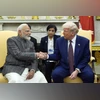
Perhaps New Delhi is taking comfort from the promise Trump made during Prime Minister Narendra Modi’s recent visit to Washington that a new trade deal between the two countries would be signed by the fall. It is of course possible that the White House wants these new levies from April as an encouragement to India’s famously refractory negotiators. Trump said himself that he believes that New Delhi will be lowering tariffs “substantially” as a consequence of his actions.
It isn’t as if Indians don’t recognize that US duties might hurt their exporters. Certainly, some in business — particularly those that have scaled up shipments to American markets in recent years — are far from happy. But, particularly in recent weeks, as the level of Trump’s determination to remake global trade has sunk in, leaders have begun to think that its exporters might have a fighting chance in this new era.
But what most outsiders identify as optimism is actually the opposite: A deep pessimism that Indian manufacturing will ever be productive and efficient enough to compete on its own terms. Officials in New Delhi are actually quite open about this. Like the American president, they blame previous administrations for signing trade deals that they insist led to de-industrialization, and are nostalgic for a world where bureaucrats, not the bottom line, determined the flow of trade.
Indian producers losing out to China was bad enough. But it is the fact that the country’s trade deficit with Southeast Asia expanded manifold after a free trade agreement came into force that has scarred many in industry and government. They are now convinced that Indian manufacturing may never be able to produce things more cheaply or with consistently higher quality than its peers.
A nation that thinks it can’t win on either cost or quality will naturally welcome a third axis. Let other emerging economies worry that tariffs and restrictions will act as a disadvantage for them against the West’s domestic producers. Indians can hope that this additional factor acts as an equalizer for its producers when compared to the rest of the emerging world.
After all, India has privileges the others do not, and isn’t afraid to use them. Its economy has size, its policies reliability. It is a geopolitical and geo-economic swing state. All of these add heft to any trade negotiations it enters. Many Indians, both in the business world in Mumbai and in the corridors of power in New Delhi, believe that if we play our cards right in bilateral negotiations with countries seeking our favor, then we can win better deals than anything the multilateral trading system gave us. Our negotiators will win what we have lost on the factory floor.
It doesn’t matter, therefore, if Trump raises tariffs on India as long as he is even tougher on everyone else. Any fear felt by those who currently export to the US from India would be temporary. Eventually, India’s global prestige will deliver its exporters the competitive advantage they could never win on their own.
I don’t know if this attitude will survive the year. There is, after all, another way that India is special: Its domestic market has potential. We don’t know if Trump even cares about US companies’ market access in Thailand or Bangladesh. But there’s plenty of evidence that he wants them to be competitive in India. Instead of being better placed than its peers, Indian trade might find itself uniquely disadvantaged — faced with extra-high barriers demanded by leaders, like Trump, who overestimate Indian producers’ efficiency and competitiveness.
Export pessimism is a disease in India, and one that has become so endemic that we appear optimistic when faced with disruptions to trade. In this new age, like in the last, Indians will learn the same lesson: Your leaders can’t grant you some shortcut to competitive success. You still have to produce things cheaper and better to win.
(Disclaimer: This is a Bloomberg Opinion piece, and these are the personal opinions of the writer. They do not reflect the views of www.business-standard.com or the Business Standard newspaper)

 "Here's why India's confidence about Trump's trade tariffs is deluded")


