


Before Trump's tariffs, there was Bush's war wagon: How India deflected it
As Donald Trump pressures India to align with his tariff policy, here's recounting how New Delhi navigated a similar situation with another US President over 20 years ago
 "Atal Bihari Vajpayee, George W Bush")
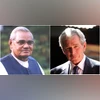
File images of Atal Bihari Vajpayee and George W Bush (R). (Photos: bjp.org/Facebook/George W Bush)
Listen to This Article
On March 19 (ET), US President Donald Trump reiterated his April 2 deadline for countries with high tariffs on American goods to reduce them or face reciprocal measures. While Trump expressed confidence that India would lower its tariffs before the deadline, he warned that his administration would impose equivalent tariffs on Indian goods if it did not.
Trump's tariff rhetoric has triggered a swift response from the Indian government. Reports suggest that discussions are underway on possible tariff reductions on various products, including automobiles, chemicals, agricultural goods, and pharmaceuticals. However, the Congress-led Opposition has criticised the Narendra Modi government's response to Trump's tariff threats, labelling it as "inadequate and submissive."
India faced a similar situation over 20 years ago, when another US President tried to force New Delhi's hand to shed its balanced and independent foreign policy. Former US President George W Bush put significant pressure on India and other nations to join his war in Iraq. But New Delhi manage to evade the US' advances, thanks to the skilled leadership of then Prime Minister Atal Bihari Vajpayee.
Here's a deep dive into how Vajpayee worked with the Opposition to deflect the US' advances.
The 2003 Iraq war
In the aftermath of the World Trade Centre attack in 2001, the US adopted a more aggressive stance in its foreign policy, leading to the declaration of a "War on Terror." The Bush administration accused Iraq of possessing weapons of mass destruction (WMD) and alleged links to terrorist organisations, including involvement in the 9/11 attacks. These claims were used to justify the invasion of Iraq in March 2003.
Also Read


 "Elon musk, musk, Elon")
 "Donald Trump, Trump")
 "US China flag, US-China flag")
Despite extensive investigations and UN weapons inspections failing to uncover evidence of active WMD programs or Iraq's direct involvement in the 9/11 attacks, the US proceeded with the invasion, citing self-defence and the promotion of freedom as reasons for unilateral action.
George Bush's outreach and problems for India
In its efforts to build a broad coalition, the US sought support from various nations, including India. The Bush administration viewed India, a historically non-aligned nation, as a strategic partner in the fight against terrorism and aimed to lend international legitimacy to its actions. Bush requested the Indian government to contribute a division of troops, approximately 17,000 soldiers, to join its war in Iraq.
The prospects of participating in the war had diverse implications for India. On one hand, participating in the war could enhance India's relationship with the US, potentially leading to support for India's aspirations for a permanent seat on the UN Security Council and recognition of its nuclear status. On the other hand, there were significant domestic and regional considerations.
Economically, there were apprehensions about the potential rise in crude oil prices and the safety of millions of Indians working in the Gulf region. The destabilisation of the Middle East could have direct adverse effects on India's economy and energy security.
Moreover, aligning with the US invasion without UN authorisation could set a precedent undermining international law, which India, as a developing nation, had a vested interest in upholding.
The war also went against India's strategic autonomy and non-alignment policy. Joining the US-led invasion could have been perceived as a departure from these principles, potentially limiting India's flexibility in international affairs.
Vajpayee's statesmanship to the rescue
Atal Bihari Vajpayee, who led a coalition government at the Centre, faced a complex decision. While he was against Bush's idea, his deputy LK Advani was in favour. In fact, Advani, on a visit to Washington, even promised Bush military support in Iraq.
Vajpayee was cautious about engaging India in a conflict that lacked clear international support and had uncertain outcomes. He was also mindful of preserving India's independent decision-making in foreign policy matters.
Recognising the importance of a unified national stance, Vajpayee engaged in extensive consultations with opposition parties and coalition partners to build a consensus that reflected the broad-based opposition to the war. These included the Left parties, which were vehemently against the war and leading street protests.
According to a report in The Indian Express, Harkishen Singh Surjeet and AB Bardhan, the then general secretaries of the CPM and CPI, respectively, were surprised when they got an invite from the PMO for a breakfast with Vajpayee.
During the meeting, Vajpayee told them about the pressure from the US and asked about their ongoing protests. Surjeet and Bardhan replied that the public response to the protests was encouraging. “But I can’t hear anything,” Vajpayee quipped, signalling that he wanted the Opposition to make more noise so that he could use domestic opposition to fend off US pressure.
Soon, Parliament passed a unanimous resolution deploring the US-led invasion, reflecting national sentiment against the war. Vajpayee's government communicated this decision diplomatically to maintain the positive trajectory of US-India relations. The US acknowledged India's decision, emphasising that it would not affect the improving overall relationship between the two countries.
By involving diverse political voices, Vajpayee ensured that the decision to abstain from the conflict was not seen as partisan but as a reflection of national interest. This approach reinforced India's democratic values and showcased Vajpayee's statesmanship.
More From This Section
 "Union Home Minister Amit Shah")
 "Deported Indians")
 "India-Pakistan, India-Pakistan flag")
 "Tulsi Gabbard, Tulsi, Gabbard")
 "Mumbai terror attack, 26/11 attack")
Topics : Donald Trump Atal Bihari Vajpayee Trump tariffs US India relations George W Bush Iraq BS Web Reports
Don't miss the most important news and views of the day. Get them on our Telegram channel
First Published: Mar 21 2025 | 6:02 PM IST