India’s marine product exports facing rough weather from punitive US tariffs are expected to get a big boost following the reduction of 26 per cent tariff as part of the India-EU Free Trade Agreement (FTA), but concerns over non-tariff barriers, which are a dominant aspect of marine trade to the EU, still remain.
In fact, non-tariff barriers could act as a big hurdle for easier access for Indian farm products to the EU as it has some stringent testing and phytosanitary standards.
“We will conduct impact assessments to analyse potential alignment of production standards between domestic and imported products, notably on pesticides and animal welfare, and increase the number of food safety audits to third countries,” an EU statement read.
As per Nitin Awasthi of InCred Research, for India, the EU market was historically constrained for India’s marine products because of a combination of tariffs in the range of 4 percent-12 per cent, and stringent compliance norms (non-tariff barriers) which caused huge delays and rejections.
All this led to costs even higher than the duty which now is at the cusp of reopening meaningfully, Awasthi said.
Late in 2025, the EU had already approved 102 new Indian processing units and in every month of CY25, marine exports from India to EU rose sequentially, with exports in recent months touching nearly 20% EU market share on a monthly basis. It has a potential to become 500,000 tonnes per year export market for Indian marine products, inCRED said.
In 2023-24, as per official data, India exported around 192,505 tonnes of marine products to the EU worth at around Rs 8461 crore while it exported 329192 tonnes to the US worth at around Rs 21,000 crore.
From the EU side, among other major items, imports tariffs on olive oil, margarine, and other vegetable oils will be brought down from the existing 45 per cent to zero in the near future. So also on sheep meat, from 30 per cent to nil.
Trade sources said cheaper olive oil imports from the EU are of little concern as olive is one of the costliest edible oils sold in India and is used only for dressing of food products. For sheep meat too, traders said it will cater only to the niche markets.
India imports around 20,000-25,000 tonnes of olive oil largely from Spain and Italy in the EU every year, but it is priced at around ₹700 per litre, which is far higher than the cheapest available edible oils in India priced at around ₹110-150 per litre.
“Even if the duty is lowered, it would not have much impact on prices and virgin olive oil would continue to be one of the costliest available edible oils in India,” said B V Mehta, managing director of Solvent Extractors Association of India. Also, olive has a “smoke-point” of around 180 degrees, which is not suitable for Indian cooking where the average “smoke-point” of oil is around 240 degrees.
However, when it comes to other vegetable oils, the other item mentioned in the list of agricultural goods on which India will lower tariffs, Mehta said it could include rapeseed oil as the EU is a major producer of this oil.
Meanwhile, on marine, the official statement said that the preferential market access covering 100 per cent of trade value, by reducing tariffs of up to 26 per cent, will unlock the EU marine market for imports of around ₹4.67 trillion ($53.6 billion).
This enhanced market access is expected to significantly improve the competitiveness of India’s marine exports while complementing and strengthening India’s export capacity in the marine sector, currently valued at ₹8,715 crore ($1 billion), to the EU, the statement added.
It claimed that the FTA will turbo-charge exports of shrimp, frozen fish, and value-added seafood exports to the EU, empowering coastal communities in Andhra Pradesh, Gujarat, Kerala and beyond, as well as India’s blue economy.
The government statement also said that India has secured preferential market access for its agricultural exports, boosting competitiveness for processed foods, tea, coffee, spices, table grapes, gherkins and cucumbers, sheep and lamb meat, sweet corn, dried onion, and some other fruit and vegetable products while safeguarding sensitive sectors like dairy, cereals, poultry, soymeal, certain fruits and vegetables, etc.

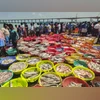 "India-EU FTA to boost marine exports with tariff cuts of up to 26%")

