China held its largest military parade yet on Wednesday to commemorate the 80th anniversary of Japan’s defeat in World War II, unveiling for the first time some of its most advanced weaponry.
The event, held in Tiananmen Square, displayed modern arms as part of President Xi Jinping’s campaign to present China as both a global power and a nation of military strength.
The ceremony began after Xi’s address, in which he spoke of the “immense national sacrifice” made by the Chinese people against the “war of resistance against Japanese aggression”.
He called it a full triumph over foreign invaders and emphasised that peace can only be maintained through global cooperation.
After Xi's speech, formations of troops and aircraft filled the skies. Helicopters carried banners reading “Justice Will Prevail", “Peace Will Prevail", and “The People Will Prevail", while another formation created the number “80” in honour of the anniversary, NBC News reported.
Naval power: YJ-class, undersea drones
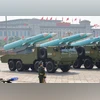
For the first time, China publicly displayed its YJ-class anti-ship ballistic missiles, including the newly developed YJ-17, described by state media as enhancing the navy’s capacity for long-range strikes.
China also unveiled ChangJian-20A, YingJi-18C, and ChangJian-1000 cruise missiles during the military parade, showcasing long-range, precise strike and multi-domain deterrence capabilities, state media said.
Alongside these, the People’s Liberation Army (PLA) showcased undersea drones, new torpedoes, and the latest version of the Dongfeng missile series, some of which are capable of carrying nuclear warheads to targets across the Pacific, including the United States.
Army: Battle tanks, radar systems
Crowds applauded as nuclear-capable intercontinental ballistic missiles rolled past, followed by China’s first fourth-generation main battle tank, equipped with an unmanned turret, radar systems, protective technology, and augmented reality features.
Air power: J-20 stealth fighters
Squadrons of J-20 stealth fighters, an important project of the Chinese air force, conducted aerial manoeuvres, joined by J-10 combat jets. Cargo planes, bombers and helicopter units added to the display.
Finale: 80,000 doves and balloons
The parade ended with fighter jets releasing streams of coloured smoke before reportedly 80,000 doves and balloons were set free over the square.
The parade saw the participation of more than 10,000 military personnel and more than 100 aircraft, and hundreds of ground armaments.
Putin, Kim, and 24 other global leaders attend
The parade saw 26 foreign leaders in attendance. Russian President Vladimir Putin, North Korean leader Kim Jong Un and Iranian President Masoud Pezeshkian were among those seated alongside Xi. This marks the first time Xi, Putin and Kim were seen together.
From South Asia, Pakistan’s Prime Minister Shehbaz Sharif, Nepal’s K P Sharma Oli and Maldives’ President Mohamed Muizzu were also present.
Japan, Taiwan criticise China's parade
China’s insistence on highlighting the Communist Party’s role in World War II was criticised by both Japan and Taiwan. Tokyo had urged world leaders not to participate, a move that sparked a diplomatic protest from Beijing.
The anniversary coincides with renewed Chinese efforts to assert territorial claims in the South China Sea and around Taiwan. It also comes amid strains between the United States and China, among other nations, as US President Donald Trump pushes for new trade deals and implements tariffs on all its trading partners.
The victory day parade also showed the progress made by China in modernising its military, a goal Xi aims to accomplish by 2035.

 "Drones, stealth jets & 80k balloons: Inside China's largest military show")


