Chinese Foreign Minister Wang Yi, who wrapped up a two-day visit to New Delhi on Tuesday, has promised his Indian counterpart S Jaishankar that Beijing will ease restrictions on exports to India of fertilisers, rare earth minerals, and tunnel-boring machines. Late in the evening, Beijing and New Delhi resumed border trade and direct flights.
Both sides also agreed to maintain a rules-based multilateral trading system with the World Trade Organization at its core, and promote a multipolar world that safeguards the interest of developing countries, a joint statement said.
The two ministers also prepared the ground for Prime Minister Narendra Modi’s visit to China later this month, his first since 2018, to attend the Shanghai Cooperation Organisation (SCO) summit in Tianjin. Modi and Chinese President Xi Jinping are due to hold bilateral talks on the sidelines of the summit and are expected to announce further steps to normalise relations between India and China. These could include the resumption of border trade, flights, and further de-escalation along the frontier.
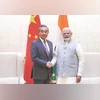
During his stay in New Delhi, Wang held delegation-level talks with Jaishankar on Monday evening. On Tuesday, he met National Security Adviser Ajit Doval for the 24th round of the special representative mechanism on the boundary question. Later in the evening, Wang called on the prime minister.
At their meeting, Modi stressed the importance of maintaining peace and tranquillity on the border and highlighted the steady progress in bilateral ties since his meeting with Xi on the sidelines of the Brics summit in Kazan, Russia, in October 2024. “I look forward to our meeting in Tianjin on the sidelines of the SCO summit,” Modi said in a social media post. He added that “stable, predictable and constructive ties between India and China will contribute significantly to regional and global peace and prosperity”.
Talks between Wang and Doval addressed issues of de-escalation, delimitation, and boundary affairs. The Indian side strongly raised the question of terrorism in all its forms, including cross-border terrorism, according to the Ministry of External Affairs (MEA).
Jaishankar also pressed India’s concerns about China’s mega-dam construction on the lower reaches of the Yarlung Tsangpo, or Brahmaputra river, warning of the consequences for lower riparian states. He emphasised the need for transparency, particularly in data-sharing on river flows.
China, meanwhile, raised the issue of Taiwan. Xinhua, the state-run news agency, reported that Jaishankar said Taiwan was part of China. But in its statement later that evening, the MEA underlined that India’s position had not changed: Like much of the world, it has a relationship with Taiwan focused on economic, technological and cultural ties, which would continue. The statement noted that China itself cooperates with Taiwan in these domains.
According to sources, Wang reassured Jaishankar that Beijing was addressing India’s requirements for fertilisers, rare earths and tunnel-boring machines. On Monday, Jaishankar had said he raised “particular concerns” during the meeting, without elaborating, adding that he had flagged them during his recent visit to Beijing.
The two countries were expected to issue a document outlining the outcomes of Wang’s meetings in New Delhi. At his talks with Wang, Doval noted there had been an “upward trend” in India-China relations over the past nine months, as peace and tranquillity had prevailed along the Line of Actual Control (LAC). He said the special representative-level dialogue had assumed “very special importance” in the context of the prime minister’s upcoming visit to Tianjin.
“The new environment that has been created has helped us in moving ahead in the various areas that we were working on,” Doval said.
Wang said both sides should “increase mutual trust through strategic communication, expand common interest through exchanges and cooperation, and properly settle the specific issues” along the borders. “We are heartened to see the stability that is now restored in the borders,” he said.
“Now the bilateral relationship is facing an important opportunity of improvement and growth. The Chinese side attaches great importance to the prime minister’s visit to China to attend the SCO summit at our invitation,” he added.
The MEA also announced that Jaishankar would travel to Moscow to co-chair the 26th session of the India-Russia Intergovernmental Commission on Trade, Economic, Scientific, Technological and Cultural Cooperation (IRIGC-TEC), scheduled for Wednesday.

 "China set to ease rare earth, fertiliser curbs: Foreign Minister Wang Yi")



