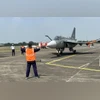
IAF to get first Tejas Mk1A this year; foreign buyers keen: HAL executives

The third Tejas production line was inaugurated in Nashik by Defence Minister Rajnath Singh, who also witnessed the maiden flight of the first Mk1A jet to roll out from it

Tejas Mk1A
Tejas Mk1A produced at HAL’s third production line in Nashik. (Photo: Bhaswar Kumar)
Bhaswar Kumar Nashik
4 min read Last Updated : Oct 17 2025 | 10:12 PM IST
Deliveries of the first Tejas Mark-1A (Mk1A) combat aircraft to the Indian Air Force (IAF) could begin this year, with several countries across South America, Africa, and Southeast Asia also expressing interest in the indigenous jet, Hindustan Aeronautics Limited (HAL) executives said on Friday at the inauguration of the company’s third Tejas production line at its Aircraft Manufacturing Division in Nashik.
 
The new Tejas production line was inaugurated by Defence Minister Rajnath Singh, who also witnessed the maiden flight of the first Mk1A jet to roll out from it. Singh also inaugurated the second production line for the Hindustan Turbo Trainer-40 (HTT-40), the indigenous basic trainer aircraft designed and developed by HAL. One of these trainers, along with a Sukhoi Su-30MKI, joined the Tejas in the air as the three flew in formation and performed acrobatic manoeuvres.
 
HAL’s Nashik facility also undertakes repair and overhaul of the Su-30MKI fleet. In the past, it has also produced nearly 1,000 Soviet- and Russian-origin jets under licence — 575 MiG-21s, 270 Su-30MKIs, and 125 MiG-27s.
 
Singh stressed that as warfare evolves rapidly, HAL must look beyond the Light Combat Aircraft (LCA) Tejas and HTT-40 to establish itself in next-generation combat aircraft, unmanned systems, and civil aviation.
 
On the sidelines of the event, company executives said deliveries of the Tejas Mk1A to the IAF would begin within this year, but only after the successful completion of the weapons-firing trials currently underway. “Ultimately, it’s a weapons delivery platform,” one of them said, adding that successful integration of the indigenous Astra beyond-visual-range missile, the British ASRAAM missile for close-range combat, and laser-guided bombs for ground attack was a critical requirement.
 
HAL missed the original February 2024 deadline to begin deliveries, primarily due to delays in the arrival of F404-IN20 engines from American manufacturer GE Aerospace. The company has already built around 10 Mk1A aircraft, though most are fitted with reserve engines as an interim measure. With GE handing over the fourth F404 engine on September 30, HAL expects the supply situation to stabilise. Successful weapons integration has been another challenge. Earlier, the company had assured that 12 Mk1A aircraft would be delivered by the end of 2025-26.
 
A fourth Tejas production line could also be set up in Nashik in the future if the growing interest from several foreign countries leads to export orders, HAL officials said. “We are receiving a number of enquiries from abroad, and if demand increases, we can add one more line here,” the company executive quoted above added.
 
While declining to name specific countries, they said the interest had come from various regions, including South America, Southeast Asia, and Africa. “We’ve got good leads, and there’s a lot of proactive support from the government,” the executive said.
 
The third line in Nashik has a current capacity of eight Mk1A jets a year. The company executives said that plans are in place to expand it to 10 aircraft annually within the next two years.
 
Together with the two existing lines in Bengaluru, the Nashik line will provide a combined annual production capacity of 24 Tejas Mk1A aircraft. HAL is also working with private partners to increase output to 30 a year by end-2027.
 
Deliveries of the first tranche of 83 Tejas Mk1A jets — contracted for ₹36,400 crore in February 2021 — were originally scheduled to be completed by February 2028.
 
In September, HAL received a follow-on order for a second tranche comprising 97 Mk1A aircraft — including 68 single-seat fighters and 29 twin-seat trainers — at a cost exceeding ₹62,370 crore. Deliveries under this contract are expected to commence in 2027-28 and conclude over six years.
 
The IAF, meanwhile, has operationalised two squadrons of the earlier Tejas Mk1 variant. The improved Mk1A variant is an indigenously designed, developed, and manufactured 4.5-generation fighter aircraft equipped with an active electronically scanned array radar, beyond-visual-range missiles, an electronic warfare suite, and air-to-air refuelling capability.

One subscription. Two world-class reads.

Already subscribed? Log in

Subscribe to read the full story →
*Subscribe to Business Standard digital and get complimentary access to The New York Times

Smart Quarterly

₹900

3 Months

₹300/Month

SAVE 25%

Smart Essential

₹2,700

1 Year

₹225/Month

SAVE 46%
*Complimentary New York Times access for the 2nd year will be given after 12 months

Super Saver

₹3,900

2 Years

₹162/Month

Subscribe

Renews automatically, cancel anytime

Here’s what’s included in our digital subscription plans

Exclusive premium stories online

  • Over 30 premium stories daily, handpicked by our editors

Complimentary Access to The New York Times

  • News, Games, Cooking, Audio, Wirecutter & The Athletic

Business Standard Epaper

  • Digital replica of our daily newspaper — with options to read, save, and share

Curated Newsletters

  • Insights on markets, finance, politics, tech, and more delivered to your inbox

Market Analysis & Investment Insights

  • In-depth market analysis & insights with access to The Smart Investor

Archives

  • Repository of articles and publications dating back to 1997

Ad-free Reading

  • Uninterrupted reading experience with no advertisements

Seamless Access Across All Devices

  • Access Business Standard across devices — mobile, tablet, or PC, via web or app

Topics :Indian Air ForceTejas Mark 1 ATejas jetFighter jet

Next Story