India and the United States (US) have signed a pact to deepen long-term strategic ties — a significant move amid the cooling bilateral relations.
On the sidelines of the Asean-plus defence ministers’ meeting on Friday in Kuala Lumpur, Defence Minister Rajnath Singh and US Secretary of War Pete Hegseth signed the framework for bilateral defence cooperation over the next decade.
In February, after a meeting between Prime Minister Narendra Modi and US President Donald Trump in Washington, DC, the two countries had announced that a new 10-year agreement on defence cooperation would be signed later this year. India and the US entered a strategic partnership in 2015.
But the 2025 pact was not a given. India-US relations are under strain: Trump’s announcement of 50 per cent tariffs on Indian goods and his repeated public claims that he stopped the India-Pakistan conflict in May by telling both countries he would not give them trade concessions unless they stopped fighting. The Indian government has denied Trump had any role to play in the ceasefire, which was proposed by Pakistan after Indian airstrikes.
“It is a signal of our growing strategic convergence and will herald a new decade of partnership,” Singh said on X after he met Hegseth.
The defence framework will provide policy direction to the entire spectrum of India-US defence relations, he said.
“Our defence ties have never been stronger,” Hegseth said on X after the meeting. Hegseth said the pact would advance bilateral defence partnership, which he described as a cornerstone for regional stability and deterrence.
“We’re enhancing our coordination, info-sharing, and tech cooperation.”
A leaders’ summit of the Quadrilateral Security dialogue, or Quad, which was supposed to be hosted by India this year, was not held, leading analysts to question the future of the grouping, comprising Australia, Japan, the US, and India, especially with China’s military and diplomatic expansion in the Indo-Pacific region.
“Defence will remain a major pillar of our bilateral relations. Our partnership is critical for ensuring a free, open and rules-based Indo-Pacific region,” Singh said.
At a time of increasing geopolitical uncertainties, Singh and Hegseth agreed to work together to address challenges, according to a media statement from the Ministry of Defence.
The statement added the secretary of war reiterated that India was a priority country for the US in defence cooperation and America was committed to working closely with India to ensure a free and open Indo-Pacific.
The 2025 framework is intended to provide “a unified vision and policy direction to deepen defence cooperation”. Singh and Hegseth reviewed the ongoing defence issues that persisted, and talked about the defence industry and technology collaboration, the statement said, without providing details.
Since 2008 India has spent more than $20 billion on defence procurement from the US.
In February, Trump complained of India’s $50 billion trade surplus with the US, and said that the US would increase military sales to India “by many billions of dollars” and “pave the way” to provide the F-35 stealth fighters.
A joint statement then said the US would sell anti-tank guided missiles (Javelin) and infantry combat vehicles (Stryker) to India this year. The US is also expected to complete the sale of six more P-8I maritime patrol aircraft.
Major US-origin platforms in use in India include C-130J, C-17, Apache, Chinook, MH60R helicopters, and the P-81.
India and the US hold joint military exercises, share intelligence, and have extensively talked on defence production, technology, and maritime security.
Trump and Chinese President Xi Jinping met in Busan, South Korea, on Oct 30. Trump said the US would cut tariffs on Chinese goods by 10 per cent from 57 per cent after China said it would work more to stop fentanyl smuggling into the US.

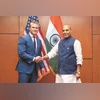 "India and US sign 10-year defence agreement amid tariff turmoil")


