From cooktops to cutlery: How to pick the right cookware for your kitchen

With dozens of materials, coatings, and claims in the market, choosing cookware has become as complex as cooking itself. Here's a guide to help you buy smart - and safe

cookware
The India cookware market reached $2.45 billion in 2024.
Namrata Kohli New Delhi
8 min read Last Updated : Jul 17 2025 | 5:14 PM IST
Whether you’re simmering a dal or stir-frying veggies, the right cookware can make all the difference. The Indian kitchen today is no longer about just patilas and kadhais. From non-stick pans to cast iron skillets, tri-ply stainless steel to ceramic-coated beauties, consumers are spoilt - even confused - for choice.
 
The India cookware market reached $2.45 billion in 2024, with projections toward $5.41 bn by 2033, driven by a 9.2 per cent CAGR (2025–33) on the back of rising urbanisation, higher disposable incomes, and a shift toward premium/eco-friendly products, according to a report from IMARC Group, a market research and management consulting firm.
 
Consumers favour stainless steel, cast iron, ceramic, and eco-friendly PFAS-free non-stick — all perceived as healthier and durable. Urban kitchen upgrades, kitchen remodeling, and influencer-led purchases via social media are boosting high-end cookware sales. Demand for induction-ready and IoT-enabled cookware is growing alongside modern appliance adoption. BIS certification mandates and exemptions for small manufacturers reflect evolving standards, especially as non-stick coatings face scrutiny from ICMR/NIN. Quality focus is now on ceramic, stainless, and cast-iron options.
 
“At Tefal, we’ve seen a clear consumer shift towards smart, durable cookware that supports fast-paced lifestyles without compromising on quality. During the recent Tefal Première in New Delhi, we showcased over 40 new products, and the response validated many of our recent innovations,” says Ashish Kakkar, chief executive officer (CEO), Groupe SEB India, a French multinational in the small domestic appliances and cookware segment that also owns the Tefal brand.

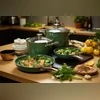
Can cookware change the dish?

“Absolutely!” says Chef Ashish Verma, executive chef at Masala Synergy, a Gurugram-based restaurant blending modern techniques with rooted Indian flavours. “Our cookware isn’t just a tool — it’s an extension of our craft. The material, shape, and heat conductivity directly influence how a dish cooks — and ultimately, how it tastes.”
 
At Masala Synergy, stainless steel pans are the workhorses. “They’re non-reactive, distribute heat evenly, and are perfect for sautéing and sauces,” he explains. “We also depend on our combi-oven for precision tasks like baking, steaming, and slow-roasting — it helps ensure consistency in a high-volume kitchen.”
 
“We don’t choose cookware based on trends — we choose it for what it does to the dish. Flavour, texture, integrity — that’s what drives our selection,” Verma says.
 
Different materials serve different roles. While cast iron has excellent heat retention and is perfect for searing and caramelising, ceramic is great for gentle cooking and stylish presentation. PFAS-free non-stick is ideal for health-conscious dishes with minimal fat. “There’s no one-size-fits-all,” Verma notes, “but stainless steel remains the most versatile. It’s durable, low-maintenance, and takes high heat without affecting food quality.”
 
His personal favourite? A well-seasoned cast iron kadhai. “It reminds me of my early days — slow-cooked gravies, smoky masalas. It adds soul to the dish, not just flavour.”

Before you buy

Know what you want to achieve. There can be different questions for different households and some of these include: What utensils are safe to use (wood, silicone, metal)? Is the cookware induction-compatible? Is the cookware dishwasher safe? Is it oven-safe (and up to what temperature)? Does it need seasoning (cast iron, carbon steel)? These questions can save you from buying cookware that ends up being a cupboard orphan.

Material Matters

Stainless steel (especially tri-ply) is a favourite in Indian homes for its durability. Tri-ply cookware — with layers of stainless steel and aluminum — ensures even heat distribution and is ideal for everyday cooking. It may be durable, non-reactive, easy to maintain but on the flipside, food may stick without enough oil.
 
Non-stick (PTFE or ceramic coated) cookware is best for cooking with small amounts of oil. But not all non-stick is created equal. Choose reputed brands that are PFOA-free. It is easy to clean, low-fat cooking but on the flipside, it has a shorter life span and the coatings can wear off.
 
Cast iron is great for high-heat cooking and retains heat much better than the rest. However, it needs regular seasoning and maintenance to prevent rusting. On the upside, it adds iron to food, lasts a lifetime but on the flipside, it is heavy and prone to rust if not cared for.
 
Hard-anodised aluminium, an upgrade from regular aluminium, is resistant to corrosion and non-reactive. It is lightweight and has a tough exterior but cannot use metal spatulas and is not induction-friendly unless specified.
 
Copper (with inner lining) is a luxury choice. It offers excellent heat control but requires regular polishing and should have a stainless steel lining to avoid reaction with food. While this is aesthetically appealing and has rapid heat conductivity, it is expensive and high maintenance.
 
Chef Ajay Chopra recommends: “Invest in 2-3 good quality multi-purpose pieces. A wok-shaped kadhai, a flat tawa, and a saucepan can cover most Indian cooking needs. Don’t fall for too many gadgets unless you cook extensively,” he says.
 
In short, choose cookware that suits your cooking habits, stovetop, and maintenance comfort. A thoughtful buy will not only make cooking easier — it might even make you love it a little more.

How to choose what's right for you

Today’s consumers are sharper — and so should their cookware choices. Start with the basics: safety and credibility. Always choose cookware made with certified food-safe materials — whether it’s PFOA-free PTFE coatings or high-quality ceramic. Avoid products with vague claims or missing safety disclosures.
 
Then match it to your cooking habits. For everyday use, look for smart features like heat indicators, such as Tefal’s Thermo-Signal, metal-safe coatings, ergonomic handles, and even heat distribution. Good cookware should feel intuitive, efficient, and easy to clean.
 
Finally, think long-term. Quality cookware should last 6–8 years, delivering consistent results without high maintenance. Go for brands with solid R&D, proven durability, and a philosophy that aligns with your values — be it health, performance, or sustainability.

Top Cookware Brands & What’s Trending

TTK Prestige, Hawkins, and Pigeon (Stovekraft) dominate the mass-market with trusted pressure cookers, non-stick sets, and induction-friendly options. Vinod Cookware is known for its toxin-free tri-ply stainless steel and sandwich-bottom ranges, while Bergner India offers energy-efficient cookware with titanium and marble finishes. Cello World brings stylish fry pans and casseroles for mid-tier buyers.
 
Among premium and niche names, Wonderchef (co-founded by Chef Sanjeev Kapoor), Meyer (PTFE-free tri-ply steel and ceramic), La Opala – Diva (glass ceramic), GreenPan (Belgian, PFAS-free), Le Creuset (French cast iron and stainless steel), and Staub (enameled cast iron) are favored by design-led and health-conscious users.
 
“We're seeing strong uptake of appliances like the PureGrind mixer-grinder with Powelix blades and the Express Steam+ iron. Our philosophy is to deliver high-performance, safe, and smart solutions,” says Kakkar.

Cookware Care: A Chef’s Golden Rules

Maintaining cookware isn’t just a chore, it’s a discipline. Chef Verma says never to rinse hot pans with cold water. “It warps the surface, especially in high-grade stainless steel,” warns Verma. Be gentle with non-stick and ceramic. Use only soft scrubbers to avoid damaging the coating. Cast iron needs love. Regular seasoning with oil keeps it naturally non-stick and rust-free. Deep clean the heavyweights. Ovens and combi-units must be descaled routinely, and grease buildup needs constant monitoring.
 
Respect your tools. “We train our team to treat cookware with respect. A well-maintained pan can last for years — and perform like a pro every single time.” Even with new-age materials and sustainable innovations flooding the market, Verma believes the basics still rule the kitchen. “It’s not just what your cookware is made of — it’s how you treat it that makes all the difference.”

What Are You Paying For?

Cookware pricing can range from Rs 800 to Rs 40,000 depending on the brand and material. Here's what drives the price:
 
  • Quality of material (tri-ply vs. single-ply steel)
  • Brand reputation and warranty
  • Imported vs. Made-in-India
  • Type of coating and safety certifications
 
Brand Key Products Price Range (INR)
Meyer Tri-Ply Stainless Steel, Non-stick Hard Anodised ₹2,000 – ₹15,000
Bergner Argent Tri-Ply, Stone-Coated Non-stick ₹2,500 – ₹12,000
Vinod Cookware Zest & Platinum Triply Stainless Steel ₹2,500 – ₹8,000
Wonderchef Die-cast Aluminium Cookware Sets 3,000-10,000
TTK Prestige (Svachh Triply) Triply Stainless Steel Cookware Range 3,000-9,000
Hawkins Futura Hard Anodised Cookware 2,500-7,000
GreenPan PFAS-free Ceramic Non-stick Cookware 4,000-14,000
Le Creuset Cast Iron & Stoneware 10,000-35,000
Staub Enameled Cast Iron, Slow Cookware 9,000-30,000
Tefal Titanium Non-stick, Ceramic Coated Cookware 3,500-11,000
  Source: Market Research  

One subscription. Two world-class reads.

Already subscribed? Log in

Subscribe to read the full story →
*Subscribe to Business Standard digital and get complimentary access to The New York Times

Smart Quarterly

₹900

3 Months

₹300/Month

SAVE 25%

Smart Essential

₹2,700

1 Year

₹225/Month

SAVE 46%
*Complimentary New York Times access for the 2nd year will be given after 12 months

Super Saver

₹3,900

2 Years

₹162/Month

Subscribe

Renews automatically, cancel anytime

Here’s what’s included in our digital subscription plans

Exclusive premium stories online

  • Over 30 premium stories daily, handpicked by our editors

Complimentary Access to The New York Times

  • News, Games, Cooking, Audio, Wirecutter & The Athletic

Business Standard Epaper

  • Digital replica of our daily newspaper — with options to read, save, and share

Curated Newsletters

  • Insights on markets, finance, politics, tech, and more delivered to your inbox

Market Analysis & Investment Insights

  • In-depth market analysis & insights with access to The Smart Investor

Archives

  • Repository of articles and publications dating back to 1997

Ad-free Reading

  • Uninterrupted reading experience with no advertisements

Seamless Access Across All Devices

  • Access Business Standard across devices — mobile, tablet, or PC, via web or app

Topics :Stainless steelkitchenaluminium

Next Story





