For years, the United Arab Emirates (UAE) sold itself to foreigners for years as a safe, tax-free oasis. That peaceful image was shattered on Saturday as Iranian weaponry rained down on Dubai, setting fire to a five-star resort, threatening the world's tallest building, and killing one person while injuring seven others at the airport in the capital city of Abu Dhabi.
Iran struck the UAE and several of its neighbours as it retaliated after the major attack by US and Israeli forces, causing fear and chaos in a place that until Saturday was predictably calm.
Now Dubai's image as a safe haven has been rocked, according to Prashant Ajmera, founder of Ajmera Law Group.
"People will see how close it is to Iran, which can bomb the UAE at any time," he told Business Standard.
"This is Dubai's ultimate nightmare, as its very essence depended on being a safe oasis in a troubled region," Cinzia Bianco, an expert on the Persian Gulf at the European Council on Foreign Relations, wrote on X. "There might be a way to be resilient, but there is no going back."
Officials tried to reassure residents and visitors that the country's air defence system is among the best in the world, bringing down drones and missiles.
"I know it's a scary time for a lot of the residents," Reem Al Hashimy, Minister of State for International Cooperation, told CNN. "We don't hear these types of loud sounds. But at the same time, those are sounds of interception. And where there has been damage — that has been primarily debris."
However, faith in Dubai remains for many.
Akshat Sherawat, Business Head (India) at Garant In, said the current tensions appear temporary rather than structural.
"The UAE has already shown that its air-defence systems, crisis response and security coordination can contain such shocks and restore normalcy quickly. The core business districts remain secure, and the authorities’ focus has been squarely on maintaining continuity and protecting residents and global tourists with utmost care and concern," he told Business Standard.
"For investors and HNIs, the key point is that Dubai’s fundamentals have not changed: zero personal income tax, world-class infrastructure, strong banking and free-zone regimes, and its role as the region’s aviation and trade hub. Short-term risk perception may tick up for a few months, but we do not see any meaningful long-term negative impact on investor appetite; if anything, the way the city has bounced back and moved to protect residents reinforces its reputation for resilience and reliability in a turbulent region," Sherawat said.
He added, "For those considering a Dubai Golden Visa or long-term residence structure, this environment still supports planning ahead without hesitation. The strategic logic, tax efficiency, regional connectivity, lifestyle and asset-protection advantages remain intact, and a well-designed residency and investment plan in Dubai continues to be a sound pillar in a diversified global portfolio."
Even billionaire Elon Musk on Sunday reaffirmed faith in Dubai, posting on X: "No country is perfect, but Dubai and UAE broadly are objectively safer and better run than many areas of Europe."
The founder and CEO of Telegram also wrote on X: "Dubai is statistically safer even with missiles flying."
The oil-rich federation of seven sheikhdoms has relied on its image as a place of serenity to attract wealthy tourists, businesspeople and future residents who want to live largely tax-free in luxury by the sea. Nearly 90 per cent of the estimated 11 million residents are foreigners. The UAE hosts nearly 3.9 million Indians, according to official data.
Real estate firms sell glimmering high-rises and poolside villas to wealthy Europeans and Americans by promoting a welcoming climate and business-friendly policies, and presenting the country as one of the safest places on earth.
Hundreds of drone and missile attacks later, though, that reputation has been shaken.
What damage was reported?
The Ministry of Defence said on Sunday that air defences had dealt with 165 ballistic missiles, two cruise missiles and more than 540 Iranian drones over two days.
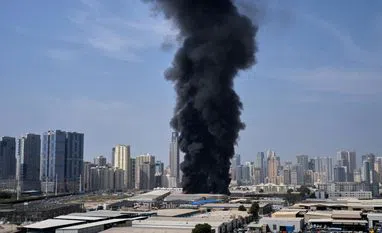
While officials said they intercepted all air attacks on Saturday, debris from the downed weapons sparked blazes at some of Dubai's most recognisable locations.
Social media videos and photos showed:
> A fire outside the Fairmont hotel on the Palm Jumeirah
> Flames licking the facade of the Burj Al Arab hotel
> Smoke rising near the Burj Khalifa, the 2,723-foot (830-metre) skyscraper
There was also a fire at Dubai's Jebel Ali Port, the city's main sea terminal and a major shipping hub. Dubai International Airport was also damaged and four employees were injured, according to the Dubai Media Office.

 "Is Dubai still a safe haven for investors, HNIs despite US-Iran conflict?")

