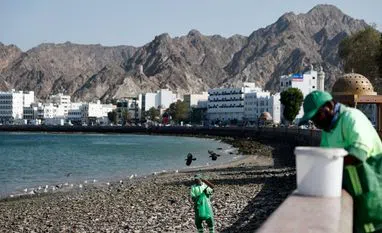
The city of Muscat in Oman is typically targeted by travelers as the cultural counterpoint to nearby Dubai and its glitzy skyscrapers. But now the city is becoming a major draw for a very different kind of visitor: people stranded by airspace closings who are willing to pay a premium to evacuate.
The drive from Dubai to Muscat International Airport, where operations are normal, can be made in just under five hours if you don’t take the scenic route along the Persian Gulf. It’s becoming a popular trip for people worried about spending a lengthy stretch of time in Dubai, where debris from Iranian missiles has rained down on the local airport and the man-made island Palm Jumeirah, and flights out of the city remain elusive.
Oman’s national carrier, by contrast, has increased flights into Europe and Saudi Arabia to accommodate fleeing travelers. It’s also running buses from the United Arab Emirates.
Austrian Air flew out people from Muscat, and Italy’s defense minister got picked up by the air force in Oman, where he traveled by land from Dubai.
But it’s those with enough funds who are flocking to Muscat, capital city in a nation of about 5.3 million people that’s known for its postcard beaches and green mountains.
Armand Arton, head of advisory firm that specializes in citizenship by investment programs, has been coordinating relocations for dozens of wealthy families in recent days. All are holders of the UAE’s Golden Visa, which requires a minimum investment of about $500,000.
Arton helped seven families evacuate by land to Oman and then fly out by private jets while UAE airspace remained closed. Some families shared jets to split costs, while one client needed a plane large enough for 22 people — his family and staff.
Services that once cost about $50,000 have doubled in price. Meanwhile, fast-track transfers to Oman now cost $5,000 per car.
“Many families are ready to pay anything from $150,000 to $200,000 to be evacuated,” Arton said.
Foreign governments are also trying to evacuate passengers through either one of the Gulf neighbors. Germany is working with Lufthansa and tour operator TUI to help move people out of Dubai by land.
Carriers from India have announced evacuation flights. While the largest airline IndiGo has planned 10 special relief operations from Jeddah to India on March 3, SpiceJet has announced it will operate four special flights between Fujairah, in the UAE, and three destinations in India starting March 4, the airline said in a statement.
Air India Express, the low-cost subsidiary of Air India, said it would resume services to Muscat starting Tuesday.
Saudi Arabia was considered the safer option Sunday when Oman was hit by drones. But on Monday, strikes by Iran were intercepted at several sites in the kingdom, leading to some restrictions on its roads and making Oman the more attractive option.
The UAE’s airspace has been largely shut down to commercial flights since Saturday, stranding tens of thousands of business and leisure travelers in Dubai.
The fluidity, and danger, of the situation is triggering fear among some Dubai visitors. Many are forced to extend their hotel stays, prompting panic-buying of food and medicine, while they look for alternative means of escape.
One of the options is to take a boat to Mumbai, though it would sail in the Strait of Hormuz, where Iran has hit several tankers.
If flights on Oman Air are full, there’s always a private jet, though prices have soared given the upsurge in demand. Arton’s clients are being told to keep their passports with them at all times and to carry as much as 100,000 dirhams ($27,000) in cash per person.
“It is much less today about dealing with passports and residency, and dealing with emotions and fears,” he said.

 "Travellers rush to Oman, Saudi Arabia to escape Dubai amid US-Iran conflict")



