Indian astronaut
Shubhanshu Shukla created history today when Axiom Mission 4 (Ax-4) was launched from Nasa’s Kennedy Space Centre in Florida. The mission lifted off aboard SpaceX’s Falcon 9 rocket at 12:01 pm IST from Launch Complex 39A at Kennedy Space Centre. The crew is expected to dock with the
International Space Station (ISS) on June 26 at around 4:30 pm IST.
This mission marks only the second time an Indian national has flown to space. The first was in 1984, when Rakesh Sharma made history by traveling to space aboard a Soviet mission. Now, more than four decades later, Shubhanshu Shukla will represent India once again among the stars.
CATCH SHUBHANSHU SHUKLA's AXIOM-4 MISSION UPDATES LIVE What is special about the Falcon 9 Block 5 rocket?
The rocket powering today’s mission, Falcon 9 Block 5, is a medium-lift, two-stage launch vehicle developed by Elon Musk’s SpaceX. Designed to carry both cargo and humans into space, this version of the Falcon 9 stands out for its reusability. Its first stage is built to return safely to Earth for reuse, dramatically cutting costs and turnaround time between missions.
When was Falcon 9 Block 5 first launched?
The Block 5 variant of the Falcon 9 made its debut on May 11, 2018, successfully placing Bangladesh’s Bangabandhu-1 satellite into orbit.
Is Falcon 9 safe for astronauts?
Yes, the Falcon 9 Block 5 was certified by Nasa in November 2020 for human spaceflight. It became the first commercial spacecraft system approved for regular crewed missions since the Space Shuttle era began in 1981. To date, it has completed 16 astronaut-carrying missions with a perfect safety record — not a single injury has been reported.
What makes Falcon 9 reliable?
Equipped with nine main Merlin engines and three backup computers, the rocket can still complete its mission even if one engine fails. As of June 2025, Falcon 9 has launched 438 times, achieving 437 successful missions — a stellar 99.77 per cent success rate, placing it among the most dependable rockets in spaceflight history.
How much load can Falcon 9 carry into space?
The rocket is capable of delivering up to 22,800 kilograms to Low Earth Orbit (LEO) on a single-use flight. When reused, it can carry 18,500 kilograms to LEO, and up to 8,300 kilograms to higher orbits such as Geostationary Transfer Orbit (GTO).
What kind of missions does Falcon 9 support?
Falcon 9 has played a crucial role in various missions — from launching Nasa's Crew Dragon spacecraft and Starlink satellites to GPS systems and science payloads like DART and PACE. It has also been used for international collaborations, including missions for Isro, such as the upcoming Axiom-4 flight.
About Axiom-4 mission
Shukla is gearing up for a 14-day stay aboard the International Space Station (ISS), where he will conduct various experiments focused on food and nutrition. These scientific activities are part of a collaborative effort between the Isro and the Department of Biotechnology (DBT), with additional support from Nasa.
As part of the mission’s engagement activities, the Axiom-4 crew is also scheduled to interact with Prime Minister Narendra Modi, students, and representatives from the space industry.
The mission has experienced multiple delays. Initially postponed due to unfavourable weather conditions, subsequent setbacks were caused by leaks detected first on SpaceX’s Falcon 9 rocket and later on a Russian module of the ISS.
According to Nasa, the current launch window was confirmed following discussions with officials from Roscosmos, focusing on the recent repairs made to the transfer tunnel in the Zvezda service module at the rear of the space station.

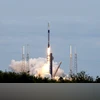 "All About Falcon 9, the SpaceX rocket taking Shubhanshu Shukla to ISS")


