Home / India News / Delhi air quality remains 'severe' as IMD issues alert for fog, cold wave
Delhi air quality remains 'severe' as IMD issues alert for fog, cold wave
Delhi's air quality remained in the severe category on Monday, with several areas recording AQI above 400 as fog and cold wave continue to blanket the capital
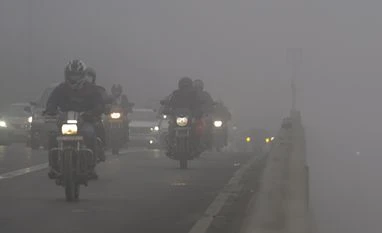
Vehicles ply on a road amid dense fog on a winter morning, in New Delhi. (Photo: PTI)
Delhi’s air quality remained in the severe category on Monday as dense fog and cold wave conditions continued to grip the national capital, further worsening pollution levels and disrupting daily life.
Several air quality monitoring stations recorded Air Quality Index (AQI) readings close to or above 400 during the morning hours, according to data from the Central Pollution Control Board (CPCB). The combination of toxic air, persistent fog and low temperatures has heightened health concerns for residents.
As of 4 pm on Sunday, Delhi’s 24-hour average AQI stood at 440, firmly placing it in the severe category. The city’s air quality is expected to remain in the very poor range from Monday until January 21 due to unfavourable meteorological conditions, including a low ventilation index of around 6,000 units and average wind speeds of 10 kmph, which are not conducive to the dispersion of pollutants.
Which areas recorded severe AQI levels on Monday morning?
Several locations across the capital reported AQI levels well within the severe category:
Anand Vihar: 461
Rohini: 471
Chandni Chowk: 454
Mundka: 467
RK Puram: 439
ITO: 430
As per CPCB standards:
0–50: Good
51–100: Satisfactory
101–200: Moderate
201–300: Poor
301–400: Very Poor
401–500: Severe
What are the major sources contributing to Delhi’s pollution?
According to the Decision Support System assessment, vehicular emissions were the largest contributor, accounting for around 12.47 per cent of overall pollution levels. Industrial emissions from peripheral areas contributed 7.8 per cent, while residential emissions accounted for 3.3 per cent.
Other sources included construction activities at 1.5 per cent and biomass burning at 1.2 per cent, highlighting the cumulative impact of multiple pollution sources on Delhi’s air quality.
What pollution curbs have been imposed under Grap Stage IV?
In response to the deteriorating air quality, the Commission for Air Quality Management (CAQM) reimposed the strictest pollution control measures under Stage IV of the Graded Response Action Plan (GRAP) on Saturday. These curbs are in addition to the measures already in force under Stages I, II and III. Authorities, including NCR pollution control boards, have been directed to escalate preventive actions to prevent any further deterioration in air quality.
According to CAQM’s health advisory, prolonged exposure to severe air quality can lead to respiratory problems and aggravate existing heart and lung conditions. Residents have been strongly advised to limit outdoor activities, especially during peak pollution hours.
What is the IMD weather forecast for Delhi today?
Cold wave and dense fog conditions continued across the capital, with several areas recording minimum temperatures of around 5 degrees Celsius.
For Monday, the India Meteorological Department (IMD) has issued a yellow alert, warning of moderate fog at many places and dense fog at isolated locations during morning hours, along with partly cloudy skies.
IMD has also forecast dense fog across several parts of the national capital. The minimum temperature is expected to hover between 7 and 9 degrees Celsius, while the maximum temperature is likely to remain between 24 and 26 degrees Celsius.

 "Delhi air quality remains 'severe' as IMD issues alert for fog, cold wave")


