By Mujib Mashal and Hari Kumar
The unbearable temperatures that arrive every summer in India are a threat to lives and livelihoods. Medical services become bogged down. Economic output suffers.
For many Indians, there is no true escape from the heat. Air-conditioning is an impossible dream. Work is done outside, under the sun, and not to work means not to eat.
In the face of those realities, the daily rhythms of life are changing in India, the most populous country on a continent that is warming at a rate twice as fast as the global average.
We witnessed these new routines when we spent a day earlier this month in Sri Ganganagar, a region in the desert state of Rajasthan that was the hottest place in the country in mid-June.
The temperature on the day of our visit peaked at 47 degrees Celsius, or 117 degrees Fahrenheit. The next day was even worse: 49 degrees Celsius, or 121 degrees Fahrenheit. Relative humidity that has been rising over the past decade compounded the misery.
Still, life carried on.
6 a.m., 30° C, 86° F
Work in the fields and on construction sites begins early, even before dawn, to catch as many cooler hours as possible.
Kulwinder Singh and his son Gurveer were out weeding their cotton field. Gurveer then helped his mother prepare food for the cattle.
His sister folded the sheets from simple woven beds in the courtyard, where the family sleeps at night to seek some respite in the breeze.
9 a.m., 36° C, 97° F
As temperatures started climbing, a canal on the edge of a village in the district was growing busy, as children jumped in to cool off.
Anmol Varma, 16, who works at a car accessories shop, said he made several visits to the canal. “All day,” he said.
10 a.m., 40° C, 104° F
By midmorning, conditions were getting tough for laborers doing cement work at a construction site. They stop their work only during the day’s hottest hours, from around noon to the early afternoon.
“We just drink more water,” said Nihal Chand, 55, one of the workers. “If we feel the heat, we go under that tree to cool off for a bit. But it’s hot there too — it’s not like there is air- conditioning there.”
11 a.m., 42° C, 108° F
As temperatures kept climbing, the flow of patients at the government health clinic in the village of Chak Maharaj Ka increased.
Dr. Purnima Bishnoi, who manages the center, said villagers were by now well practiced in reducing the heat’s impact, avoiding the hottest hours outside and stocking rehydration remedies.
Many patients, like Baljinder Kaur, have pre-existing conditions that are aggravated by the rising heat.
Ms. Kaur, 75, is asthmatic. But she was complaining of stomach pain and diarrhea. After getting medicine and being treated with a nebulizer, she left for home with her husband and grandson.
Noon, 43° C, 109° F
By noon, the laborers at the construction site had paused their plastering of a wall. But there wasn’t much relief as they cooked their lunch under the baking sun.
The villages around Sri Ganganagar become largely deserted between midday and late afternoon, with people retreating indoors.
But that was less of an option in the city proper. Roadside carts remained open, and construction work continued in the blistering heat. The fire department tried to cool off the streets by spraying water, and volunteers ran water stands.
“The main thing is the laborers and people who work outside,” said Dr. Deepak Monga, who leads the city’s main hospital. “They continue their work, because otherwise they die of hunger.”
3 p.m., 47° C, 117° F
The temperature peaked at 47 degrees Celsius (117 degrees Fahrenheit) around 3 p.m. and remained there for a couple of hours.
On the highway leading to the village of Chak Maharaj Ka, one family was busy rushing cups of water to travelers.
Half of the family members filled buckets and glasses, while the other half rushed to stop red-eyed motorcycle riders, truck drivers and travelers passing through the area. Two women rinsed the cups between every run.
The family, who come out every afternoon during the hottest hours, described their offering of water as charity in a society that sees good deeds as central to salvation.
“This is the only thing that goes with you,” said Bhupender Suliya, 20, who was rushing water. “Nothing else.”
6 p.m., 42° C, 108° F
People started trickling outside again by early evening, as the temperatures began to inch down.
Shops in the village market reopened, and elders pulled out their chairs and congregated for chats. On the farms, work resumed.
7:30 p.m., 37° C, 99° F
After sunset at 7:35, the temperature continued its downward trend. Children were still jumping into the canal to cool off.
Gurmail Singh and his family, including grandchildren visiting from New Zealand, spent their evening outside and prepared their beds in the courtyard. But he lamented that the nights remained warm.
“Who can fall asleep in this heat?” Mr. Singh said.

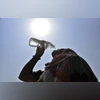 "How India's hottest region survives extreme summer heat each year")


