
Let's befriend every language: SC rejects plea to remove Urdu sign board
The plea had challenged the Bombay High Court's decision, which also ruled that the use of Urdu is not prohibited under any law in India
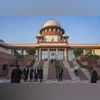 "Let's befriend every language: SC rejects plea to remove Urdu sign board")
WebinarsNew
Deep DiveNew
Explore Business Standard
The plea had challenged the Bombay High Court's decision, which also ruled that the use of Urdu is not prohibited under any law in India
The Supreme Court recently held that the display of a language other than the official one of a State is not prohibited under any law in India, while dismissing a plea seeking the removal of an Urdu signboard of a municipal council in Maharashtra.
Upholding a decision of the Bombay High Court, an apex court bench comprising Justices Sudhanshu Dhulia and K Vinod Chandran dismissed a plea seeking the removal of an Urdu signboard placed beneath a Marathi signboard on a new building of the municipal council in Maharashtra's Akola.
"Our misconceptions, perhaps even our prejudices against a language, have to be courageously and truthfully tested against the reality, which is this great diversity of our nation: Our strength can never be our weakness. Let us make friends with Urdu and every language", the bench stated in its judgement.
The plea had challenged the Bombay High Court's decision, which also ruled that the use of Urdu is not prohibited under any law in India.
The plea claimed that, as per the provisions of the newly enacted Maharashtra Local Authorities (Official Languages) Act, 2022, the use of the Urdu language on the signboard of the Municipal Council is not permitted.
However, the top court disagreed with the appellant's submissions and stated, "The entire case of the appellant, to our mind, is based on a misconception of law. We see no reason, therefore, to interfere in the present case. Thus, it proceeded to dismiss the plea.
Earlier this month, Maharashtra Chief Minister Devendra Fadnavis stated that while there is nothing wrong with agitating for the promotion of the Marathi language in Maharashtra, it should remain within the bounds of the law.
Fadnavis further warned that any individual or group resorting to unlawful actions would face appropriate legal consequences.
"There is nothing wrong with agitating for Marathi in Maharashtra. Even the government believes that the use of Marathi should be promoted. But if someone takes the law in their hands, action needs to be taken against them...," Fadnavis stressed.
(Only the headline and picture of this report may have been reworked by the Business Standard staff; the rest of the content is auto-generated from a syndicated feed.)
First Published: Apr 16 2025 | 11:23 PM IST


 Connect with us on WhatsApp