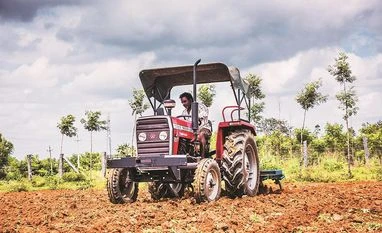
Expected above-normal monsoon, increased minimum support prices (MSPs) for key crops, and rising replacement and construction demand are likely to drive domestic tractor sales to a record high of approximately 9,75,000 units in the financial year 2025-26 (FY26), marking a 3-5 per cent year-on-year growth.
In FY25, tractor sales had dipped by 1.04 per cent.
Sales for that year had come in at 8,83,095 units, down from 8,92,410 units in FY24, according to data from the Federation of Automobile Dealers Associations (FADA).
Good times ahead
But the ongoing financial year is expected to bring good news.
A recent analysis by Crisil Ratings says that a surge in demand will likely propel sales beyond the previous peak of 9,45,000 units achieved in FY23, sustaining the consistent volume expansion witnessed since FY19. This projection follows a healthy 7 per cent increase in tractor sales in financial year 2025, according to the Crisil report.
Analysts attribute the expected turnaround in FY26 to favourable macro and agriculture-linked factors.
“The Indian Meteorological Department’s forecast of an above-normal monsoon should lift rural sentiment and reinforce farmer confidence,” said Anuj Sethi, Senior Director, Crisil Ratings.
“This, along with the expected rise in MSP for key cash crops and a pick-up in construction activity, should help drive tractor volumes higher this year,” Sethi said.
Bharat TREM V factor
Another factor expected to boost sales is the anticipated implementation of Bharat TREM V emission norms from April 1, 2026.
With prices likely to rise 10-20 per cent post-implementation, depending on horsepower, a wave of pre-buying is expected in the final quarter of FY26, similar to what was observed when TREM IV norms were rolled out in January 2023.
Tractors in the 41-50 HP range, which account for over 60 per cent of industry volumes, are expected to remain dominant, especially as farmers remain price-sensitive. During the TREM IV phase, many buyers shifted to lower HP models to avoid price hikes.
Despite the regulatory headwinds, Crisil expects operating margins for manufacturers to remain stable at 13.0-13.5 per cent in FY26, due to easing input costs and healthy volumes. This stability provides a cushion for investments in capacity expansion and emission control technologies.
“With capacity utilisation nearing 75-80 per cent and the TREM V transition ahead, OEMs are likely to enter a strategic capex cycle of around ~4,000 crore. Yet, the capex-to-Ebitda ratio will remain lean, under 0.25 times, reflecting the sector’s financial strength,” said Poonam Upadhyay, Director, Crisil Ratings.
Agriculture continues to drive 70-75 per cent of tractor demand, with the rest coming from construction and infrastructure activity, sectors set to benefit from government allocations in the Union Budget.
However, analysts caution that the final outcome will depend on several evolving factors, including the spatial and temporal distribution of monsoon rains, movement in commodity prices, interest rate trends, and the timely implementation of emission regulations.