Home / Industry / Auto / PM Modi unveils Suzuki e-Vitara, stresses Swadeshi and reforms drive
PM Modi unveils Suzuki e-Vitara, stresses Swadeshi and reforms drive
PM Modi launched Suzuki's e-Vitara at Hansalpur, stressing Swadeshi, reforms, and manufacturing push, while urging states to focus on ease of business and global investment
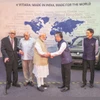
Prime Minister Narendra Modi with Suzuki Motors President Toshihiro Suzuki, Gujarat Chief Minister Bhupendra Patel, and Maruti Suzuki India Chairman R C Bhargava during the flagging off of the e-Vitara from the Hansalpur facility, in Ahmedabad. (Photo: PTI)
Prime Minister Narendra Modi on Tuesday said investment might come from anywhere in the world, but if production took place in India, it was ultimately swadesi. Speaking at Maruti Suzuki’s Hansalpur plant in Ahmedabad, where he flagged off the company’s first global strategic battery electric vehicle (BEV) — the e-Vitara — Modi underlined self-reliance, manufacturing strength, and reforms aimed at making India a hub for emerging industries.
The statement comes even as Chinese firms have faced investment curbs in the country since the 2020 Galwan clashes, with tighter foreign direct investment (FDI) rules slowing approvals and new proposals. Some recent developments, however — including US President Donald Trump’s tariffs on India and Chinese Foreign Minister Wang Yi’s visit to New Delhi — suggest a tentative reset, as the two neighbours explore limited cooperation while keeping sensitivities in mind.
The made-in-India e-Vitara will be exported to more than 100 countries, including advanced markets like Japan and Europe. Local sales in India by Maruti will begin later.
“My definition of swadesi is very simple: It doesn’t matter whose money is invested — dollars, pounds, black or white. What matters is that the sweat of my countrymen has gone into production. The money may be someone else’s, but the sweat is ours. The production carries the fragrance of my motherland, the soil of Bharat,” Modi said.
Modi urged citizens to embrace the principle of “vocal for local” as a way of life. “Let us be vocal for local. Swadesi should become our life mantra, my friends; walk proudly towards swadesi. What Japan is producing here, that is swadesi too,” he said.
The PM also launched local production of lithium-ion battery electrodes for strong hybrid cars at the TDS plant — a joint venture of Toshiba, Denso and Suzuki.
He urged states to focus on every small detail in their effort to attract global investment, highlighting that even cultural and lifestyle preferences of potential investors could make a difference.
Recalling his experience in Gujarat, Modi said he once arranged Japanese food and golf courses to make Japanese investors feel at home, and later also introduced Japanese language studies in local schools. “If you want development, if you want investment, you must pay attention to every detail,” he said, urging lagging states to treat such efforts as opportunities.
The prime minister reminded state governments that reforms and ease of doing business were central to a healthy investment climate. “We have to be proactive, emphasise single-window clearance, and reform laws. This is the age of competition — the faster a state keeps policies clean and simple, the more confidence investors will have,” he said, adding that competition among states would ultimately benefit the nation.
The PM underlined that India’s ambitions went beyond current successes in manufacturing and exports, as the country was preparing itself for leadership in advanced technologies. “India is not going to stop here. We are stressing mission manufacturing and futuristic industries. India is taking off in semiconductors — six plants are about to be ready. We have to take semiconductor manufacturing further,” he said.
He acknowledged challenges such as the shortage of rare-earth magnets crucial for electric mobility, and pointed to the new National Critical Mineral Mission, which will oversee over 1,200 exploration projects to secure resources and boost resilience in strategic sectors.
The PM emphasised that India’s industrial growth would continue to rely on partnerships with trusted allies, citing Japan as a key collaborator. He described the India-Japan relationship as a “made for each other” partnership and expressed confidence that the two countries would continue to expand their cooperation in next-generation manufacturing. He also said that India’s path of self-reliance was not just about economic independence but also about national pride and global contribution.

 "PM Modi unveils Suzuki e-Vitara, stresses Swadeshi and reforms drive")

