Godrej Consumer Products is the third- largest advertiser on television, behind Hindustan Unilever and Reckitt Benckiser. Cinthol, Good Knight, Kama Sutra, Park Avenue, and all the other brands under it, together earned it a revenue of ₹14,680 crore in 2024-25 (FY25). That year, its expenditure on advertising grew by two and a half times, to ₹1,020 crore. Over 95 per cent of this was spent on the ‘large screen’ — that is, television, both linear, and internet-enabled or connected.
“For us, it is not about digital or TV — it is about the large versus small screen, and we are big believers of the large screen,” says Harsh Deep Chhabra, global head, media, Godrej Consumer Products.
Godrej Consumer Products is an exception, considering that advertisers have been deserting television en masse. Television, the largest medium in India in terms of reach and revenue for over three decades, has been losing both.
“There has been at least a 20 per cent decline in ad revenues on TV in the first six months (of 2025),” says Mihir Shah, vice-president, Media Partners Asia. This follows three straight years of decline in both advertising and pay revenues (see charts). The reasons: A structural shift in how TV is watched and, therefore, how advertisers view it, and a soft ad market that doesn’t appear to be recovering.
“Advertising grew only during the IPL (Indian Premier League). All other genres have de-grown,” points out Ashish Sehgal, who was until recently the chief growth officer, ad-sales, broadcast and digital, at Zee. “Spending by the top 50 TV advertisers, who account for three-fourths of TV advertising, have bottomed out.”
Most broadcasters are scrambling to find a solution. Sun TV is building its movie and sports franchise businesses to shore things up. Sony roped in Gaurav Banerjee as managing director and CEO from Disney Star last year. His first brief, say analysts, is to revive the television business. Disney Star merged with Viacom18 in 2024 to form JioStar in a bid to scale up. All of them have seen television revenues — and in the case of Zee and Sun, even share prices — sliding down.
Vivek Couto, executive director, Media Partners Asia, goes to the extent of saying: “TV is damaged.”
In 2019, over 210 million Indian homes had a television set — that was an audience size of almost 900 million. These were largely direct-to-home (DTH) or cable homes. Thanks to the pandemic and the rise of streaming, this is down to 157 million homes, reaching 659 million people — a fall of 43 million homes (see chart).
A little under half of those 157 million homes are on DD Freedish — a free DTH service from the state broadcaster. The remaining 92 million homes are either hybrid — they have a combination of cable/DTH and connected TV — or use only one of these. Much of the audience growth is coming from either DD Freedish or from people watching YouTube on TV. All of this is ad-supported growth. If you put YouTube aside, Zee, Sony, Star, and almost every major broadcaster, has a presence on DD Freedish. Why, then, has the industry not been able to capitalise on this growth?
“The ad rates on free-to-air television are a fraction of pay TV,” Shah points out. On the online side, 30-40 per cent of OTT viewing is catch-up TV. The largest broadcaster, JioStar, also owns one of the largest OTT platforms. Most others have a sizeable audience, if you combine their streaming and linear audience numbers. Yet, the viewer watching, say, Anupama on connected TV (CTV) is half as valuable as the one watching it on linear TV. And the one watching it on DD Freedish is even less so.
The picture is unlikely to change unless three things happen simultaneously.
First, the ad market starts to grow. Since 2023, growth has slipped below the usual 10-12 per cent to 7-8 per cent, overall.
Unsurprisingly, much of the growth goes to digital. In most years, “there was always one new category that lifted ad growth — handset OEMs (original equipment manufacturers), telecom, startups,” says Shah. “In the recent past, no new advertiser category has emerged, while the largest advertiser, FMCG (fast-moving consumer goods), has slowed.”
Rajeev Dubey, vice president marketing, Dabur India, points to the FMCG results: “Nobody has grown by 10-12 per cent, the way they used to. Everybody has cut advertising. Our commitments are not what they were 4-5 years back.”
Sehgal says in the current economic situation, everyone wants instant results. “When you have limited money, the thinking is: ‘We will build the brand later. For now, let us focus on selling.”
It isn’t about just the shifting audience. Those the broadcasters are capturing online. It is also about advertisers who are more performance oriented, while TV is about impact. “Performance marketing has always existed in the form of coupons or telemarketing,” says Chhabra. “It depends on what the brand’s goal is — short-term business push or long-term brand value.”
This is the second thing that’s needed: Advertisers who are more focused on brand-building, such as HUL or Godrej.
This means an emphasis on reach, time spent, total attention, and impact.
“Co-viewing on TV (four people per connection) and on CTV (1.8 per connection) is good,” says Chhabra. That takes care of reach. “On social media, you can scroll past my ad. People usually drop off after three seconds. On both TV and YouTube, the ad will be watched for at least 10-20 seconds,” he explains. “So, the cost per effective reach, after factoring in attention, is best on both linear and connected TV,” he adds. Most advertisers, however, don’t look at it that way.
Sehgal is of the view that advertisers aren’t gauging TV’s strength properly. “The opaqueness of the TV rating system, when it comes to measuring its impact, becomes a deterrent.”
This is the third thing that’s required: Data on the impact of television, and on how much of the shift online is being captured by it.
The Broadcast Audience Research Council (BARC) has been flogging the same reach numbers since 2018, when the last baseline study was done. The reason: The Census hasn’t happened since 2011. “An establishment survey doesn’t need the Census. The sooner we do a fresh study, the better it will be,” says Chhabra. Godrej uses research agencies to fill the gaps.
In July this year, Kevin Vaz, president, entertainment, JioStar, came on the board of BARC. And in August, Banerjee became chairman. For both these companies, TV is a huge part of their topline. Not surprisingly, a study on connected TV and a fresh baseline study are in the works.
“Barring IPL and Bigg Boss, there is little to keep viewers engaged,” says Shah. “Most prime-time Hindi fiction shows have been running for over 14 years. There is a strong case to refresh television programming,” he adds, echoing what Uday Shankar, vice chairperson, JioStar, told this writer last year: “Television still has a long runway in India. You’re still talking about 90-95 million paying subscribers. In terms of watch time (about 4 hours a day), reach (800 million viewers), advertising value (4-6 times of digital on a per unit basis), whatever metric you take, it is very powerful. The creative, brand, and consumer experience innovation needs to step up.”

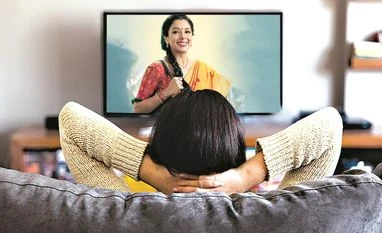 "Cracks on the screen: Can TV fix its slide with ads and smarter metrics?")











