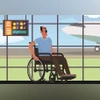
On February 12, an 80-year-old man who had flown into Mumbai airport collapsed after walking 1.5 km from the aircraft to the immigration counter. He had pre-booked a wheelchair with the airline but wasn’t given one. He died soon after. On Thursday, the Directorate General of Civil Aviation (DGCA) fined the airline, Air India, Rs 30 lakh.
This wasn’t an isolated incident of an airline or airport authority mismanaging a case where an individual needed special attention.
On January 31, a flyer disabled by birth was asked to stand up and walk two steps during the security check-in process at the Netaji Subhas Chandra Bose International Airport, Kolkata. The woman, Arushi Singh, recounted her ordeal on X: “She said sirf 2 minute khade ho jao (just stand for two minutes). I explained again that I have a disability by birth.”
Another flyer, Virali Modi, who is paralysed waist down since 2006, narrated her trauma during a December 5 flight from New Delhi to Mumbai. Through a post on X, she said she had to wait for 40 minutes to deplane after everybody had exited the flight.
“The cabin crew were chatting to the captain or someone in a similar uniform. The cleaning crew had come on board and I had to inform them. That’s when they rushed to arrange an aisle wheelchair,” Modi wrote.
Travellers with special needs – including senior citizens, pregnant women and persons with disabilities – who require a wheelchair at the airport and/or on the plane, can pre-book this service when buying their flight ticket.
The problem arises because airlines don’t have a standard operating procedure for wheelchairs, says Arman Ali, executive director, National Centre for Promotion of Employment for Disabled People, a Delhi-based non-profit. “The crew operates according to the rules prescribed by their airline.” Ali has himself faced problems while travelling by air.
According to the last Census in 2011, 27 million people in India have some form of disability. That is 2.21 per cent of the country’s population. Of these, 20 per cent have a mobility problem.
The number of people with reduced mobility travelling by air has gone up over the years, Ali says. While awareness about their rights and the rise of social media is helping them voice their grievances, airline staff needs to be sensitised to their needs.
Two ground handling employees with major airlines tell Business Standard that they typically carry 10-15 per cent more wheelchairs than have been pre-booked for a flight. This surplus accounts for passengers who may request a wheelchair without prior booking.
"If, say, there are 300 passengers on a flight, and 70-80 have pre-booked a wheelchair, I generally take about 100 wheelchairs to the plane's door using the aerobridge. That’s my company's protocol," one of the employees says.
Most passengers who pre-book wheelchairs have limited mobility and are usually requested to proceed to the plane's door by walking. For those needing assistance inside the aircraft, separate cabin wheelchairs are available.
If a passenger brings a personal wheelchair, it is either kept in the aircraft's bulk storage area, or if it is too big, it is handled at the check-in counter, where the airline provides its own wheelchair.
An executive involved in airport operations expresses surprise at the absence of a wheelchair for the Air India passenger, noting that typically, pre-booked wheelchairs are arranged in advance.
Air India did not respond to Business Standard's queries till the time of going to print.
Airline employees first verify the boarding passes of passengers who have booked wheelchairs. "Occasionally, passengers don't want to wait for the verification, walk to the boarding gate and use the airport buggies to collect their check-in luggage," a ground handling employee says.
Ali counters, saying that the passenger’s responsibility is left solely to the porter or loader at the airport. “The decision of whether a passenger can use a personal wheelchair is taken by the loader,” he says. “The loaders usually have little understanding about the passenger’s condition.”
Lack of awareness and sensitivity are major issues, he points out.
“A lot of times, senior citizens or aged solo travellers use wheelchairs bought for people with special needs. This also adds to the delay,” says Vibhas Sen, a Paralympic fencer.
Ali says the community has, in a collective effort, written twice to Civil Aviation Minister Jyotiraditya Scindia and DGCA for a meeting or awareness programme that would include all stakeholders. "We are waiting for a response," he says.
Sen, who wears a caliper alongside a wheelchair, recounts another incident: “Last week, when I was travelling, the CISF (Central Industrial Security Force) personnel was rude and totally ignorant. He was clueless (about the caliper) and kept asking me to remove it. The matter was resolved only when I asked a senior official to intervene and said that I could not be questioned like this.”
Sen says that the airline’s escort, who arranged the wheelchair after 15 minutes, told him that the staff meant for people with special needs had been reduced to half, hence the pressure.