Home / Industry / News / India-UK trade pact: Tariff cut may not impact Scotch whisky retail prices
India-UK trade pact: Tariff cut may not impact Scotch whisky retail prices
The revised tariffs will apply to both bottled-in-origin (BIO) and bulk imports
premium
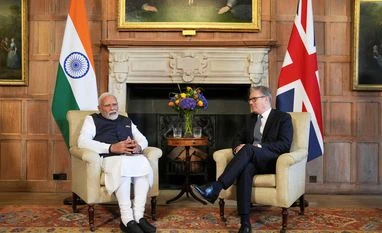
Britain's Prime Minister Keir Starmer welcomes Indian Prime Minister Narendra Modi at Chequers near Aylesbury, England, Thursday, July 24, 2025. | Photo: Reuters
3 min read Last Updated : Jul 25 2025 | 11:44 PM IST
The India-UK free trade agreement (FTA), under which tariffs on whisky and gin have been halved from 150 per cent to 75 per cent, which will further fall to 40 per cent in a decade’s time, will not necessarily impact prices of Scotch whisky and gin for Indian consumers.
According to a May 2025 report from the International Wine & Spirit Research (IWSR), blended Scotch grew the strongest of all the large whisky categories in India in 2024, with volumes rising by medium single digits and sales more than doubling since 2020.
India is known to be a whisky market, with widespread national sales. However, while the data company’s forecasts anticipated an upside from the FTA, it added that its impact should not be overestimated.
“While tariffs have been slashed from 150 per cent to 75 per cent, the impact on shelf prices is closer to 10 per cent and it is not a given that this will be passed on to consumers,” it had stated in the 2025 executive summary.
The revised tariffs will apply to both bottled-in-origin (BIO) and bulk imports.
Industry executives agree, stating that tariffs make up only up to 15 per cent of the final retail price, and with state taxes and costs for distribution and marketing, prices could be down by a mere 10 per cent. This may not be passed on to consumers, they said on the condition of anonymity.
A senior commerce ministry official said that a major portion of whisky imports into India are used in the manufacture of blended whisky, whose production is set to rise due to cheaper raw material.
“We are foreseeing significant strategic and cost advantages from this development. We have estimated our Scotch requirements at over ₹250 crore in 2025-26 (FY26), and this treaty represents a substantial opportunity for value creation,” said Abhishek Khaitan, managing director at Radico Khaitan, one of the largest importers of Scotch whisky.
Some liquor players also believe that the FTA will help consumers have access to premium Scotch whisky at reduced prices.
“The UK FTA is a positive move for the Scotch whisky segment, and it will enhance accessibility and affordability for Indian consumers. For import-driven portfolios like ours, this could fast-track category adoption, bring price parity closer to Indian Made Foreign Liquor (IMFL), and enable deeper reinvestment into consumer-building efforts,” said Debashish Shyam, cofounder and director, Ardent Alcobev, which sells Dram Bell blended Scotch whisky.
However, the real benefit, Shyam added, will depend on how quickly the duty reductions are implemented, and whether the states align their tax structures accordingly.
Spirits made up 51.2 per cent of the total beverage alcohol market in 2024, dominated by whisky. According to the data company, India consumed 258,750 under-9-litre cases of whisky in 2024, which is set to witness a compound annual growth rate (CAGR) of 3.1 per cent from 2024 to 2029. These included 8,509.60 cases of Scotch whisky, the company stated, adding that India is set to become the biggest Scotch market in the world by 2027.





