
SpaceX to launch Indian startups Pixxel, Dhruva Space satellites into orbit
The SpaceX Falcon 9 will launch OHB Italia's NAOS (National Advanced Optical System) spacecraft on a rideshare mission alongside seven other satellites
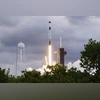 "SpaceX to launch Indian startups Pixxel, Dhruva Space satellites into orbit")
WebinarsNew
Deep DiveNew
Explore Business Standard
The SpaceX Falcon 9 will launch OHB Italia's NAOS (National Advanced Optical System) spacecraft on a rideshare mission alongside seven other satellites
Bengaluru-based space start-up Pixxel Space is launching three more hyperspectral earth imaging satellites onboard SpaceX's Falcon-9 rocket on Tuesday night, marking the completion of the first phase of Firefly -- India's maiden private earth imaging satellite constellation.
Hyderabad-based Dhruva Space is also launching its first commercial LEAP-01 mission carrying payloads from Australia-based Akula Tech and Esper Satellites onboard the Falcon-9 rocket from the Vandenberg Space Force Base in California.
Pixxel had launched the first set of three Firefly satellites in January and the additional three satellites would mark the completion of the first phase of the constellation, creating a six-satellite network in the sun-synchronous low earth orbit at 550 km.
Each compact approximately 50-kilogram satellite carries advanced sensors powerful enough to deliver the highest-resolution commercial hyperspectral imagery available, capturing data in more than 135 spectral bands at 5-metre resolution with the ability to revisit any point on Earth daily.
"This launch is where our vision begins operating at scale," Awais Ahmed, Founder and CEO of Pixxel, said in a statement last week.
"With six Fireflies in orbit, we can monitor the planet with a fidelity never before seen in commercial space. We are closer than ever to making hyperspectral intelligence accessible to all those working to solve humanity's toughest challenges," he said.
This combination of spectral richness, spatial precision and global coverage will unlock insights previously out of reach, from detecting crop stress before it is visible to identifying pollution in near real time and tracking climate-driven changes across ecosystems.
Dhruva Space Leap-1 mission comprises launching Akula Tech's space-ready AI model optimisation technology that allows optimisation and compression of any Geospatial AI/ML models to run efficiently on the edge in space.
"Our hyperspectral imager aboard the LEAP-1 mission will deliver spectrally-rich Earth observation data through our EarthTones API, demonstrating how Australian innovation can compete on the global stage," Przemyslaw Lorenczak, Co-founder, Esper Satellites was quoted in a statement issued earlier this month.
The SpaceX Falcon 9 will launch OHB Italia's NAOS (National Advanced Optical System) spacecraft on a rideshare mission alongside seven other satellites.
Alongside the main satellite is Dhruva Space's LEAP-1; Planet's Pelican-3 and Pelican-4; and Exolaunch's Acadia-6 and Pixxel's FFLY-1, FFLY-2, and FFLY-3.
(Only the headline and picture of this report may have been reworked by the Business Standard staff; the rest of the content is auto-generated from a syndicated feed.)
First Published: Aug 26 2025 | 5:15 PM IST


 Connect with us on WhatsApp