BSE stock price can crash 19% as Sebi okays expiry day switch

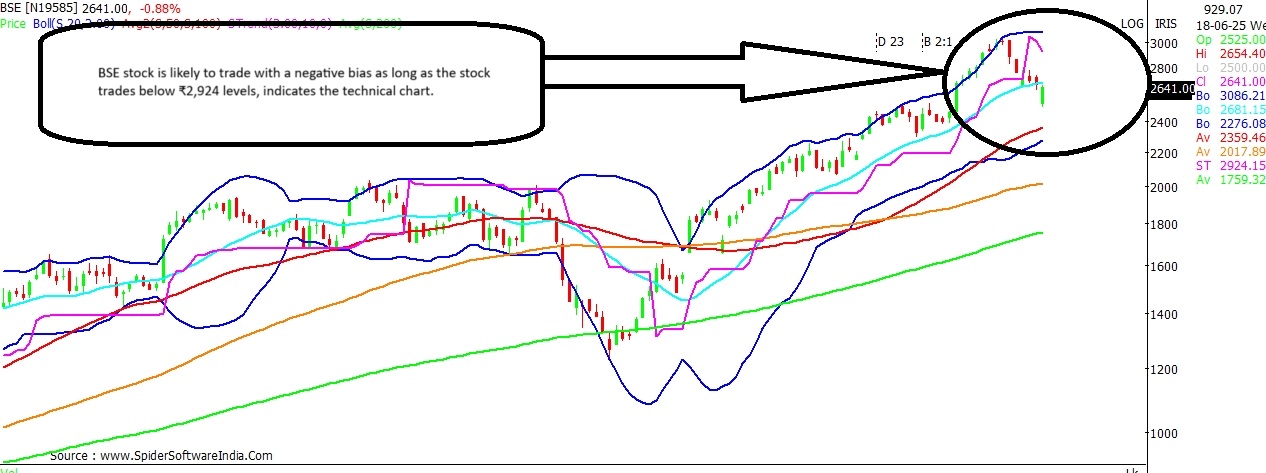
Technical chart shows that BSE stock is likely to trade with a negative bias as long as it sustains below ₹2,924 levels. Here are the key support levels to track.

VIX VAPOUR RISING, markets crash, sensex
Technical chart indicates that the BSE stock can fall another 19% from here on.
Rex Cano Mumbai
2 min read Last Updated : Jun 18 2025 | 10:05 AM IST
Shares of the Bombay Stock Exchange (BSE), listed on the National Stock Exchange (NSE) declined up to 6.2 per cent in intra-day deals on Wednesday to a low of ₹2,500 after the Securities Exchange Board of India (Sebi) approved to switch the derivatives expiry day of both the stock exchanges.  Derivatives contracts on the NSE will now expire on Tuesdays from September onwards, moving from the current Thursday expiry. Conversely, BSE contracts will expire on Thursdays, shifting from the current Tuesday expiry.  In May, the market regulator issued a circular restricting expiries to just two days a week and asked each exchange to select one. The current expiry days will remain in effect until August 31. Analysts believe BSE could cede some market share owing to the shift in expiry days. READ MORE  In recent days, BSE stock has witnessed selling pressure after the NSE placed it under the Additional Surveillance Measure (ASM) Stage-1 framework. Stocks placed under ASM framework require 100 per cent of the traded value to be blocked as margins. Further, pledging of stocks under the ASM category is barred.  ALSO READ | BSE, MCX, IEX: Which exchange stock is worth your portfolio?  BSE stock from its life-time high of ₹3,030 on June 10, 2025, has shed as much as 17.5 per cent at today's low.  At 9:40 AM, BSE share price had recouped some of the day's losses and traded around ₹2,643 amid trades of around 4.2 million shares at the counter on the BSE. Technical chart hints at likely further pain for the stock, with a downside risk of 19.4 per cent from here on. 

BSE

Current Price: ₹2,643  Downside Risk: 19.4%  Support: ₹2,500; ₹2,359; ₹2,275  Resistance: ₹2,680; ₹2,924  The BSE stock is likely to trade with a negative bias as long as the stock remains below ₹2,924 levels. At present, the stock is seen testing resistance around its 20-Day Moving Average, which stands at 2,680. CLICK HERE FOR THE CHART  The medium-term chart indicates that BSE share price can slide towards the weekly trend line support, which indicates a likely downside risk of 19.4 per cent from present levels to ₹2,130 levels. Intermediate support for the stock can be anticipated around ₹2,500, ₹2,359 and ₹2,275 levels. 

One subscription. Two world-class reads.

Already subscribed? Log in

Subscribe to read the full story →
*Subscribe to Business Standard digital and get complimentary access to The New York Times

Smart Quarterly

₹900

3 Months

₹300/Month

SAVE 25%

Smart Essential

₹2,700

1 Year

₹225/Month

SAVE 46%
*Complimentary New York Times access for the 2nd year will be given after 12 months

Super Saver

₹3,900

2 Years

₹162/Month

Subscribe

Renews automatically, cancel anytime

Here’s what’s included in our digital subscription plans

Exclusive premium stories online

  • Over 30 premium stories daily, handpicked by our editors

Complimentary Access to The New York Times

  • News, Games, Cooking, Audio, Wirecutter & The Athletic

Business Standard Epaper

  • Digital replica of our daily newspaper — with options to read, save, and share

Curated Newsletters

  • Insights on markets, finance, politics, tech, and more delivered to your inbox

Market Analysis & Investment Insights

  • In-depth market analysis & insights with access to The Smart Investor

Archives

  • Repository of articles and publications dating back to 1997

Ad-free Reading

  • Uninterrupted reading experience with no advertisements

Seamless Access Across All Devices

  • Access Business Standard across devices — mobile, tablet, or PC, via web or app

Topics :BSE stocksTrading strategiesstocks technical analysisMarket trendsMarket technicalsThe Smart InvestorStocks to avoidtechnical callsBuzzing stocksstock market trading

Next Story