As humans pursue their quest for immortality, ethical questions remain

Even as labs push the boundaries of age reversal, mythology reminds us that longevity carries consequences beyond the biological
putin, xi, kim, russia, north korea, china
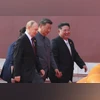
Xi Jinping, Vladimir Putin, and Kim Jong Un leaned close — not to talk of missiles but of biotech, organs, and lifespans stretched to 150 years. | Photo: AP/PTI
Kumar Abishek New Delhi
4 min read Last Updated : Sep 12 2025 | 11:30 PM IST
A parade in Beijing was meant to showcase steel and certainty: Columns of modern weaponry, synchronised salutes, leaders framed like statues above Tiananmen Gate. Then a hot-mic moment betrayed something softer. Xi Jinping, Vladimir Putin, and Kim Jong Un leaned close — not to talk of missiles but of biotech, organs, and lifespans stretched to 150 years. The men who embody power’s permanence revealed their own unease with the inexorables of time; the clock is ticking. 
The longing to outwit death has trailed humanity for millennia. In Indian mythology, devas and asuras churned the cosmic ocean to extract amrita, the nectar of immortality. The prize promised eternity but also provoked chaos: Who would drink first, who would rule forever? Alchemists mixed metals in search of eternity, philosophers debated its worth, novelists sketched futures where death was little more than a scheduling glitch. The seekers change — devas, kings, scientists, moguls — but the craving endures: To keep living. 
What once belonged to epic now lives in experiment. Partial cellular reprogramming nudges cells backwards in time with Yamanaka factors (genes that reset cell identity), coaxing them into a younger state. In mice, the results border on miraculous: Tissues rejuvenated, vision restored. Push too far, though, and the cells forget who they are, tumbling into tumours. Jeff Bezos-backed Altos Labs is betting billions that this perilous dance can be choreographed into therapy, a reset of the biological clock itself. At the centre of the new creed of longevity stands Bryan Johnson, the millionaire biohacker who has turned his body into a testbed, a project he calls Blueprint. His pursuit of age reversal runs on relentless discipline, a strict diet, and even controversial plasma transfusions, including from his teenage son. The spectacle is equal parts fascinating and faintly mad. 
Meanwhile, quieter advances hum along. Senolytic drugs aim to clear away “zombie” cells that accumulate with age, leaking inflammation and dysfunction. In animals — and early human trials — they rejuvenate hearts, brighten eyes, strengthen lungs. Aubrey de Grey’s SENS framework approaches ageing like a maintenance backlog: Repair mitochondria, sweep protein clumps, patch DNA, tidy cellular debris. The goal is not immortality but negligible senescence: Slower wear, longer vigour, decades rather than centuries. 
The sober counterpoint comes from a piece published in Nature, in which S Jay Olshansky, Bradley J Willcox, Lloyd Demetrius, and Hiram Beltrán-Sánchez argue: “Until it becomes possible to modulate the biological rate of aging… radical life extension in already long-lived national populations remains implausible in this century.” 
Ageing cannot be cured by any single pill or magic bullet: Telomeres shorten, mitochondria stumble, proteins misfold. Pull one thread and others unravel. Extending a mouse’s life by 30 per cent is remarkable; stretching humans by a century is another matter entirely. 
Science fiction has long rehearsed scenarios biology hasn’t yet delivered. Richard Morgan’s Altered Carbon imagines consciousness endlessly recycled into fresh bodies, widening gulfs between the wealthy long-lived and the expendable poor. Drew Magary’s The Postmortal sketches laws, marriages, and meaning collapsing when death is postponed indefinitely. 
Even as labs push the boundaries of age reversal, mythology reminds us that longevity carries consequences beyond the biological. Ashwatthama, cursed to wander the earth for eternity after the Kurukshetra war, embodies the hidden cost of immortality: A witness to endless change, forever outside the world he cannot leave, a reminder that living forever is not always a gift. 
The ethical dilemmas sharpen with every lab breakthrough. If longevity therapies arrive as products, who will buy them? Will society split into biological haves and have-nots? The ancients anticipated this imbalance when divine nectar threatened cosmic order. Today the risk is less mythical but just as urgent: Longevity for the few, decline for the rest. 
Still, the incremental gains matter. Senolytics that ease heart disease, gene therapies that restore sight, regenerative scaffolds that keep kidneys or livers working for another decade. They may not rewrite the human condition, but they redraw the map of old age, its final chapters less punishing and more humane. The tools — CRISPR, stem cells, nanotech — are real. 
Perhaps immortality will remain half-legend, half-lab report. Perhaps science delivers not forever but increments: Fragile, real, precious increments of time. For now, the ocean still churns, the lab lights still burn, and the amrita remains just beyond reach.

One subscription. Two world-class reads.

Already subscribed? Log in

Subscribe to read the full story →
*Subscribe to Business Standard digital and get complimentary access to The New York Times

Smart Quarterly

₹900

3 Months

₹300/Month

SAVE 25%

Smart Essential

₹2,700

1 Year

₹225/Month

SAVE 46%
*Complimentary New York Times access for the 2nd year will be given after 12 months

Super Saver

₹3,900

2 Years

₹162/Month

Subscribe

Renews automatically, cancel anytime

Here’s what’s included in our digital subscription plans

Exclusive premium stories online

  • Over 30 premium stories daily, handpicked by our editors

Complimentary Access to The New York Times

  • News, Games, Cooking, Audio, Wirecutter & The Athletic

Business Standard Epaper

  • Digital replica of our daily newspaper — with options to read, save, and share

Curated Newsletters

  • Insights on markets, finance, politics, tech, and more delivered to your inbox

Market Analysis & Investment Insights

  • In-depth market analysis & insights with access to The Smart Investor

Archives

  • Repository of articles and publications dating back to 1997

Ad-free Reading

  • Uninterrupted reading experience with no advertisements

Seamless Access Across All Devices

  • Access Business Standard across devices — mobile, tablet, or PC, via web or app

Topics :Vladimir PutinBeijingXi JinpingResearchBS Opinion

Next Story



