Adhir Ranjan Chowdhury’s suspension from the Lok Sabha has been revoked after he offered an apology for his remarks in the Lower House (which have since been expunged and, therefore, cannot be reproduced here). The main thing is, we will be able to hear Mr Chowdhury’s speeches — in dire Hindi — once again in the Lok Sabha, for what they are worth.
But then oratorical flourish is not the reason Mr Chowdhury was appointed leader of the Opposition and leader of the Congress in the Lok Sabha in 2019 in the first place. Sonia Gandhi is extremely fond of the MP from Behrampore, West Bengal. She refers to him as a “fighter”, which he is, as he is indefatigable in his opposition to both Mamata Banerjee and the Bharatiya Janata Party (BJP). Both use him as target practice, though their tactics are different. Ms Banerjee has leveraged her position as chief minister to frame some of Mr Chowdhury’s closest associates in Murshidabad and Malda — his area of influence — in criminal cases. Many have joined the Trinamool Congress to prevent this possibility. In Parliament, the BJP toys with him, implying “injustices” done to him by the Gandhi family. In the recent vote of confidence debate, Prime Minister Narendra Modi made his “gud ka gobar kaise kiya jata hai, koi inse seekhe” (one should learn from him how to snatch defeat from the jaws of victory) remark in the context of Mr Chowdhury’s speeches. The BJP mockingly offered him time to make his speech from its own quota. In the past, Union Home Minister Amit Shah yielded and let him tie himself up in knots during the debate on Article 370 as the leader of the Opposition deviated almost completely from the Congress line on Kashmir and the role of the United Nations. Video grabs of his speech show Sonia Gandhi turning and gesticulating to him to stop, signals he ignored. This was largely, though not entirely, a function of Mr Chowdhury’s determination to speak in his execrable Hindi.
Mr Chowdhury is a self-made politician in the sense that politics was not an inheritance. He belongs to a region in West Bengal where the Muslims are in a majority, 51 per cent of the voters on average. The Malda-Murshidabad-Uttar Dinajpur region has been a stronghold of the Congress for decades, represented as it was by Abdul Barkat Ataur Ghani Khan Chowdhury, former Union railway minister. The difference is, Mr Chowdhury is a Hindu elected from a Muslim-dominated region. He has been a Lok Sabha MP five times consecutively. That puts him right up there on the Lok Sabha seniority charts, though the party has better speakers like Shashi Tharoor and Manish Tewari.
His politics was of the Robin Hood variety, derived from Left militancy, which inspired him to join politics but which he gradually gave up. Young men who tried to molest women would be thrashed roundly in full public view; many parents who could not afford to get girls married were assisted financially by Mr Chowdhury; he funded sport, Durga puja pandals, community libraries, and all the other routes to power in Bengal politics. His style was to project quiet menace that could quickly graduate to cold rage — and then if you disappeared in the Bhagirathi (which runs through his constituency), nobody was responsible but yourself! He was embroiled in half a dozen cases, some attracting Section 302 of the Indian Penal Code (murder) and 307 (attempt to murder). In most, he was acquitted.
After the death of sitting MLA and state minister Subrata Saha in 2022, the Congress won the Sagardighi Assembly constituency for the first time in 50 years, in a by-election, entirely due to Mr Chowdhury’s efforts: The constituency fell in his area of influence. He campaigned vigorously against the Trinamool Congress. Within two months, the winner Bayron Biswas, the first and only Congress MLA in the Assembly since 2021, joined the Trinamool Congress. Whatever his faults and drawbacks, Mr Chowdhury has never wavered in his allegiance to the Congress. But now, it is his party that might have to give up on him.

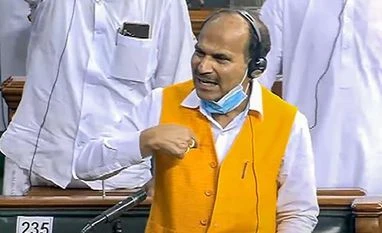 "Diminishing world of Adhir Chowdhury")












 Connect with us on WhatsApp