Govt goes into pantomime mode to assuage foreign critics

Political observers will do their own math to explain what might have led to such an unusual alignment of political correctness
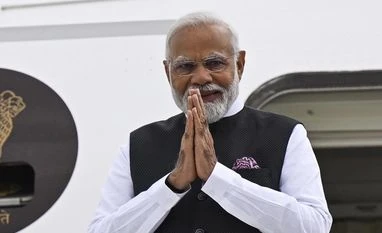
PM Modi in Paris
Photo: PTI
Bharat Bhushan New Delhi
6 min read Last Updated : Jul 26 2023 | 3:10 PM IST
From Washington DC and Cairo to Paris and Abu Dhabi, Prime Minister Narendra Modi is the season's flavour. However, the recurrent charge that his government is antithetical to India's religious minorities hobbles his stride across the world stage.

On the day he was guest of honour at France's Bastille Day Parade, its premier newspaper, Le Monde, ran an article headlined "Narendra Modi has fostered state-sponsored violence for decades". Describing his career as "punctuated by violent nationalist upsurges, purges and abuses", the article says that Indian Muslims were "under relentless attack from Hindu nationalists with the support of the BJP-led government" and that "violent, armed mobs regularly attack Muslims and openly call for the rape of Muslim women". It was a deliberate attempt to discredit the leader who only a day earlier had been given France's highest civilian award, the 'Grand Cross of the Legion of Honour'.

During his US visit, the charge was led by former President Barak Obama in an interview with CNN's Christian Amanpour, where he urged President Joe Biden that "the protection of Muslim minority in a majority Hindu India is something worth mentioning." He insisted that while the US had to do business with countries whose governments and political parties were not "ideally democratic" – referring to China and India – it would be perfectly all right for Biden "to uphold those principles and to challenge, whether behind closed doors or in public, trends that are troubling". It is not known whether President Joe Biden heeded this advice in their closed-door discussions.

However, in an unusual move, Prime Minister Modi, averse to answering questions from journalists, agreed to take one from the White House Press Corps. Was it a coincidence that the question was about the steps he would take to protect minority rights, the rights of Muslims and uphold free speech in India? The journalist happened to be a Muslim and a woman to boot. Political observers will do their own math to explain what might have led to such an unusual alignment of political correctness.

Consider two further events immediately following the prime minister's visit to Washington, DC.

On his return journey, Prime Minister Modi stopped at Cairo for an official visit. He chose to visit the 11th Century Al-Hakim Mosque, which had been repaired with the help of the Dawoodi Bohra community. The mosque visit underlined his long-standing links with the affluent Bohra community of Gujarat, a state he once ruled and which houses the seat of the sect at Siddhpur in Patan. It showcased the Indian Prime Minister in a mosque in a Muslim country in the company of Muslim leaders he was comfortable with. Dawoodi Bohras are mostly Shias -- a minuscule minority of India's predominantly Sunni Muslim population -- and, traditionally, BJP supporters. They have not borne the brunt of Hindutva violence against minorities. Although their Indian population is only about 1-1.2 million, the signal the interaction sent out was that Prime Minister Modi and his government were Muslim-friendly.

Another noteworthy event post the US visit was Delhi hosting an official visit of Muslim World League chief Mohammad Bin Abdulkarim Al-Issa, a former justice minister of Saudi Arabia, in Delhi. Al Issa met both Prime Minister Modi and President Draupadi Murmu. India's national security advisor (NSA) hosted a lavish dinner in his honour, attended by the clutch of Muslim clerics usually showcased on such occasions. At an event for Al-Issa at the India Islamic Cultural Centre in Delhi, the NSA declared that "India is home to Islam", where it occupies a unique and significant "pride of place".

Al-Issa is the right-hand man of Saudi Crown Prince Mohammad Bin Sultan, aka MBS. The Muslim World League, of which he is Secretary General, was founded in 1962 by King Faisal to spread Salafism globally. The difference between Wahhabism and Salafism is that the former is a pared-down Islam that rejects modern influences, whereas Salafism seeks to reconcile Islam with modernity. Al Issa predictably said just the things his hosts wanted to hear; that he had not experienced anywhere else the kind of peaceful coexistence he has witnessed in India and praised Indian democracy, the Constitution of India and the values that promote peaceful coexistence.

However, these damage control operations were thrown out of joint by the scathing and unprecedented criticism of the government by the European Parliament on the civil war-like situation in Manipur. The conflict was described in an EU parliamentary resolution as between "Hindu Meiteis" and "Christian Kukis" and denounced "in the strongest terms nationalistic rhetoric deployed by leading members of the BJP party (sic)", noting that human rights organisations have accused the party of "divisive ethno-nationalistic policies." Even though the EU resolution has been criticised as an "interference in the internal affairs of India", it would not be surprising were leaders of the ruling regime to call Christian bishops for a dialogue. It would be yet another pantomime without any change on the ground.

These carefully choreographed public events suggest that Western criticism of India's treatment of its minorities has indeed cut the regime to the bone. But the BJP government's playbook of mosque visits and photo-ops with Islamic clerics only addresses the problem in a limited way. It shows that its leadership only sees citizens through the lens of religion and maulanas of various hues as representative of India's Muslim citizens. But massaging the egos of clerics will not assure India's Muslim citizens of security. That has to be based on constitutional rights and faith in the instruments of public order. Public pantomimes are a fake resolution of the real problem that the world is pointing to.

But can the ruling party give up the majoritarian ideology that drives its political actions? Can the Hindu-Muslim communal card really be taken off the table for the 2024 general election and Prime Minister Modi's bid for a third term? For the time being, certificates of support from clerics and visits to mosques appear to be the best the BJP government can do to counter its global critics.

One subscription. Two world-class reads.

Already subscribed? Log in

Subscribe to read the full story →
*Subscribe to Business Standard digital and get complimentary access to The New York Times

Smart Quarterly

₹900

3 Months

₹300/Month

SAVE 25%

Smart Essential

₹2,700

1 Year

₹225/Month

SAVE 46%
*Complimentary New York Times access for the 2nd year will be given after 12 months

Super Saver

₹3,900

2 Years

₹162/Month

Subscribe

Renews automatically, cancel anytime

Here’s what’s included in our digital subscription plans

Exclusive premium stories online

  • Over 30 premium stories daily, handpicked by our editors

Complimentary Access to The New York Times

  • News, Games, Cooking, Audio, Wirecutter & The Athletic

Business Standard Epaper

  • Digital replica of our daily newspaper — with options to read, save, and share

Curated Newsletters

  • Insights on markets, finance, politics, tech, and more delivered to your inbox

Market Analysis & Investment Insights

  • In-depth market analysis & insights with access to The Smart Investor

Archives

  • Repository of articles and publications dating back to 1997

Ad-free Reading

  • Uninterrupted reading experience with no advertisements

Seamless Access Across All Devices

  • Access Business Standard across devices — mobile, tablet, or PC, via web or app

More From This Section

Disclaimer: These are personal views of the writer. They do not necessarily reflect the opinion of www.business-standard.com or the Business Standard newspaper

Topics :Narendra ModiIndia Prime MinistermediaFranceUnited StatesBarrack ObamaBJPIndia-Franceminorities

Next Story



