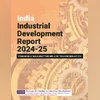
INDIA’S INDUSTRIAL DEVELOPMENT REPORT 2024-25: Towards a manufacturing transformation
Producer: ISID
Publisher: Academic Foundation
Pages: 206
Price: Rs 2,500
The British-Hungarian economist Nicholas Kaldor’s assertion that “few countries, if any, attained economic growth without industrialization” is as relevant for India as any other country. The trajectory of most developed economies indicates a similar pattern; they evolved from manufacturing to services to technology. Today, a combination of these factors help them remain competitive. Having missed the industrial revolution and failing to make a timely course correction after Independence, India paid a heavy price in terms of economic growth and jobs. The assumption that services would help to leapfrog the economy was, in hindsight, erroneous. On the path to Viksit Bharat 2047, the need to urgently make systemic and structural corrections has been critically analysed by the India Industrial Development Report 2024-25, brought out by the Institute for Studies in Industrial Development (ISID).
The report makes recommendations for positioning India as the next manufacturing hub, underlining the positive impact of policy initiatives such as Make-in-India, Production Linked Incentives (PLI), infrastructure development, industrial corridors, promotional measures and so on. This optimistic projection is expected to be a long haul given that the share of manufacturing in India’s gross domestic product (GDP) has stagnated at 17 per cent, much behind its East Asian peers at about 30 per cent, and share in global manufacturing is meagre at 3.1 per cent.
The report, while acknowledging the importance of big industry, advocates strengthening medium and small enterprises and startups, considering their potential to generate jobs and promote balanced growth; nearly 65 million MSMEs generate about 109 million jobs, contributing 30 per cent to GDP and 49 per cent to exports. But 99.5 per cent are micro enterprises, making them vulnerable to import surges, monopolist buyers, price fluctuations and dumping. ISID recommends support through government procurement, affordable credit, cluster formations, ease of regulation, use of e-commerce and adoption of Industrial Resolution 4.0 (IR4.0) technologies. However, making raw materials and components available at competitive prices in a highly monopolistic domestic environment remains a challenge.
Analysing India’s less-than-impressive export performance compared to its peers, the study highlights its modest share in global exports that grew incrementally from 0.52 per cent in 1990 to 1.81 per cent in 2022. In the same period, China’s share grew from 1.79 to 14.36 per cent. One way to narrow this gap, the report suggests, is to participate in the Global Value Chains (GVCs) through free trade agreements. Also, to navigate the disruptive reciprocal tariffs, it may be prudent to diversify and deepen supply chain networks closer home in Asia. This calls for industry orientation and prioritising exports at the policy level.
ISID lauds India’s impressive foreign direct investment (FDI) flows at about $70 billion at an average in the last few years. However, distilling that number reveals disproportionately lower FDIs in the greenfield (manufacturing) than in the brownfield (M&As) and foreign portfolio investments . The flight of capital is also worrisome. Even as the Indian Missions abroad embark on encouraging multinationals to establish manufacturing units in India, as ISID suggests, the prospects for the China+1 shift hinges on making our investment climate robust. An upgrade of India’s model Bilateral Investment Treaty 2015 is a work in progress. FDI is not a silver bullet; more significant is the private sector’s ability to raise capital for projects and taking calculated risks.
ISID analyses Indian industry’s abysmally low R&D investment at 0.70 per cent of GDP, much below the global average of 1.92 per cent, and recommends enhancement of such investments above 2 per cent in new IR4.0 technologies to achieve global competitiveness. A domestic carbon pricing mechanism has been suggested to support both decarbonisation of Indian industry and counter EU’s Carbon Border Adjustment Mechanism.
ISID supports spatial manufacturing activity across India’s 11 multimodal industrial corridors, being developed across 19 states covering 163 districts, an approach in sync with Paul Krugman theory of economic geography underpinned by structural transformation. The Gati Shakti initiative through use of digital technologies should resolve the last mile delivery challenges. Further, ISID sees merit in India playing a prime role in developing cross-border economic corridors along current connectivity projects.
ISID’s recommendations for a New Industrial Strategy, the creation of the National Industrial Development Bank of India for exclusively manufacturing and setting up an apex body of experts for policy guidance are novel and commendable. They may well hold the key to drive India’s manufacturing-led growth towards achieving Viksit Bharat 2047.
The reviewer is a serving Indian Foreign Service officer