Missing Mr Xi

China's leader skips the G20, underlining his unwillingness to make place for an aspirational India
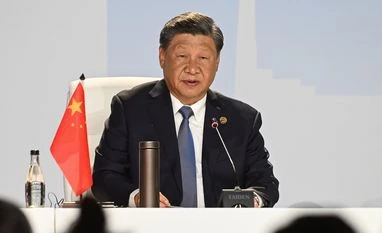
Xi jinping
Photo: Bloomberg
Mihir S Sharma
5 min read Last Updated : Sep 08 2023 | 10:53 PM IST
Leaders from across the world have gathered in New Delhi this weekend for the G20 summit. An expectant air hangs over the city: The Public Works Department has spruced large parts of it up, and the security services have shut the rest of it down.

For Prime Minister Narendra Modi, the international outcomes, while important, might in fact be secondary. The general election is looming, and Mr Modi would like a conspicuous success at the summit. A crucial part of Mr Modi’s implicit contract with his voters is that, under him, India will take on a leadership role in world affairs that matches or even outmatches the country’s size and economic strength.

There is, however, a problem at the heart of this effort: The People’s Republic of China. The G20’s vibe isn’t as celebratory as it could be, because it will feel incomplete without President Xi Jinping. We learned this week that Mr Xi won’t be attending, though we weren’t told why. There has been plenty of speculation: Some argue that Mr Xi may not want to discuss China’s stuttering economy with other world leaders, others that it’s a way of elevating the Brics grouping, which just took in a slew of new members. There have even been (somewhat fanciful) claims that internal Communist Party politics is keeping him away.

Many in New Delhi aren’t working very hard to figure out why Mr Xi kept away. We think we already know: It’s a pointed snub to Indian aspirations. His absence — especially after he turned up in Johannesburg for a Brics meeting just a fortnight ago — is hard to read as anything else. Especially if you read it, as some policymakers do, as part of a pattern established by China’s top leaders in the Xi era, in which India’s claims to global leadership have been repeatedly diminished and ignored.

Let’s face it: For Mr Modi, this state of affairs must be both a personal disappointment and an equally personal responsibility. He has made the choice, multiple times, to attempt a complete reset of relations with the People’s Republic of China. That was, in fact, his first major foreign policy initiative when he came into power nine years ago. The two leaders strolled along the redeveloped Sabarmati waterfront in Ahmedabad and sat together on a swing; but, even as they chatted, news broke that the People’s Liberation Army had begun a fresh incursion into Indian-held areas in the Himalayas, setting off a sustained confrontation with Indian troops.

This was only the first of many snubs. Beijing’s diplomats have also thwarted their Indian counterparts’ attempts to sanction Pakistan-based terrorists at the United Nations, and kept India out of the Nuclear Suppliers Group, which regulates international commerce in nuclear materials.

The upshot: Indian policymakers feel that they have gone out of their way to respect Beijing’s various red lines, but have received no such consideration in return.

Disputes over the border and terrorism could perhaps be treated as ephemeral, issues that could conceivably be sorted out over time. But, in fact, in an age defined by the ambitions of Mr Xi, worries about the future of the India-China relationship run deeper. The central problem is that it now looks like Beijing will not support and ease India’s rise to the global high table, the way India did for China’s rise over the past decades.

This adds some context to the anger and disappointment around Mr Xi’s unexplained absence from New Delhi this weekend. This G20 summit was designed by Mr Modi as a coming-out party for a newly assertive, fast-growing power. Over the past months, there have been dozens of high-level meetings meant to work on the summit’s final agenda; but, unlike during Indonesia’s presidency last year, these ended without a joint statement from the ministers in attendance. Chinese and Russian officials have consistently refused to allow the consensus wording on the Ukraine war hammered out during Indonesia’s presidency to be used during India’s. And now Mr Xi has tried to pull the rug from under the summit itself.

Are we overthinking this? Surely, the fact that both countries profess to want a “multipolar world”, a clear dig at the United States and the West, is more important than snubs, real or imagined? I’m not so sure. After all, India and the People’s Republic of China have sharply diverged on the basic question of what a multipolar world would look like. India is convinced that a new set of institutions that properly represent developing countries must replace the post-war order. Meanwhile, Beijing, for all its claims of not wanting a new cold war, appears comfortable imagining a diarchy with the United States — a “G2”, as it was called during the Obama administration. There’s no place in Beijing’s vision for India as an equal partner.

If Mr Xi and his generation of leaders resent the US for not adjusting to China’s rise and making room for a new superpower, they seem wilfully blind to how they are engendering the same resentments in the giant country to their south. India’s rise is slower and less dramatic than China’s; but, unless China makes room for it, it risks a future in which it must deal with two angry giants, not one.

One subscription. Two world-class reads.

Already subscribed? Log in

Subscribe to read the full story →
*Subscribe to Business Standard digital and get complimentary access to The New York Times

Smart Quarterly

₹900

3 Months

₹300/Month

SAVE 25%

Smart Essential

₹2,700

1 Year

₹225/Month

SAVE 46%
*Complimentary New York Times access for the 2nd year will be given after 12 months

Super Saver

₹3,900

2 Years

₹162/Month

Subscribe

Renews automatically, cancel anytime

Here’s what’s included in our digital subscription plans

Exclusive premium stories online

  • Over 30 premium stories daily, handpicked by our editors

Complimentary Access to The New York Times

  • News, Games, Cooking, Audio, Wirecutter & The Athletic

Business Standard Epaper

  • Digital replica of our daily newspaper — with options to read, save, and share

Curated Newsletters

  • Insights on markets, finance, politics, tech, and more delivered to your inbox

Market Analysis & Investment Insights

  • In-depth market analysis & insights with access to The Smart Investor

Archives

  • Repository of articles and publications dating back to 1997

Ad-free Reading

  • Uninterrupted reading experience with no advertisements

Seamless Access Across All Devices

  • Access Business Standard across devices — mobile, tablet, or PC, via web or app

More From This Section

Disclaimer: These are personal views of the writer. They do not necessarily reflect the opinion of www.business-standard.com or the Business Standard newspaper

Topics :BS OpinionXi JinpingChinaG20 meetsG20 summitNew Delhi

Next Story



