Mumbai's trillion-dollar realty faces real climate risk, not a distant threat

With seas rising and drainage failing, Mumbai's property market is heading for a climate reckoning that few investors or policymakers are truly prepared for
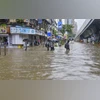
Mumbai Rains
As sea levels rise and land subsides, Mumbai’s coastal skyline faces mounting climate threats—posing deep risks to infrastructure, housing and real estate valuations (Photo:PTI)
Ajay Shah
6 min read Last Updated : Jul 21 2025 | 10:34 AM IST
There has been a deceleration in the global policy work on decarbonisation, starting in the first Donald Trump presidency in the US (2016) and then Russia’s invasion of Ukraine (2022). The outlook on emission is now more challenging. We all have to shift from planning on something near the median scenario to something closer to the high-emission scenarios.
 
What does this mean for Bombay? In high-emission scenarios computed by the International Panel for Climate Change, the sea level at Bombay is likely to rise by about 25 cm by 2050. This reflects the thermal expansion of sea water and the global melting of ice in a warmer world. 
Alongside this, there is a local geological phenomenon that affects Bombay, which is subsidence. Bombay is subsiding by around 2 mm per year. This reflects factors including sediment compaction, groundwater extraction, and the load of the urban built environment upon the reclaimed land. This phenomenon is likely to add about 5 cm to the rising waters by 2050. Putting these together, the sea level at Bombay is likely to rise by about 30 cm or about 12 inches. 
When we look beyond 2050, high-emission scenarios are much worse than the median scenario. So we should think that the waters will rise by about 12 inches to 2050 and then things will get much worse to 2100. 
In a swimming pool, we can readily visualise a water level that's about 12 inches higher. We tend to visualise ourselves standing at the Aksa beach, and water at the knees reaching up to the waist. But the sea is not a swimming-pool. It is full of motion. When the average sea level rises by a small amount, this has big implications for the urban environment. 
It directly elevates the probability and severity of coastal flooding events, particularly during astronomical high tides and meteorological storm surges. Areas currently experiencing occasional “nuisance flooding” will encounter such events with greater regularity and increased inundation depth. 
The drainage system will worsen. The existing urban drainage infrastructure largely relies on gravity for discharge, and will work less well. This will impede the efficient discharge of rain and river water. This will give more prolonged waterlogging after precipitation events. Ideally, good city governance should involve investment in building and operating adequate pumping stations.
 
The higher sea level will impact transportation networks (roads, railways, metro lines), utility conduits (sewage systems, water supply pipes, electrical cables), and building foundations in low-lying zones. The combination of more frequent inundation and more saltwater exposure will induce accelerated degradation, higher maintenance costs, and a reduced asset lifespan. Private and public actors would ideally muster the resourcing and management to combat this higher depreciation rate and stave off catastrophic failures. 
Under realistic Indian conditions, there will be flaws in public and private actions. The pumping stations will be inadequate, the operation and maintenance of assets will be patchy, and so many things will go wrong. 
The problem of global warming is often seen as something speculative, something that will happen in the deep future. The reasoning above locates us in a specific Indian setting (ie Bombay) and a date that fits within normal human planning horizons (ie 25 years out). For anyone below 75, these are scenarios that matter. 
An integration of these physical climate risks into financial decision-making is necessary for accurate market pricing. For individuals and entities considering real estate investment in Mumbai, eg for long-term use or for bequest, the 30-cm effective sea level rise by 2050 constitutes material non-financial information for thinking about future utility and future asset valuation. 
Real estate investors need to think about three kinds of concerns. Anticipated risks of future floods and increased operational costs will reduce investor and end-user demand, exerting downward pressure on property prices in vulnerable locations. Costs of property ownership will increase due to higher insurance premiums (or the potential withdrawal of flood insurance coverage), augmented maintenance expenditures for floodproofing, and potential structural repairs necessitated by water damage. The market for properties with significant climate-risk exposure may become less liquid as the pool of informed buyers shrinks. 
These problems also impact upon the thinking of financial firms. The scenario for 2050 is becoming material for the planning horizon for firms with real estate exposure. Real estate in Bombay alone is perhaps worth half to one trillion dollars, and adverse events for this will ricochet through the system of asset prices. Lenders face credit risks associated with potential collateral devaluation, and increased default probabilities from borrowers incurring climate-related losses. 
In India, the Reserve Bank of India (RBI) has been making progress on these questions. They are close to releasing rules for banks and financial institutions regarding the disclosure and management of climate-change risks. This will give regular disclosures about climate-related risks within loan portfolios, along with mitigation strategies, targets, and stress tests. It will take substantial work, by financial firms, to develop these capabilities, and a three-year lead time is envisaged prior to mandatory disclosures.
 
Given the strategic apathy of many Indian financial firms, new kinds of disclosures will first reflect mere compliance with RBI rules, with contracting out to consultants and software vendors. A great deal of new knowledge building will be required to utilise this data more deeply for reshaping investment strategies and the behaviour of a variety of firms. Understanding and responding to climate change will become a differentiating factor shaping an edge in the performance of better firms. 
Such reporting will reshape incentives at many levels. Investors in financial firms will be able to reprioritise in favour of the better prepared ones. Financial firms will face market-based incentives in favour of more climate-resilient assets. Properties demonstrating resilience to projected hydrological changes will likely command a premium, while those with identified vulnerabilities will experience adjustments in market value. In similar fashion, climate change needs to be woven deeply into financial regulation all across the financial system, including the regulators and the  Employees’ Provident Fund Organisation.
 
The author is a researcher at XKDR Forum

One subscription. Two world-class reads.

Already subscribed? Log in

Subscribe to read the full story →
*Subscribe to Business Standard digital and get complimentary access to The New York Times

Smart Quarterly

₹900

3 Months

₹300/Month

SAVE 25%

Smart Essential

₹2,700

1 Year

₹225/Month

SAVE 46%
*Complimentary New York Times access for the 2nd year will be given after 12 months

Super Saver

₹3,900

2 Years

₹162/Month

Subscribe

Renews automatically, cancel anytime

Here’s what’s included in our digital subscription plans

Exclusive premium stories online

  • Over 30 premium stories daily, handpicked by our editors

Complimentary Access to The New York Times

  • News, Games, Cooking, Audio, Wirecutter & The Athletic

Business Standard Epaper

  • Digital replica of our daily newspaper — with options to read, save, and share

Curated Newsletters

  • Insights on markets, finance, politics, tech, and more delivered to your inbox

Market Analysis & Investment Insights

  • In-depth market analysis & insights with access to The Smart Investor

Archives

  • Repository of articles and publications dating back to 1997

Ad-free Reading

  • Uninterrupted reading experience with no advertisements

Seamless Access Across All Devices

  • Access Business Standard across devices — mobile, tablet, or PC, via web or app

Topics :BS OpinionMumbaiWater Level

Next Story


