Crash test

New hit-and-run law demands better policing
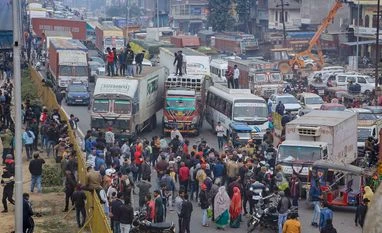
Truck drivers protest
Truck drivers protest (File Photo)
Business Standard Editorial Comment Mumbai
3 min read Last Updated : Jan 04 2024 | 10:41 PM IST
Protests earlier by truckers, since withdrawn, and now by cab drivers over the new law on hit-and-run accidents reflect problems both with the road transportation industry and the nature of the country’s policing and judicial systems. The new law, Section 106, is part of the Bharatiya Nyaya Sanhita (BNS), passed by Parliament to replace the Indian Penal Code (IPC). It imposes a jail term of up to 10 years and/or a fine if a driver injures or kills anyone through rash and negligent driving and fails to report it to a police officer or magistrate soon after the incident. Punishment under the old IPC entailed a jail term of two years and/or a fine. The new laws are in consonance with standards in the United States (US) and European Union. In the US, for example, every state imposes criminal charges for fleeing the scene of an accident. Punishment includes imprisonment of between one year and 15 years, and fines between $5,000 and $20,000. A look at the statistics in India suggests that a stringent penal law was overdue.

According to the National Crime Records Bureau (NCRB), India has between 43,000 and 47,000 recorded hit-and-run cases, involving over 50,000 victims. The high share of hit-and-run cases in road fatalities — it is the second-largest cause of road accident deaths — points to the problem of non-reporting. Since the law applies to all citizens, why are only truckers and cabbies so exercised about it? The answer lies in the fact that they are most vulnerable to the new law because incentives for rash and negligent driving are hardwired into the commercial vehicle services. It is, for example, a well-established practice for transporters to offer truckers generous bonuses for delivering goods ahead of time. Likewise, cab drivers as daily wage earners seek to maximise their earnings by transporting as many fares as possible, a trend the advent of platform aggregators has accentuated. The other question is why Indians are reluctant to discharge their civic duty when it comes to reporting hit-and-run accidents. This is partly a function of the deeply disagreeable nature of police interface with the public — a 2018 study showed that fewer than 25 per cent of Indians trust the police — the fear of being embroiled in typically long-drawn court cases and, not least, the inability to access cost-effective legal help. The new law, then, though designed to act as a deterrent, could as well encourage a lower rate of reporting too.

The low conviction rate highlights the real problem indeed, those responsible for hit-and-run accidents often get away with them. The NCRB data shows that only about 49 per cent of cases end in conviction. This is an issue that no law, however tough, can address without expanding and training the state police forces and equipping them with adequate infrastructure such as efficient surveillance cameras at the very least. In Delhi, for example, there are around 80,000 police persons but only around 6,000 of them are in the traffic section. Section 106 of the BNS, therefore, is well-intentioned but likely to be ineffective without a robust foundation in the law-enforcement apparatus.

One subscription. Two world-class reads.

Already subscribed? Log in

Subscribe to read the full story →
*Subscribe to Business Standard digital and get complimentary access to The New York Times

Smart Quarterly

₹900

3 Months

₹300/Month

SAVE 25%

Smart Essential

₹2,700

1 Year

₹225/Month

SAVE 46%
*Complimentary New York Times access for the 2nd year will be given after 12 months

Super Saver

₹3,900

2 Years

₹162/Month

Subscribe

Renews automatically, cancel anytime

Here’s what’s included in our digital subscription plans

Exclusive premium stories online

  • Over 30 premium stories daily, handpicked by our editors

Complimentary Access to The New York Times

  • News, Games, Cooking, Audio, Wirecutter & The Athletic

Business Standard Epaper

  • Digital replica of our daily newspaper — with options to read, save, and share

Curated Newsletters

  • Insights on markets, finance, politics, tech, and more delivered to your inbox

Market Analysis & Investment Insights

  • In-depth market analysis & insights with access to The Smart Investor

Archives

  • Repository of articles and publications dating back to 1997

Ad-free Reading

  • Uninterrupted reading experience with no advertisements

Seamless Access Across All Devices

  • Access Business Standard across devices — mobile, tablet, or PC, via web or app

Topics :Business Standard Editorial Commentroad accidenttruck strikeIndian Penal Code

Next Story



