Politics over Delhi's pollution and worsening air quality has once again surfaced. With the air quality index (AQI) soaring past 300 in most parts of the national capital, the Aam Aadmi Party (AAP) has now accused the
Rekha Gupta-led Delhi government of its "failure" to stop pollution in the city.
Meanwhile, Delhi's Environment Minister Majinder Singh Sirsa on Tuesday accused the Aam Aadmi Party (AAP) government of Punjab of forcing the farmers to burn crop residue to increase the pollution levels in the national capital.
Sirsa said, "The farmers in Punjab are being forced to burn stubble in the fields by the AAP government. The highest number of parali burning incidents occurred in AAP-ruled Punjab on Diwali night." He further claimed that while the AAP government condemned the Delhi CM, the BJP and Sanatan Dharm followers over the celebration of Diwali and bursting of crackers, the real reason behind worsening air quality was stubble burning in Punjab, news agency PTI reported.
Blame game erupts over pollution in Delhi
AAP MLA Gopal Rai accused the BJP-led government of "making excuses" and not taking measures to prevent pollution. He said, "There is a lot of pollution in Delhi. The level of pollution has increased. But the Delhi government is not doing anything. They are making excuses and blaming other states. BJP is in power everywhere in UP, Haryana, and Rajasthan. Why didn't they talk to any other state first before Diwali?"
AAP's Saurabh Bharadwaj also launched a scathing attack on Gupta's government, questioning why the "promised artificial rain was not conducted".
Speaking to ANI, Bharadwaj said that the Delhi government has colluded with private hospitals and wants people in the national capital to fall ill.
AQI up just 11 points: Sirsa
Defending the party, Sirsa said that the AQI has only risen by 11 points after Diwali. He also accused AAP of playing "religious politics", adding that will AAP challenge the sacrifice of goats on Eid by our Muslim community?
BJP MP Manoj Tiwari also claimed that the air quality in the national capital is improving. He further added that with strict control measures and technological interventions, it is expected that in the next two and a half years, the situation in the national capital will become breathable again, ANI reported.
He added that despite this year's Diwali being celebrated with green crackers, the air quality remains better than in previous Septembers. Responding to allegations levelled by Saurabh Bharadwaj, Tiwari said, "Their (AAP) 11-year tenure has just ended. We have been repeatedly saying that it will take us 2-2.5 years to bring Delhi to a health-friendly and breathable condition. Despite that, the same people who polluted Delhi make such statements, and it makes me laugh. Currently, Diwali is celebrated with green firecrackers. There is happiness among the people of Delhi. The AQI, which used to reach the dangerous category in September, is still below that in October."
Amit Malviya, BJP's IT Cell Head, blamed the Punjab government, adding that Delhi will continue to choke unless "Punjab stops burning stubble".
In a post on X, he added, "Stop blaming Deepawali for the sins of the Aam Aadmi Party — it's their smoke, not the festival's lamps or firecrackers, that darkens Delhi's skies. Their dark shadow still looms large over the Capital."
Supreme Court relaxes ban on green crackers
On October 15, the Supreme Court relaxed its ban on the sale and use of green crackers in the national capital, allowing the residents to burst crackers between 6 am and 7 am and 8 pm and 10 pm; however, the rules were widely flouted. The court, in its order, noted that it was taking a "balanced approach, taking into account the conflicting interests and permitting in moderation, while not compromising the environmental concerns arising".
Delhi AQI today
On Tuesday, while most areas recorded an AQI of over 300, AQI in localities like Greater Kailash and Patel Nagar crossed the 500-mark, entering the "severe" category.
AQI between 0 and 50 is considered good, 51 to 100 satisfactory, 101 to 200 moderate, 201 to 300 poor, 301 to 400 very poor, and 401 to 500 severe.

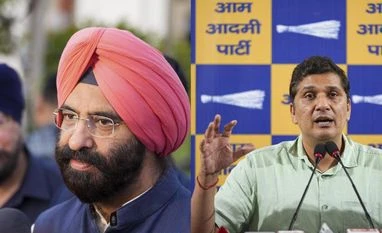 "As Delhi breathes toxic air after Diwali, political blame game erupts again")



