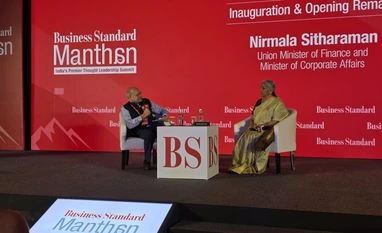
The first day of Business Standard’s annual summit, BS Manthan, brought together policymakers, business leaders, and economic experts to dissect the challenges and opportunities in India’s economic landscape. The two-day event, coinciding with Business Standard’s 50th anniversary, began on February 27 at the Taj Palace, New Delhi, featuring discussions on India’s position in a shifting global order, its economic growth trajectory, and critical sectors such as banking, investment, defence, climate action, and technology.
Economic matters should transcend political divides, says FM Sitharaman
Union Finance Minister
Nirmala Sitharaman inaugurated the summit, delivering a keynote address on 'The Great Reset: India in a New World Order'. She said that the global order will no longer be dictated solely by developed nations and that India must prioritise its strategic interests rather than remain non-aligned. She highlighted trade and technology as crucial pillars in this transformation, while also stressing the importance of attracting talent and navigating global economic turbulence with a clear policy framework.
Speaking about global and bilateral trade, Sitharaman said, "Every country wants to be treated special and wants to be sure that the special treatment that they get is not by default given to everybody else. That is the way in which trade is being refashioned whether world accepts it or not... Your trade has to grow and your supply chains will also need to be ensured."
During a fireside chat, she spoke on fiscal policy and economic governance, emphasising that economic matters should transcend political divides. She also reaffirmed India’s economic resilience amid global headwinds and urged corporates to play a greater role in investment-led growth.
ALSO READ: Global order won't be determined by developed nations: FM Sitharaman Uday Kotak cautions against sticking to old world banking Veteran banker Uday Kotak, founder and director of Kotak Mahindra Bank, provided insights into the evolving financial landscape, stating that physical banking’s dominance will decline in favour of digital solutions.
He highlighted the increasing influence of politics on global finance, citing the Trump administration’s economic policies as an example of market disruptions. “If you look at global finance today, every morning brings a fresh piece of information that can change our entire worldview,” Kotak said. “Especially in the Trump era, we are witnessing politics play a much bigger role in financial decisions. We are moving to a world where power is power,” he added.
Kotak also underscored the need for India to manage its current account deficit and enhance domestic competitiveness to withstand foreign capital outflows.
“What are we going to do about the mix of our current account especially if the United States wants to equalise? Some of it will be substitution, but some of it may have a net impact,” Kotak said.
“The answer to the current account deficit is ultimately domestic competitiveness,” he said and added that India needs to focus on two things and one of them is productivity.
“India can dramatically improve its ROTI, that is, return on time invested,” Kotak said. Kotak advised that the banking sector, instead of focusing on the traditional way of banking, should look at providing solutions to the customers in a holistic manner, which not only takes care of their savings needs but also their investing needs.
“The real challenge,” he said, “is to get back our animal spirits — the drive to build, invest, and grow fearlessly. That’s what will define India’s future in the global econom,” he said.
Chris Wood, global head of equity strategy at Jefferies, shared his outlook on the Indian stock market. He predicted a 10–15 per cent rise in the next 12 months if foreign institutional investors (FIIs) return. However, he remained cautious in the short term due to valuation concerns and the shift of foreign capital towards China.
“If someone has no exposure to Indian stocks, they should start buying now. When the tide turns, the rally would be very sharp. That said, we are still in a 'sell on a rise market' in India and not 'buy the dips',” he said.
Wood also discussed gold as a long-term bet, citing geopolitical tensions and reserve hoarding as key drivers.
ALSO READ: Indian markets can rise 15% in a year; FII selling surprised me: Chris Wood Self-reliance is the key, says PK Mishra, PM's principal secretary
PK Mishra, principal secretary to the Prime Minister, reinforced the 'Aatmanirbhar Bharat' vision, advocating for an "anti-fragile" approach in an unpredictable world. He stressed the importance of reducing reliance on external supply chains and strengthening domestic production capabilities.
“The Covid-19 pandemic showed us that we cannot afford to be too dependent on external sources because supply chains can be disrupted. Therefore, the Prime Minister speaks of ‘Aatmanirbhar Bharat’,” Mishra explained.
“Even during slowdowns, PM Modi sought opportunities rather than just reacting to crises. We are optimistic — we withstood the pandemic and multiple geopolitical crises,” he said.
Mishra also emphasised the continued relevance of agriculture in India’s growth trajectory, despite its shrinking contribution to gross domestic product (GDP). He highlighted the need for diversification in farm incomes and policy support for rural economic sustainability.
ALSO READ: 'Aatmanirbhar means readiness for uncertainty', says Principal Secy to PM We aim to push for sustainable practices worldwide: Bhupender Yadav
Union Environment Minister Bhupender Yadav outlined the country's climate strategy, asserting that India has successfully achieved key commitments under the Paris Agreement ahead of schedule. He said that India is a leader in the Global South and called for equitable access to climate finance and technology from developed nations. He reiterated that coal dependence will naturally decline as India accelerates its renewable energy expansion, including solar, wind, and green hydrogen projects.
And as India gears up to host COP33, Yadav said, “Our goal is to push for sustainable practices worldwide while ensuring that the economic aspirations of developing nations are not stifled."
ALSO READ: India's climate future lies in renewable energy, says Bhupender Yadav Amitabh Kant on EV revolution, industrial growth and India’s economic ambitions
Amitabh Kant, India’s G20 Sherpa stressed the importance of India’s electric vehicle (EV) sector, stating that Tata Motors and Mahindra & Mahindra will ensure Tesla does not dominate the Indian market.
He urged the government to adopt EVs in all official capacities and pushed for expanded production-linked incentive (PLI) schemes to spur domestic manufacturing.
Kant also called on the government to lead by example, stating, “Every Indian should move to an EV, and the government should not buy any fossil fuel cars. The government should become the first driver of EV adoption.”
Kant also called for structural economic reforms, advocating for faster policy execution, streamlined regulations, and a greater push for urbanisation to drive long-term growth.
While acknowledging the government’s positive initiatives, Kant stressed the need for faster policy implementation, particularly at the state level. He commented, “Our economists are communists and our bureaucrats have a socialist mindset.”
ALSO READ: Tata, M&M will not allow Tesla to succeed in India, says Amitabh Kant India’s economic reset amid a new world order According to Dharmakirti Joshi, Chief Economist, Crisil, India’s economic cycles are now more aligned with global trends, driven by increased trade, stronger financial linkages, and deeper integration into the world economy. He highlighted two standout patterns: global synchronisation — where India’s economic cycles now mirror global ones due to tighter trade and financial ties, and growth divergence – with India trending upward while advanced nations slump. “This is due to strategic domestic interventions that have boosted the country’s potential growth rate,” he explained, adding, “India has the ability to accelerate even further” with the right policies. Joshi pegged next year’s growth at 6.5 per cent, a return to the pre-pandemic rate, but stressed that reforms could push it higher.
Laveesh Bhandari, president CSEP, economist, entrepreneur, and environment evangelist, argued that India’s global rise hinges on fixing its internal machinery. “We have to be internally strong,” he urged. “Internal strength essentially means a strong capacity within the state.” He also called for parallel Free Trade Agreements (FTAs) with multiple countries, tailored to India’s needs. Separately, he also flagged a glaring weak spot: the judiciary. “Is our judiciary equipped to ensure that contract promises are kept? Certainly not,” he opined.
Tushar Vikram, CEO & Country Head India, Mashreq, brought an international angle to the discussion mentioning India’s deepening ties with the United Arab Emirates (UAE). “The Comprehensive Economic Partnership treaty signed between India and UAE in 2022 has led to increased business cooperation,” he said. “With UAE as India’s third-largest trade partner, it is also a gateway to Africa and a hub for Indian exports. UAE is looking at food security, health security — all this is critical to India as well,” he said, highlighting how UAE firms are investing in India’s debt and equity markets.
Sundeep Sikka, CEO & MD, Nippon Mutual Fund, turned the lens on India’s financial evolution, crediting the mutual fund industry for channelling household savings into growth. “Just 10 years back, only 0.8 per cent of household savings were coming in from mutual funds. Today’s count is 6 per cent,” he said. Sikka also predicted that India’s fast growth will draw foreign investors — “FIIs will keep taking tactical calls; everyone would want a share in India's growth story.”
Defence and private sector: Collaboration and coordination Rajinder Singh Bhatia, Chairman, Defence Business, Kalyani Group, and President, Society of Indian Defence Manufacturers (SIDM) noted that if India is to be 'Viksit Bharat' and occupy its rightful place in the committee of top nations, it cannot be a net importer of security. "This means we need to be self-reliant," he said.
Admiral (retd) R Hari Kumar, former Chief of Naval Staff, also reiterated the Navy’s focus on atmanirbharta in defence.
“We need to harness all the capabilities available in the country, including the private sector. The Indian Navy has committed to becoming a fully indigenous force by 2047. The construction of INS Vikrant by Cochin Shipyard is a testament to this commitment, involving nearly 500 MSMEs. Such projects create a multiplier effect, benefiting the economy and generating employment.”
Samir Kamat, Secretary, Department of Defence R&D, Ministry of Defence, and Chairman, DRDO, stressed the necessity of private sector participation in research and development (R&D).
“Private sector involvement in both production and R&D is absolutely essential for India to become Atmanirbhar and a global technology leader, as envisioned by our Prime Minister. The private sector is more dynamic than government organisations, offering greater flexibility in hiring top talent. Startups and MSMEs play a crucial role in disruptive technologies, an area where government entities often struggle to adapt quickly," Kamat said.
New paradigms in financial reporting Ajay Bhushan Pandey, chairperson of the National Financial Reporting Authority (NFRA) emphasised the importance of auditing and the need for oversight of auditors in India’s aspirations of becoming a 'Viksit Bharat'. He said, "In the past two years, the quality of audits has improved, and for that, I must appreciate the auditing firms. This is an encouraging sign. If you compare audits now to those conducted a few years ago, the standards have improved significantly. I must commend the auditing firms — we are seeing vast improvement."
Pandey asserted that with the highest number of chartered accountants globally, India has the potential to become the world's leading auditing hub. He emphasised the importance of adhering to global accounting standards, stating, "The world's accounting can happen in India, but how can we achieve this if we do not align with global standards? It is necessary to integrate ourselves with international norms."
Markets regulator Sebi (Securities and Exchange Board of India) has also begun mandating companies to comply with these standards, he said.
With more discussions lined up for Day 2, including deep dives into India’s semiconductor ambitions, the future of jobs, and luxury branding, BS Manthan will continue to be a platform for discussions on India’s evolving economic framework. Stay tuned as Business Standard brings live coverage and expert analysis from the event.

 "BS Manthan: A thought-provoking day-1 of insights on economy, policies")


