Behind the electronics surprise: India's path to $500 billion by 2030

India's one Achilles heel in electronics production has been its heavy dependence on smartphones, that too a lot on exports
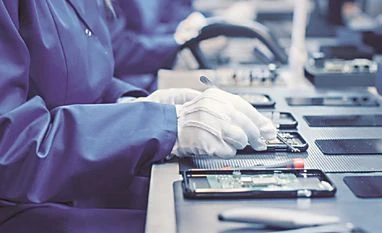
smartphone manufacturing
Surajeet Das Gupta New Delhi
8 min read Last Updated : Oct 10 2025 | 10:26 AM IST
It was conceived as a “Make in India” boost to the electronics component industry across sectors — from mobile devices and consumer electronics to auto, industrial electronics, and telecom. But the start was slow, with government officials having to extend the deadline by a month after many companies failed to submit applications fast enough.
 
However, when the Electronics Component Manufacturing Scheme (ECMS) closed on September 30, the results came as a complete surprise. The response was overwhelming: As many as 249 applicants were ready to invest a total of over ₹1 trillion, more than double the scheme’s target. And its initial target of production value was crossed by 2.2 times to ₹4.56 trillion, along with the promise of 142,000 jobs. 
The overall tenure of the scheme is six years, with a one-year gestation period – that is, it runs until March 31, 2032. 
A senior official at the Ministry of Electronics and Information Technology (Meity) said: “We never imagined this kind of response. We thought we would get investments of $7.5 billion or so but we got $14-15 billion. No government scheme has seen such a response, and the key reason is we had massive engagement with stakeholders.” 
Not everyone will be eligible for the incentives, though, as that would mean doubling the ₹22,806 crore allocated for sops. And there are many applicants who might not even be serious players. But the phenomenal interest in the scheme has affirmed faith in India’s growing status in the global electronics market. India is the world’s third-largest mobile phone manufacturer by value, and also ranks in the top ten in terms of all electronics manufacturing. China dominates both these categories. 
Ambitious targets 
The scheme is key to consolidating and improving India’s position. The government has fixed an aggressive target for electronics manufacturing, aiming to take it to $500 billion by 2030. Seventy per cent of this ($350 billion) is expected to come from finished products (like mobile phones, laptops, and TV sets), and 30 per cent ($150) from sub-assemblies and components. 
The target is ambitious, given that total electronics manufacturing in the country is pegged at $135 billion for FY25, with finished products accounting for a massive 88 per cent share. Sub-assemblies and components are a small part with a production value of only $15 billion.   
Going by these numbers, India would need to strike up a tenfold increase in sub-assembly and component production value to reach the 2030 target. 
The fact is that it is the potential of this growing sub-assembly and components market that attracted companies to the incentive scheme — firms ranging from traditional electronic manufacturing services players such as Dixon and Foxconn, to auto component makers Samvardhana Motherson and Uno Minda, to big conglomerates like the Tatas.     
Experts say even if India is unable to reach the 2030 target for component production — achieving, say, only $100 billion (or 66 per cent) — it will still entail a hike in production value by 6.6 times in 2030.
 
Clearly the scheme is aimed at reducing India’s high dependence on imports, especially from China, with its implications for the supply chain. For instance, Indian companies buy bare PCBs (printed circuit boards) worth over ₹30,000 crore annually, but 88 per cent of these are imported. Other key areas show a similar trend — imports account for as much as 100 per cent of lithium ion cells, 88 per cent of display module sub-assemblies, 81 per cent of camera module sub-assemblies, and 83 per cent of the mechanics for mobiles. 
The scheme focuses on some key sub-assemblies and parts that cover, for instance, 55 per cent of all of the raw materials and components needed to make a mobile phone, says Indian Cellular and Electronics Association (ICEA). If and when all these are procured within India, the value addition in the phone would go up from the current 18 per cent to 35-40 per cent by 2030. This was a key criteria behind the scheme. 
Complex process 
Putting together such a complex scheme was not easy. To begin with, Meity set up a three-member committee under Joint Secretary Sushil Pal last year to come up with the initial barebones package. In the nearly 12 months since then, say sources privy to the discussions, at least 100 face-to-face meetings have taken place between government officials, company executives, and industry associations such as ICEA and Electronics Industries Association of India.   
There were 10-12 big meetings where all the top industry representatives across segments were invited for detailed consultations.     
An outreach programme was then devised both globally and in India for direct interactions with interested companies. These took Meity teams to Taiwan, Japan, and South Korea, alongside visits to at least 40-50 domestic factories. 
This gave officials a deeper insight into the business as they went about structuring the incentives.
 
Discussions with stakeholders helped officials identify 12-odd components and sub-assemblies, which needed a manufacturing focus. These had to meet three key criterias — there should be demand for local production, they should boost value addition, and they should be of strategic importance to Make in India. 
Bespoke model 
Here, officials realised that, unlike the one-scheme-fits-all formula of production-linked incentive (PLI) schemes, these incentives had to be tailormade for specific components — such as turnover- or  capex-linked incentives, or even a hybrid of both. 
Associations pitched in robustly. ICEA identified 81 global companies that were key international players in sub-assemblies and 63 that were in components to gauge their interest. It also took feedback from its members to compare India’s sub-assembly manufacturing costs with those of its global competitor, Vietnam — valuable for structuring incentives if India wanted to be a global export hub.   
The response came as a useful input: The cost of production in Vietnam was lower by 9-12 per cent for camera modules, 13-15 per cent for battery cells, and 10-12 per cent for mechanics for mobiles. 
Armed with such inputs, Meity drove home to prospective companies the importance of scale, which in turn would require them to make reasonable investments so that they are competitive in the global market. Sources said this was a sticky issue that saw a lot of debate – many smaller operators wanted investment caps, which differ from product to product, to be lowered further. Otherwise, they complained, they might not be able to participate. 
Another problem was a reluctance by companies to invest in capital equipment and their sub-assemblies. But they came around later once the government offered a 25 per cent incentive on capex to build units. 
The scheme provided a lot of flexibility, which had been missing in most previous incentive schemes like PLIs, and encouraged scale. Unlike in older PLI schemes where fixed funds were earmarked for successful applicants — leaving no room for rewarding companies that exceeded targets —ECMS introduced a dynamic flexible framework.
 
Here applicants can now decide their own production targets and are incentivised proportionately — rather than in a rigid fashion with pre-determined incentive caps. By not fixing caps on incentives, the new scheme encourages more investment and scalability, companies say. 
Cutting dependence 
India’s one Achilles heel in electronics production has been its heavy dependence on smartphones, that too a lot on exports. In FY25 for instance, although mobile device production value hit $65 billion (which is half the total value of electronics manufacturing), as much as $24 billion came from exports —dominated by Apple Inc. 
Companies and policymakers are acutely aware of this issue. If the mobile manufacturing momentum continues, it is estimated that the domestic market growth of mobiles will come essentially from consumers upgrading to more premium phones. 
This could see the domestic market in mobile phones hitting around $60-70 billion by 2030. 
But, as far as exports are concerned, Apple Inc has shifted only 20 per cent (one in five) of its iPhone-making global capacity to India so far, according to industry estimates, which leaves plenty of room for expansion and export growth. Scaling up capacity could see exports of smartphones zoom to $70-80 billion by 2030, overtaking domestic sales.   
The Cupertino-headquartered company has already tied up with around 40 broad component manufacturers in India. Many of these firms have applied for incentives under the scheme, and are set to become anchor clients to Apple Inc and part of its global supply chain. 
Apple’s export plans are dependent on two crucial factors. First, any change in US President Donald Trump’s tariff rates – currently at zero for exports of mobile phones to the US from India – could upset the export plans. 
The second is linked to the existing PLI scheme for mobile devices, which is set to end this financial year, prompting a clamour from mobile phone makers to extend the scheme, and tweak it for exports if needed. Clearly, mobiles — and the PLI scheme for them — have a huge role to play in the success of the ECMS scheme. 
And that means the ball is in the government’s court.   
 

One subscription. Two world-class reads.

Already subscribed? Log in

Subscribe to read the full story →
*Subscribe to Business Standard digital and get complimentary access to The New York Times

Smart Quarterly

₹900

3 Months

₹300/Month

SAVE 25%

Smart Essential

₹2,700

1 Year

₹225/Month

SAVE 46%
*Complimentary New York Times access for the 2nd year will be given after 12 months

Super Saver

₹3,900

2 Years

₹162/Month

Subscribe

Renews automatically, cancel anytime

Here’s what’s included in our digital subscription plans

Exclusive premium stories online

  • Over 30 premium stories daily, handpicked by our editors

Complimentary Access to The New York Times

  • News, Games, Cooking, Audio, Wirecutter & The Athletic

Business Standard Epaper

  • Digital replica of our daily newspaper — with options to read, save, and share

Curated Newsletters

  • Insights on markets, finance, politics, tech, and more delivered to your inbox

Market Analysis & Investment Insights

  • In-depth market analysis & insights with access to The Smart Investor

Archives

  • Repository of articles and publications dating back to 1997

Ad-free Reading

  • Uninterrupted reading experience with no advertisements

Seamless Access Across All Devices

  • Access Business Standard across devices — mobile, tablet, or PC, via web or app

Topics :take twoElectronicsmanufacturing

Next Story



