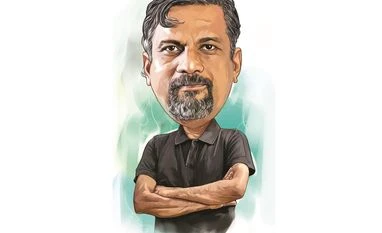
On a 625-km bus ride from Chennai to Tenkasi, a good 12 hours from Tamil Nadu’s east to west coast, scenes from Swades keep playing in my head. The 2004 Bollywood blockbuster could well be the life of the man I am making this journey to meet.
Like the film’s lead, Shah Rukh Khan, Sridhar Vembu, the poster boy in India’s software-as-a-solution (SaaS) ecosystem, shunned his comfortable life in the US to settle down in a village that barely has motorable roads.
It is not an easy drive to the Zoho Corporation founder’s home. His farm is in a village called Govindaperi, which is another 40-minute drive from the main city of Tenkasi. Tenkasi, incidentally, is known for its waterfalls in Courtallam, a panchayat town described as the “spa of South India”.
Non-existent roads aside, the view is beautiful, with palm groves and golden rice fields spread out in the shadow of the Western Ghats.
Vembu is India’s 48th richest man with a net worth of some $3.8 billion (according to Forbes). His company services some big names: Amazon, Hotstar, Levi’s, Siemens, L’Oréal, Mahindra, Yokohama, Hyatt, Stanford University, Fossil, Godrej. The list is long and diverse. But even Google Maps cannot locate his address in the village he moved to from San Jose in California’s Bay Area in October 2019.
I finally reach his farm. The gate has security and his house is about half-a-km further down. But there’s an e-autorickshaw to take me to where he will meet me: Kalaivani Kalvi Maiyam, a learning centre on the farm that he opened during the pandemic for children from villages in and around Tenkasi.
I find him waiting in the nearby canteen where our lunch has been arranged. He is wearing a white mundu (formal dhoti) and a brown shirt. And no, he has never watched Swades.
The 55-year-old billionaire behind the multinational tech company, which makes computer software and web-based business tools (it’s best known for Zoho Office Suite), is a man of simple tastes.
Laid out before us is a traditional vegetarian Tamil meal served on banana leaf. There’s Karuppu Kavuni, a variety of black rice that he grows on his farm. High in fibre and antioxidants, “it is much better for our health than white rice,” Vembu says. There’s also avial, sprouts-and-carrot salad, parippu (moong lentil) curry and mix-veg. Most of the vegetables are from Vembu’s farm, which was earlier called ‘Kerala farm’, perhaps because of its proximity to the neighbouring state or because of a former Malayali owner.
This is Vembu’s daily lunch. For breakfast, he has fermented rice. It used to be a childhood staple “and then we lost all these food habits,” he says. A late lunch is his last meal of the day.
The conversation shifts to why he returned to the village. “Look around and you’ll know the answer,” he says. “Life is simpler here. I don’t miss anything, and we have fibre optic connection.”
With his business operating in different time zones, Vembu’s day starts before the rooster crows. He’s up at 3 am, works till 6 am and then takes a break to exercise, go for a swim, and do yoga. “I am back to work around 9.30 am. In between, I have breakfast, which takes no more than 10 minutes since I just have to drink it (fermented rice, remember?).” He wraps up the day early and goes to bed around 9 pm.
Vembu is also opening a clinic on the farm for the local community. Kalaivani Kalvi Maiyam, the learning centre, meanwhile, has 130 students across primary, middle and high school from surrounding villages. Another building spread across 75,000 sq ft is under construction. Zoho hopes to have 200 such centres across India in the next five years on the lines of the National Institute of Open Schooling system.
Vembu passed out of the Indian Institute of Technology (IIT) Madras in 1989 and after a PhD from Princeton, joined Qualcomm as a wireless systems engineer. “I tried to build hardware on my own in Silicon Valley and spent $20,000 to $30,000 on it, but that was the first failure. It taught me that I should stick to software.”
The decision led to the birth of Zoho in 1996. The company was founded in Chennai as AdventNet by Vembu, his family and his friend Tony Thomas. The name was later changed to Zoho – from ‘small office / home office (SOHO)’. The ‘Z’, he says, makes it a “cooler name”. “Zoho was Raju’s brainchild (Zoho’s Chief Evangelist Raju Vegesna).”
While we are talking, buttermilk, rasam and ghee (clarified butter) from milk sourced from the farm, which has about 70 cows and 40 buffalos, is served.
The company is now on a rural expansion drive through the hub-and-spoke model. Zoho decided to adopt this model of offices in 2020 to cater to a distributed workforce and as part of its 'transnational localism' strategy during Covid – of being locally rooted, while staying globally connected. The hub offices are ones that can accommodate 1,000 or more employees, while the spoke offices are smaller, of up to 100 employees.
The company currently has five hub offices – in Chennai, Tenkasi (where it opened shop 11 years ago), Renigunta, Tiruppur and Trichy – and some 30 spoke offices in India. There are plans to open hub offices in Tirunelveli and Madurai as well.
“We need to create opportunities in rural areas,” Vembu says. “Chennai already has 12-13 million people, Mumbai, 25-30 million and Bengaluru, around 15 million. The question is: can these cities accommodate another 10-20 million? In terms of population density, our villages are like the suburbs in the US.”
That said, he brings up the collapse of Silicon Valley Bank (SVB), Signature Bank and Credit Suisse. The current global downturn is still in its nascent stage and for the SaaS industry and Zoho, it is a “time for caution and not expansion,” he says. He believes amid these uncertainties companies have to take it month-to-month or quarter-to-quarter.
Ask him about the biggest challenge that he is facing in Tenkasi, and the Zoho founder says, “Wild pigs. Farming is very difficult here. I wish somebody would do something about this.”