Home / Technology / Tech News / Trust, data and compute key for AI development, says Meta's Alexandr Wang
Trust, data and compute key for AI development, says Meta's Alexandr Wang
At the India AI Impact Summit 2026, Alexandr Wang said talent, energy, data and compute are key to AI growth, stressing policy support, collaboration and safe development
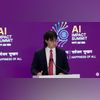
Alexandr Wang, Chief AI Officer at Meta, at India AI Impact Summit 2026. (Photo: India AI/YouTube)
Alexandr Wang, Chief AI Officer at Meta, outlined the core requirements for building artificial intelligence (AI) and highlighted India’s growing role in the global AI ecosystem.
Speaking at the India AI Impact Summit 2026, Wang said AI development depends on four essential pillars. "There are four building blocks for AI, including talent, energy, data and compute."
He said that governments and industry must work together to ensure access to these elements, so countries can build AI systems suited to their own needs rather than relying on external priorities. According to him, this requires strong national AI strategies and consistent policies that promote innovation, rather than fragmented regulations that create barriers.
He also emphasised collaboration between public and private sectors to deliver these building blocks and deploy AI systems that serve citizens and support economic growth.
Meta’s scale and reach in AI
Wang noted that Meta is among a small group of companies with the resources, talent and ambition to advance AI research and deploy it at scale. "If you want to make technology that serves society, Meta has an incredible opportunity to get this technology into people's lives," he said, adding that 3.5 billion people use at least one of its apps every day.
He added that AI tools from the company are already widely used across India by businesses and creators. These include automatic translation of social media reels into viewers’ languages and AI-powered customer communication tools for small businesses on WhatsApp.
Wang said India has world-class developers building innovative solutions to address societal challenges. He cited healthcare research at Ashoka University, where scientists used Meta’s Sam 3 model -- trained on billions of images -- to accelerate identification and segmentation of cancer tumours and at-risk organs.
He also highlighted Meta’s recently open-sourced Omni-lingual model, which recognises speech in more than 1,600 languages and can adapt to new languages using minimal audio samples.
"It's not a fantasy that in a few years, will have real-time voice-to-voice translation for every spoken language on Earth," he said.
Wang said Meta is collaborating with the Indian government through its AI coach platform by providing datasets in 10 major Indian languages to help build models that understand local contexts.
Safety and risk management
Wang stressed that safety remains central to Meta’s AI development. "Our AI needs to work the way we say it does, as well as we say it does and as safely and securely as we need it to"
He said the company invests heavily in model evaluation science, improves testing frameworks and builds new methods to address emerging risks. These include risk assessments, expert evaluations, red-teaming exercises, and fine-tuning before releasing models. Meta also monitors aggregate usage trends across its apps to detect potential risks and improve systems through feedback loops.

 "Trust, data and compute key for AI development, says Meta's Alexandr Wang")

